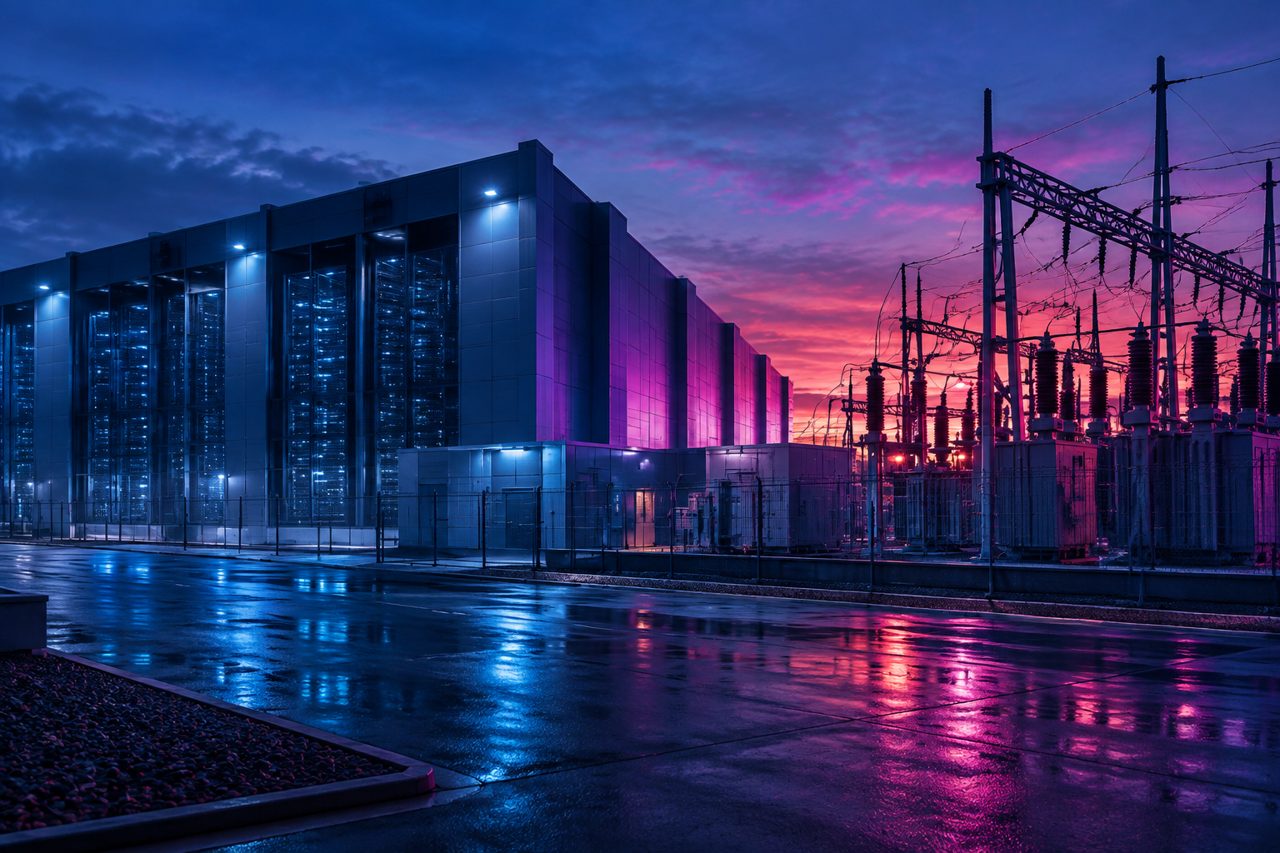
The site has been found, investors are ready, and servers could arrive. But one question is holding everything up: when will power be available? With the rise of artificial intelligence, data centers are once again becoming a heavy industry, dependent on grids, transformers and permits. Their competitive advantage no longer rests solely on the power of their machines: it also depends on their ability to supply them with electricity. By September 2026, this battle for megawatts could reshape the cloud market. This analysis draws on facts established through June 2024; subsequent developments are presented as potential scenarios.
Computing meets its physical infrastructure
For years, the digital sector has sold a promise of elasticity: a few clicks are enough to obtain more storage or computing power. Behind this apparent lightness, however, lie buildings, cooling systems and a continuous power supply. Generative AI widens that gap. Training large models requires clusters of accelerators; running them for millions of users adds recurring consumption, the scale of which depends on usage and system efficiency.
The trend was already visible in 2024. In its Electricity 2024 report, the International Energy Agency estimated that global electricity consumption from data centers, AI and cryptocurrencies could exceed 1,000 terawatt-hours in 2026, up from around 460 in 2022. This was a projection covering more than AI alone, not an established outcome. But it pointed to pressure on infrastructure.
The problem is not just a national one. A country may have abundant generation without being able to deliver several dozen megawatts to a particular plot of land immediately. What matters is local grid capacity, the availability of a substation, the work required and its timeline. The electricity may exist; the route to deliver it has yet to be built.
A grid connection becomes a strategic asset
For an operator, a secured grid connection turns a real estate project into marketable capacity. Conversely, an uncertain connection date undermines the entire chain: equipment reservations, financing, recruitment and commitments to customers. A completed building with insufficient power ties up capital without generating the expected revenue. The project’s real timeline may therefore be set by the grid operator, not the builder.
This constraint was already evident in several European markets. In Ireland, the regulator adopted specific criteria for assessing data center connection requests as early as 2021, given the risks to the electricity system. In the Netherlands, grid congestion was weighing on many economic projects. These situations do not amount to a blanket ban: they show that electrical capacity is becoming a contested resource.
By September 2026, this scarcity could strengthen operators with sites already connected to power or projects at an advanced stage. But announced capacity is not always deliverable capacity. For an investor, checking the technical and contractual terms of the grid connection is becoming as important as examining future rental income. Prerequisite work, a gradual ramp-up or operating restrictions can alter profitability.
Buying energy is not enough to secure power
Major technology companies have been using long-term power purchase agreements, often known as PPAs, for years. These agreements can help support new renewable energy facilities and provide greater control over some price risk. For a data center expected to operate for decades, that visibility can carry considerable weight in the investment decision.
However, three issues must be distinguished: buying a quantity of energy, having sufficient power available at all times and being able to physically receive it. A solar contract does not guarantee power at night. An agreement covering generation elsewhere does not automatically resolve local congestion. And annual matching through renewable energy purchases does not mean that every hour of operation is carbon-free.
The convergence of technology and electricity generation was already tangible in March 2024, when AWS acquired a data center campus adjacent to the Susquehanna nuclear power plant in Pennsylvania from Talen Energy. The deal illustrated the appeal of a nearby, continuous power supply. It did not, however, demonstrate that this model could be adopted widely: tariffs, grid access rules and cost sharing remain decisive.
The new map of data center locations
The ideal address is therefore no longer necessarily the one closest to a major business district. For some model training workloads, companies may favor an area where electricity is available, competitively priced and relatively low-carbon. Immediate proximity to users matters more for applications sensitive to response times. Not all computing workloads can tolerate the same distance.
France has advantages in its nuclear fleet and historically low-carbon electricity generation. Nordic countries can point to their climate and energy resources. But no national advantage removes the need for a local assessment. Fiber connectivity, land availability, skills, access to water where cooling depends on it, taxation and sovereignty requirements can overturn a site’s ranking.
Cheap can even prove costly. Less expensive electricity loses its appeal if the connection arrives too late, construction costs soar or customers reject the location. Looking ahead to 2026, decisions should therefore focus increasingly on the total cost of capacity that can actually be used rather than the quoted price per kilowatt-hour alone.
Flexibility, the next area for negotiation
Faced with grid constraints, operators can seek to become better partners for the electricity system. Some computing tasks can be shifted in time; batteries can help absorb fluctuations or provide grid services. But the scope is not unlimited. An interactive service promised around the clock cannot be managed like a computing task that can be deferred, and a battery is no lasting substitute for an inadequate grid connection.
Negotiations also extend beyond price. Who pays for grid upgrades? What safeguards prevent capacity from being reserved for projects that will never materialize? How should a resource also needed by housing, transport and industry be allocated? Local acceptance is becoming an economic issue. Heat recovery can help, provided nearby users and viable technical conditions can be found.
What happens next? By September 2026, the winner may be less the operator announcing the largest campus than the one delivering a dependable power supply in the right place at the right time. Efficiency gains in chips and models could curb demand per unit of computing, without guaranteeing a fall in total consumption if usage surges. For corporate customers and investors alike, one question should come before any promises of performance: does this computing capacity really have the electricity it needs to operate?