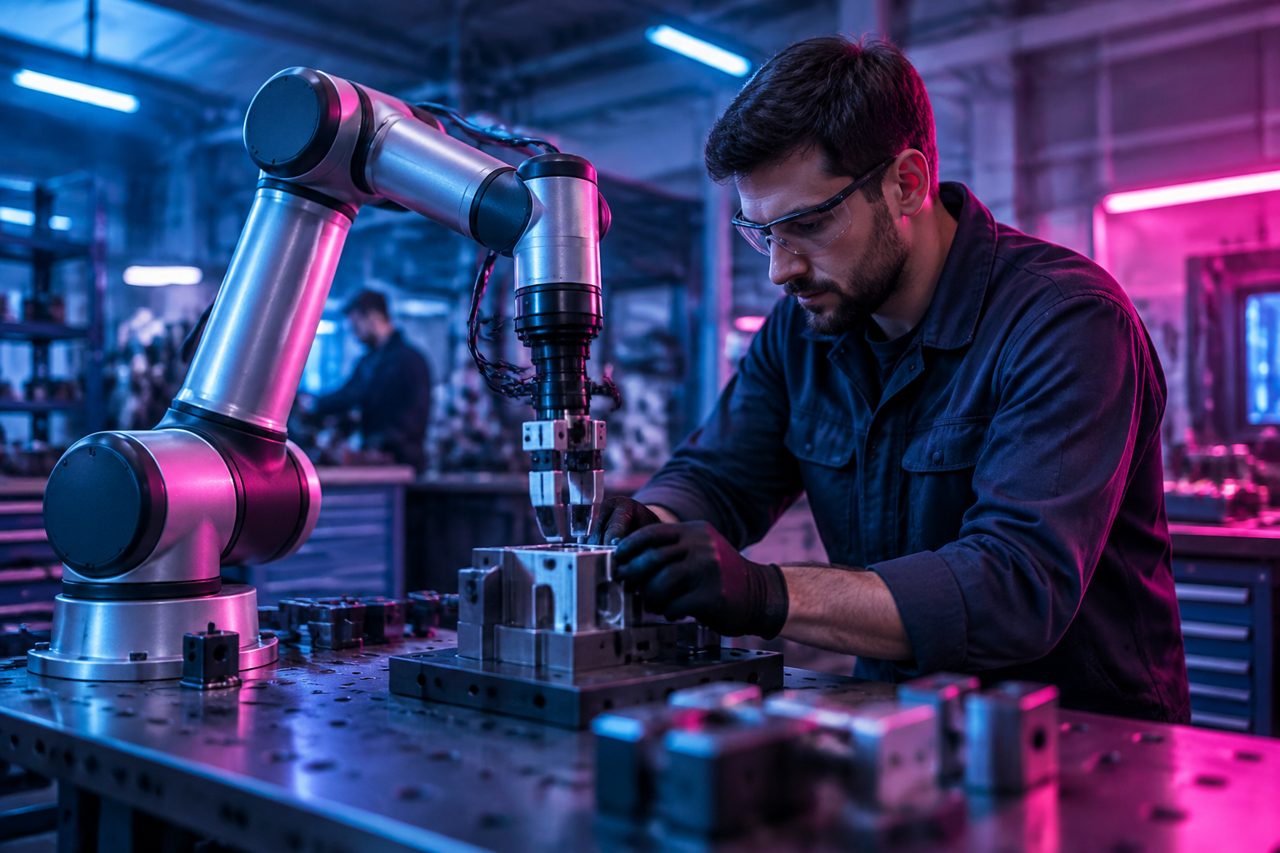
At first glance, the choice looks much like that of a commercial vehicle: buy, lease or pay per use. But in a small or medium-sized manufacturing business, a robot never works alone. Parts must be presented to it, its movements programmed, its surroundings made safe and production changeovers organized. The real question is therefore not “how much does the machine cost?” but “who pays when it is not producing?” By September 2026, this question could become decisive for business leaders drawn to automation but reluctant to tie up their cash.
Three models, three ways to allocate risk
Robotics on demand, often marketed as Robot-as-a-Service, or RaaS, is not a futuristic concept. Before 2025, companies such as Formic in the United States were already offering robotic equipment as a service. Meanwhile, collaborative robots have broadened the range of options available to smaller businesses. These developments make a wider variety of contracts in 2026 plausible, but do not justify claims that subscriptions will become the norm. The models will probably coexist: their suitability depends on the process, production volumes and skills available in the factory.
Buying: building assets, but taking responsibility
Buying gives the company control over the asset and, subject to licenses and contracts, greater freedom to modify it. It is particularly well suited to steady production, a long-term need and a business capable of managing integration. A cell used intensively over several years can therefore be cost-effective. But the owner bears the risks of obsolescence, underutilization and difficulty reselling. Above all, buying a robot does not mean buying production capacity that can be used immediately: the complete installation may require far more resources than the robotic arm alone.
Leasing: preserving cash, not eliminating uncertainty
Leasing spreads out cash payments. Depending on the arrangement, it can also make it easier to replace equipment or eventually purchase it. But a lease payment is not a guarantee of reliable operation. A finance lease may leave the SME responsible for integration, maintenance and the consequences of a breakdown. Financing the machine must be distinguished from the associated services. The commitment period, insurance, any purchase option price, return fees and permission to make modifications matter just as much as the advertised monthly payment.
Paying for a service: transferring some of the risk
Under a RaaS offering, the supplier may include hardware, initial programming, monitoring and maintenance in exchange for a recurring payment, sometimes linked to usage or output. The appeal is clear for an SME without a robotics specialist. However, the scope varies considerably. Some contracts are essentially enhanced leases; others commit the provider to a defined level of performance. Comparing them therefore requires examining what is delivered, measured and guaranteed, rather than relying on the marketing label.
Quotes often overlook the space around the robot
Imagine a workshop automating the palletizing of boxes. The arm and its gripper are the visible components. It may also be necessary to rework the conveyor, stabilize the packaging, move a label printer, change forklift access routes or upgrade an electrical supply. The cell must also handle misshapen boxes and imperfect pallets. These details make the difference between a convincing demonstration and equipment that actually runs for an entire shift.
Safety deserves its own budget: risk assessment, guarding, sensors, validation and training. A so-called collaborative robot does not automatically make the application collaborative or safe. The load being handled, the tool and operating speeds all affect the risk. Integration also takes time from employees who are already busy: production, maintenance, quality and IT staff. Their time, testing and the downtime needed for commissioning must be included in the calculation, even when they do not appear on any external invoice.
Programming once is almost never enough
The initial program is designed for a specific situation. Then comes a new format, an additional product variant or a supplier with different tolerances. Trajectories, the gripper, the vision system or control parameters need adjusting. Simplified interfaces reduce some difficulties, but do not eliminate the need for testing or an understanding of the process. In small-batch production, the cost of changeovers can outweigh the cost of financing.
Before signing, the company should obtain cost estimates for several representative modifications: adding a product variant, changing the production rate or moving the cell. Who can carry out the work? With what access rights and lead times? Will programs and backups be retrievable? A solution that is initially economical becomes restrictive if every adjustment requires work by an exclusive provider. Conversely, a service that includes regular changes may justify a higher subscription fee.
Availability is not production
A robot can be technically available while the line is waiting for parts. It can also operate while producing rejects. Paying for its availability therefore makes sense only with a precise contractual definition: covered operating hours, reference production rate, expected quality, exclusions and measurement method. Is scheduled maintenance deducted? Is a gripper fault covered? Who determines the cause of a stoppage when several pieces of equipment interact?
It is also important to distinguish between response time, time to intervention and time to restore service. Prompt telephone support is no substitute for a locally available spare part. Commitments must specify critical spare-parts inventories, on-site interventions, cybersecurity for remote access and any compensation. Even with penalties, a contract will not necessarily cover the cost of a missed customer delivery. The SME therefore still needs continuity arrangements: reduced-capacity manual operation, buffer stock or alternative capacity.
Comparing the cost of usable output
To choose between offers, it is better to request calculations covering the same period and scope. The relevant denominator is the actual output meeting specifications, not the maximum rate listed in the catalog. Three scenarios are often enough to expose weaknesses: normal activity, a reduced workload and changes to the product. For each, the business leader must add up:
- Purchase or service payments, integration and building modifications.
- Programming, training, energy, consumables and wear parts.
- Maintenance, downtime, production changeovers and internal staff time.
- Exit costs: dismantling, return, data transfer or resale.
Buying often favors stable, intensive use; leasing primarily addresses a financing constraint; a service can be appropriate when the supplier genuinely assumes some of the technical risk. No model guarantees complete flexibility: a subscription may involve a long commitment or minimum charges. A trial using real parts, with written acceptance criteria, is worth more than a general promise of productivity.
What next? By September 2026, advances in vision systems and programming tools could make some adjustments easier, without removing the physical constraints of factory floors. The best strategy for an SME remains to start with a clearly defined process, measure its losses and compare contracts with identical scopes. Buying a robot, leasing a cell or paying for a service then becomes an informed economic decision—not a gamble on an appealing monthly payment.