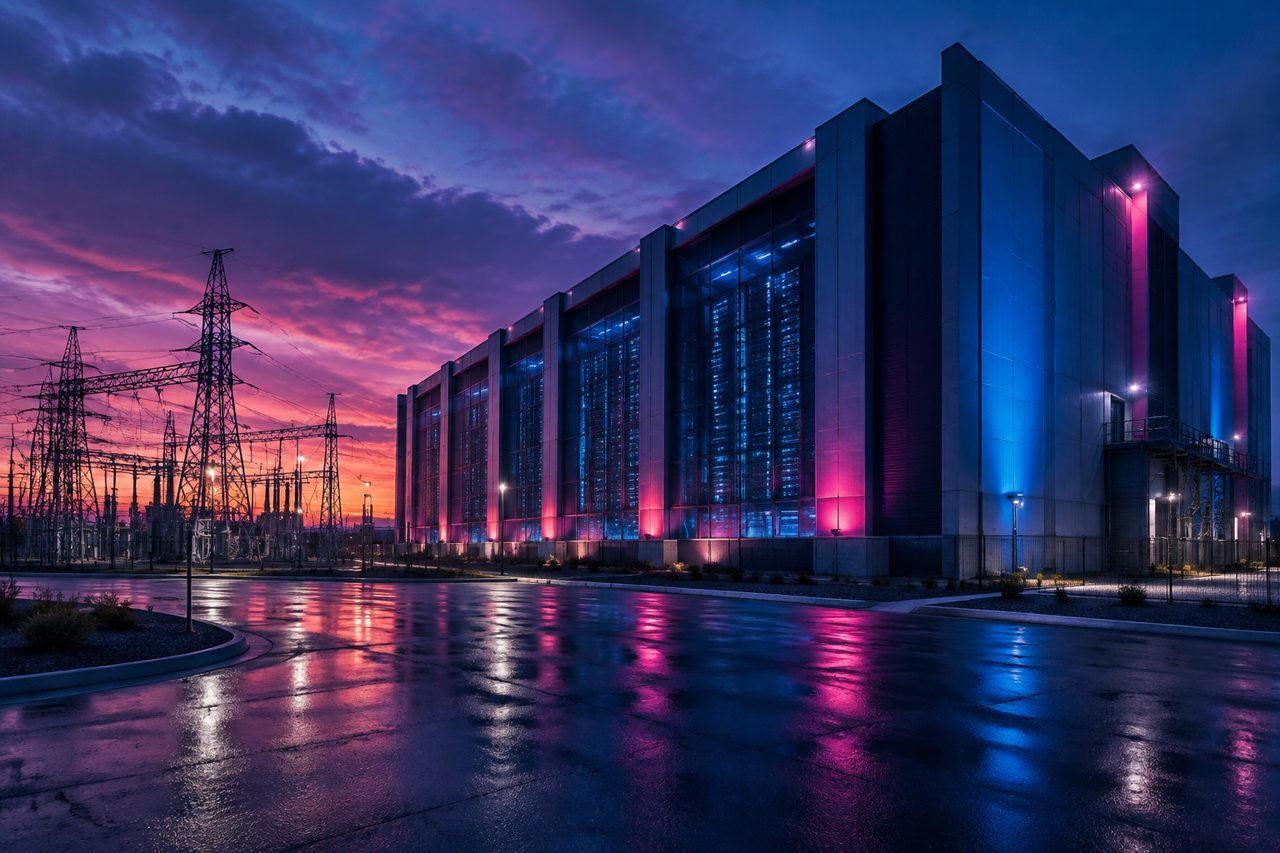
State-of-the-art accelerators, billions to invest, impatient customers: on paper, everything is ready. But the data center is still waiting for its grid connection. This is the paradox of industrial-scale artificial intelligence: its growth depends on very physical infrastructure, sometimes less spectacular than a chip, but far harder to obtain quickly. Looking ahead to September 2026, access to available, reliable electricity secured under contract is emerging as a major competitive advantage. This analysis draws on facts documented through mid-2024; developments considered beyond that point are forward-looking assessments.
The real bottleneck is shifting
The first wave of generative AI put graphics processors in the spotlight. Their availability, price and performance determined the capacity to train models. But buying servers is not enough to make them run. Racks need power, heat must be removed, facilities must be secured and suitable network connectivity must be available. As equipment becomes denser, these constraints are becoming central to site selection.
The trend was already apparent in projections published by the International Energy Agency in January 2024: global electricity consumption by data centers, AI and cryptocurrencies could more than double between 2022 and 2026. That scenario grouped together different uses and did not measure AI alone. Nevertheless, it pointed to growing pressure on power systems, particularly in regions with high concentrations of facilities.
The problem, then, is not simply producing more electricity nationwide. It is delivering it to the right place, at the right time, with the required capacity. A country can export electricity while still having areas unable to accommodate a major new consumer quickly.
The grid connection becomes a strategic asset
For a developer, two neighboring plots can have radically different economic values. The first has an accessible substation and confirmed grid connection capacity. The second requires a new power line, grid upgrades and several approvals. Even if its purchase price is lower, the latter can become the more expensive choice once years of waiting are factored in.
This phenomenon is far from theoretical. In Ireland, grid constraints prompted the regulator to introduce rules governing the assessment of new data center connection requests as early as 2021. Location and the ability to contribute to electricity supply security became decisive factors. In Singapore, the selective resumption of projects after a pause introduced in 2019 also illustrated the authorities’ determination to choose which infrastructure to allow rather than accept every application.
For September 2026, the central hypothesis is this: power capacity that can actually be made available could matter more than the amount of buildable land. This would favor operators that submitted applications early and secured their sites. But a place in a queue does not amount to a guaranteed power supply: technical studies, infrastructure financing and construction schedules remain decisive.
Signing an energy contract does not create a power line
Major technology companies have made extensive use of long-term power purchase agreements, often called PPAs. These can help support renewable energy projects and make some costs more predictable. For a capital-intensive business, reducing energy uncertainty can facilitate investment decisions and reassure financial backers.
But these contracts do not solve everything. Buying the annual equivalent of your consumption from a solar farm does not mean receiving that output every hour. The data center generally continues to depend on the grid, its constraints and its supply-demand balance. Contract prices, electricity delivery charges, exposure to generation shortfalls or surpluses, and physical availability must be assessed separately.
The deal announced in March 2024 by Amazon Web Services to acquire a data center campus next to the Susquehanna nuclear power plant in Pennsylvania highlighted another strategy: bringing computing closer to a major source of generation. It did not demonstrate that this approach could be replicated everywhere. Such arrangements also raise questions about regulation, cost sharing and the impact on other consumers.
Suitable land requires a rare combination
Cheap land far from major cities seems an obvious solution. But the other ingredients still need to come together: fiber-optic connectivity, access to electrical infrastructure, permits, maintenance teams and cooling conditions suited to the project. Depending on the technology chosen, water availability and local restrictions can also be factors. The ideal location is a combination of resources, not simply a plot of land.
France has strengths here: largely decarbonized electricity generation, established digital infrastructure and industrial expertise. Yet none of this guarantees an immediate grid connection or local acceptance. Land use, equipment-related disturbances and trade-offs between industrial uses can slow a project. A well-connected brownfield site can therefore be worth more than undeveloped land that appears easier to build on.
Training and responding do not require the same address
Not all AI uses face the same geographical constraints, either. Training can sometimes be located far from users, provided connectivity is suitable and applicable data rules are respected. Inference, when it supports interactions sensitive to response times, may require greater proximity. The future map is therefore likely to combine large computing hubs with more distributed capacity, rather than simply follow the cheapest electricity.
A new competitive hierarchy
This geography potentially favors players able to commit capital long before the first revenues arrive. Reserving a site, funding studies and negotiating contracts take time and a degree of financial strength. Cloud giants can spread these risks across multiple locations. New entrants often have to choose between waiting, paying a hosting provider that is already connected or relocating their project.
Owners of existing capacity could thus strengthen their bargaining power. But a building with a power supply must be distinguished from a facility immediately suited to AI: power density, cooling and internal architecture may require substantial work. For investors, announced megawatt figures are not enough. Value depends on permits, contractual commitments and a credible commissioning date.
Local authorities, too, have an interest in looking beyond headline-grabbing announcements. What lasting jobs will be created? Who will fund grid upgrades? Can waste heat be put to use by nearby consumers? A project should be judged on its actual benefits and constraints, not just the size of its investment.
What next? Looking ahead to September 2026, competition could play out as much in negotiations with grid operators as in chip orders. The winners would not necessarily be those announcing the largest campuses, but those turning a promise of power into operational capacity. For businesses and regions alike, the key question becomes: how much power is available, by what date, at what cost and creating what value?