More and more startups are being created in the fintech sector in Africa, and most of them harbor the unstated goal of taking advantage of the burgeoning mobile payment industry on the African continent. The phenomenon is seemingly interesting in many respects because the problem of financial inclusion is a classic one in sub-Saharan Africa, where pure banking penetration remains one of the lowest regional rates.
While the first African unicorn comes from the world of mobile payment, analyzing banks’ reactions to the disruption of their business and the tensions linked to the emergence of new financial players reveals that no sector of human activity will escape digital transformation.
One of the latest news items published in the online media AgenceEcofin accelerated the release of posts whose gestation had lasted too long: BGFIBank is launching a new service this week in Gabon called BGFITime, which aims to keep branches open until 8 p.m. on business days and until 5 p.m. on Saturdays. Two months earlier, Société Générale in Africa, which has the best banking information system on the continent, organized its Innovdays in collaboration with Jokkolabs in the form of a hackathon on the theme: “Reinventing the customer experience in the branch”, while every day, the continent’s major banks expand or launch their mobile banking service to facilitate interactions with their customers.
At first glance, these different experiences may reflect a desire for banks to adapt to their increasingly competitive environment and to the demand of a growing middle class for banking services better suited to their constraints: lack of time, need for automation, increasingly flexible working hours. These developments, presented as ambitious projects, are, on closer inspection, comparable to the last gasp of a dying man. While it is true that banks are trying to resist as best they can the disruption brought to their professions by technological innovations such as mobile money, blockchain, and the various startups taking off on the continent, it also seems true that these pseudo-innovative projects denote a certain refusal of innovation.
The latest figures produced by the GSM Association on the mobile money industry in Africa and the world in 2015 reveal troubling but revealing facts about the banking lobby losing ground to new types of players like telcos and fintech startups. According to this study,
- Mobile money services are now available in 93 countries worldwide through 271 service offerings,
- 85% of countries ranked as having the lowest banking rates in the world now have a mobile money offering
- 100 million new mobile money accounts were created in 2015 in sub-Saharan Africa and South Asia, representing 25% of all existing Mobile money accounts on the planet
- In 2015, 51 of these 93 countries adopted a regulatory framework for mobile money services
- Mobile Money services saw growth in their number of subscribers of approximately 31% from 2014 to the end of 2015, an acquisition of approximately 411 million new subscribers
and more strikingly:
- There are 19 emerging markets where there are now more mobile money accounts than bank accounts, and there are now more than 37 emerging markets in the world where the number of mobile money agents exceeds the number of bank branches by a ratio of 10 to 1.
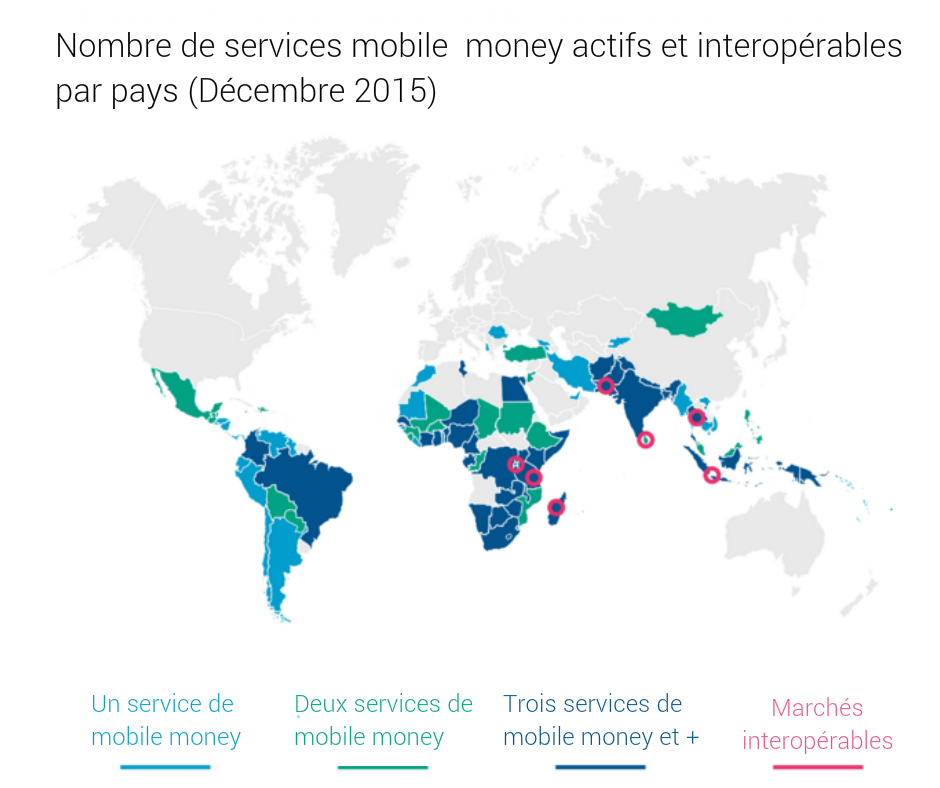
If these figures do not express a tangible reality for ordinary people, there is one piece of information that went unnoticed and should attract our attention a bit more: Botswana is now the leading country in the world in terms of mobile money adoption. Mobile money now represents about 45% of the money supply in circulation in the Botswanan economy. At the same time, West Africa (a zone with one of the lowest banking rates in the world) is experiencing twice as much growth in the number of active mobile money agents as in any other region in the world.
What do these figures mean in simple terms?
The various figures above mainly reflect a reality that more and more experts agree on: the success of telcos where the failure of banks to advance banking penetration and bring more financial security via better inclusion to populations is easily noticeable. More and more people are using mobile money to access basic financial services such as savings and credit, as well as for the purchase of goods and services such as paying bills, remote purchases, etc. The GSMA also states that “Mobile wallet services have contributed more to the financial inclusion of populations in the last ten years than traditional banks have managed to do in a hundred years.”
“Mobile money has done more to extend the reach of financial services in the last decade than traditional “bricks and mortar” banking has in the last century”.
A poignant fact marks this spectacular achievement: in West Africa, there are now more Mobile Money accounts than traditional bank accounts, and nearly half (47.3%) of these account holders now live in rural areas. Investors have not been mistaken: According to Disrupt-Africa, which conducted the first study on startup financing in Africa in 2015, fintech startups rank second in the fields that have benefited most from fundraising, while the startup Interswitch, offering digital and mobile payment solutions in Nigeria, will soon be the first African unicorn.
One may legitimately wonder if this revolution will definitively complete the continent’s transition from hard cash to mobile money.
If the example of Botswana does not provide the beginning of an answer for savvy observers, and if banks have until now relied on States, central banks, and the banking lobby to slow down the progression of mobile money, the new perspectives linked to the prospect of a quasi-universal, easily collectible tax represent a completely new element that could radically change the perception that public authorities may have of Mobile Money.
The universal tax, the ultimate argument for Mobile Money
Indeed, the near traceability of mobile money operations in a context where the love for fiat currency favors the development of the informal sector is a determining factor that will allow authorities to assess citizen income and apply a fairer and quasi-universal tax. This prospect of a fairer, more universal, easily collectible tax represents the determining element that could lead to the generalization of mobile money and public authorities’ behavior towards telecommunications operators. Certain measures such as the unique subscriber identifier, the roaming number, and the establishment of national mobile money regulation are all premises and architectural elements of public authorities’ shift towards a generalization of mobile money. The ubiquity of the mobile phone, the staggering coverage rates of cellular network operators in Southern countries and the room for growth in cellular phone penetration, and the establishment by the African Development Bank of a fund dedicated to Digital Finance seem to be weighty arguments for predicting promising days for Mobile Money services and potentially a springboard for the generalization of Mobile Money.
What future for banks?
While most mobile money offerings today are designed by telcos in collaboration with a bank or financial institution (due to the risk of illiquidity and the fact that collecting money from the general public remains an activity comparable to “deposit collection”), this state of affairs is now set to change. The recent granting to telecom operators of Electronic Money Issuer (EMI) licenses by central banks in Africa, and the freedom to break away from banking operators for the launch of mobile money offerings, open new perspectives for telecom operators in financial services: flexibility for the development of new services, financial investments, credit operations… Telecom operators have not been mistaken. Orange is the first cellular network operator to acquire an EMI license for its Senegalese, Malian, Ivorian, and Guinean subsidiaries, and other giants in the sector should soon follow.
A possible policy for the generalization of Mobile Money and the acquisition of EMI licenses by telecom operators should push bankers in the near future to profoundly rethink the very nature of their activities: the drop in the number of withdrawal and deposit operations would systematically lead to a questioning of the retail banking model due to a drastic drop in branch attendance, questioning the architectural and organizational model of the bank as well as the branch deployment model. While it is presumptuous to think that mobile payment operators will not completely replace banks, it is nonetheless easy to guess that banks must seriously consider focusing on their securities trading activities, deposits for large principals and key accounts, asset management, and the provision of bank guarantees for international trade operations, to name just those.
In many respects and in view of the statistics, it seems illusory to think that minor measures such as the hyper-digitalization of the bank, as Société Générale thinks, or the opening of new time slots for BGFI will be enough to counter the wind of banking disruption. There are events that must not be resisted and that are better accompanied: the digital revolution is one of them.
The digital transformation of banking is underway. Gentlemen bankers, you have been warned!