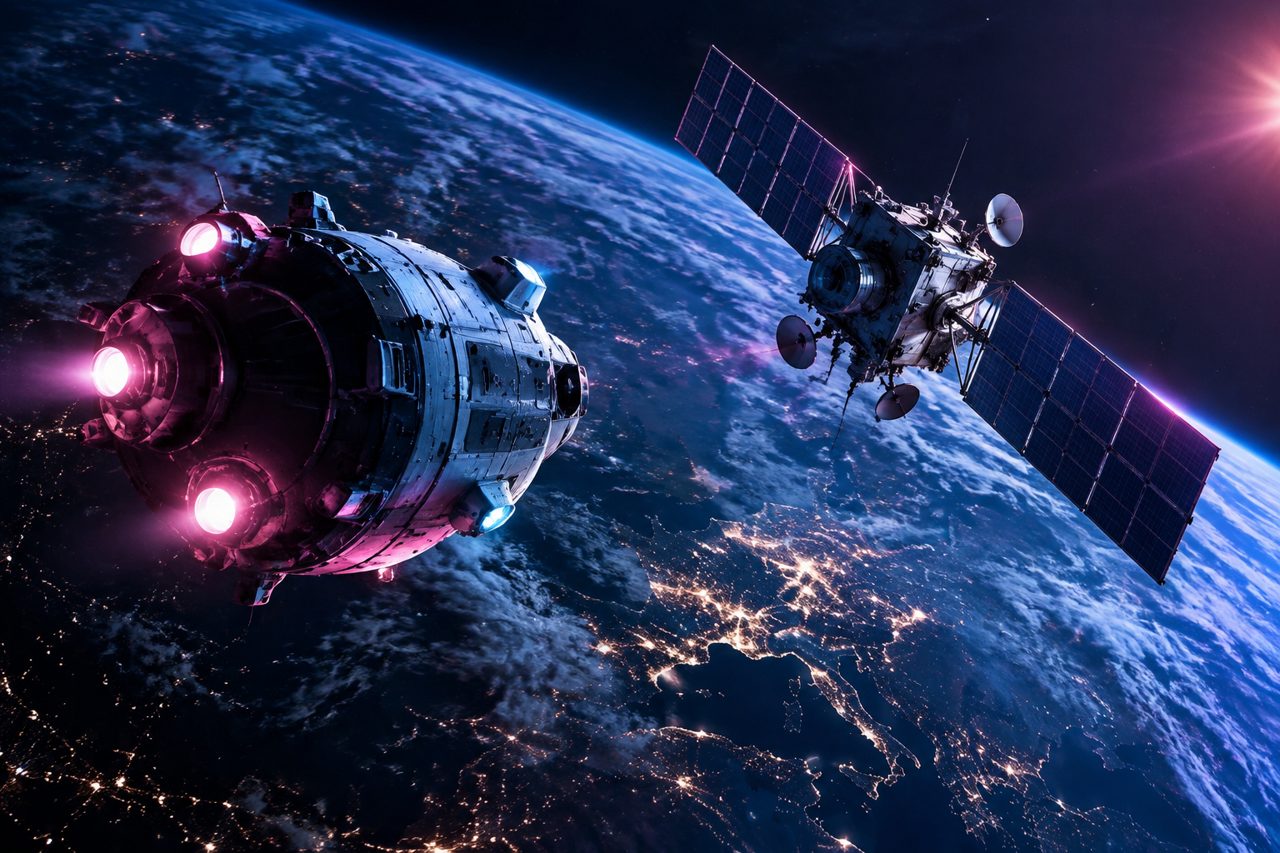
A satellite can cost a fortune, still work perfectly and yet be nearing retirement: it simply lacks the fuel to maintain its position. Does it really need replacing? In-orbit servicing promises another option: send a servicing vehicle, attach it to the spacecraft and give it several additional years of life. Looking ahead to September 2026, however, this prospect deserves more than a story about roadside assistance in space. There is an enormous gap between extending a mission and fixing a fault. Here is what the milestones documented through 2024 establish, and the developments they suggest could follow.
The first service: lending an engine
The most convincing evidence comes from Northrop Grumman’s MEVs, or Mission Extension Vehicles. In 2020, MEV-1 docked with the Intelsat 901 telecommunications satellite, which had been positioned above operational geostationary orbit. The combined spacecraft then moved into an operational position. In 2021, MEV-2 joined Intelsat 10-02 directly in its operational orbit. In both cases, the vehicle provides propulsion and attitude control for the client satellite.
This is not a repair in the usual sense. No robotic technician replaces a circuit board. The satellite retains its payload, antennas and communications functions; its partner handles the maneuvers needed to extend its life. This approach sidesteps a fundamental obstacle: these spacecraft were not designed to receive a servicing vehicle.
This model is particularly attractive to geostationary operators. At an altitude of nearly 36,000 kilometers, a telecommunications satellite represents an expensive asset, sometimes still commercially useful as its propellant reserves dwindle. Gaining a few years can preserve revenue and provide time to prepare a successor. But its onboard equipment must not become obsolete before that extension ends.
Approaching without touching, touching without breaking
An orbital rendezvous is less like parking than a choreographed dance between two fast-moving objects, monitored by cameras, sensors and software. Corrections must remain controlled despite shadows, reflections and changing light conditions. At close range, an error can damage both vehicles and create debris that endangers other users.
Much also depends on the client’s cooperation. A stabilized satellite with a known geometry and condition is a relatively favorable target. A defunct spacecraft tumbling in space is another matter. The robot must estimate its motion, choose a grasping point and absorb contact forces without tearing off a fragile component. An insulation blanket is not a handle; an antenna is not a docking point.
The Japanese ADRAS-J mission, launched in 2024 by Astroscale, illustrates this cautious progression. Its aim was to inspect an abandoned rocket stage at close range without capturing it. Observing an uncooperative object lays the groundwork for future interventions, but does not yet demonstrate the ability to grasp it and then move it safely. Inspection, capture and repair are three distinct levels of difficulty.
Refueling in orbit: a formidable plumbing challenge
Refueling seems intuitive: transfer fuel from one tank to another. In space, however, it requires managing the position of fluids in microgravity, pressures, temperatures and leak-tight connections. Some propellants are toxic or chemically aggressive. Above all, many existing satellites have filling systems designed for use on the ground before launch and made difficult to access afterward.
The US OSAM-1 project was intended, among other objectives, to demonstrate refueling of Landsat 7, a satellite not prepared for the operation. NASA announced its cancellation in March 2024, citing technical, financial and scheduling difficulties, as well as changing demand for refueling unprepared spacecraft. This cancellation does not spell the end of all orbital servicing. It highlights the cost of an ambitious goal: working on an old machine as though it had been designed to be taken apart.
The most credible path is therefore to prepare future satellites: accessible refueling interfaces, robust capture points, visual markers and replaceable components. But that preparation adds mass, costs and qualification requirements. Operators must pay today for a service whose future availability and price remain uncertain.
A market, but not for every orbit
The economic calculation goes beyond the price of the satellite being saved. Servicing must be compared with replacement, factoring in the servicing vehicle’s launch, its maneuvers, its insurance and the revenue preserved. A vehicle able to serve several clients in succession would spread its costs more effectively. But moving from one orbit to another consumes fuel; making a substantial change in orbital plane can be particularly costly.
In low Earth orbit, large constellations change the equation. When a satellite is mass-produced and regularly replaced by a more capable model, an individual intervention can cost more than replacement. By contrast, some observatories, scientific platforms or specialized equipment could justify an expensive service. Astronaut servicing missions to the Hubble Space Telescope demonstrated the value of a repairable design, without proving the economic viability of a robotic equivalent.
Life extension is not automatically an environmental benefit. It can avoid manufacturing and launching a replacement, but it also requires a vehicle, propulsion and a controlled end to the mission. The overall impact depends on the complete scenario. Repairing an aging spacecraft without planning its eventual removal would merely postpone the problem rather than solve it.
Who authorizes the servicing vehicle to intervene?
An abandoned satellite is not a wreck that anyone is free to salvage. Space law preserves ownership rights over launched objects, while the state of registry retains jurisdiction and control. An intervention therefore requires appropriate authorizations and agreements. The framework rests notably on the 1967 Outer Space Treaty and the 1972 Convention on International Liability for Damage Caused by Space Objects.
Contracts must specify who bears the cost of a failure, lost revenue or damage to a third party. They do not, on their own, settle states’ international liabilities. Proximity operations also raise a strategic question: a vehicle capable of grasping a satellite to assist it could use similar capabilities to disrupt it. Transparent maneuvers, consent and information sharing become conditions for trust.
What next? The most plausible trajectory for the years after 2026 is not a universal garage, but gradual specialization: inspection, life extension, then refueling of satellites designed for it. Complex repairs would remain reserved for assets that justify them. The real turning point may come less from a spectacular robotic arm than from common interfaces, insurable contracts and repeat orders. To make repairs possible tomorrow, the priority is to start designing differently today.