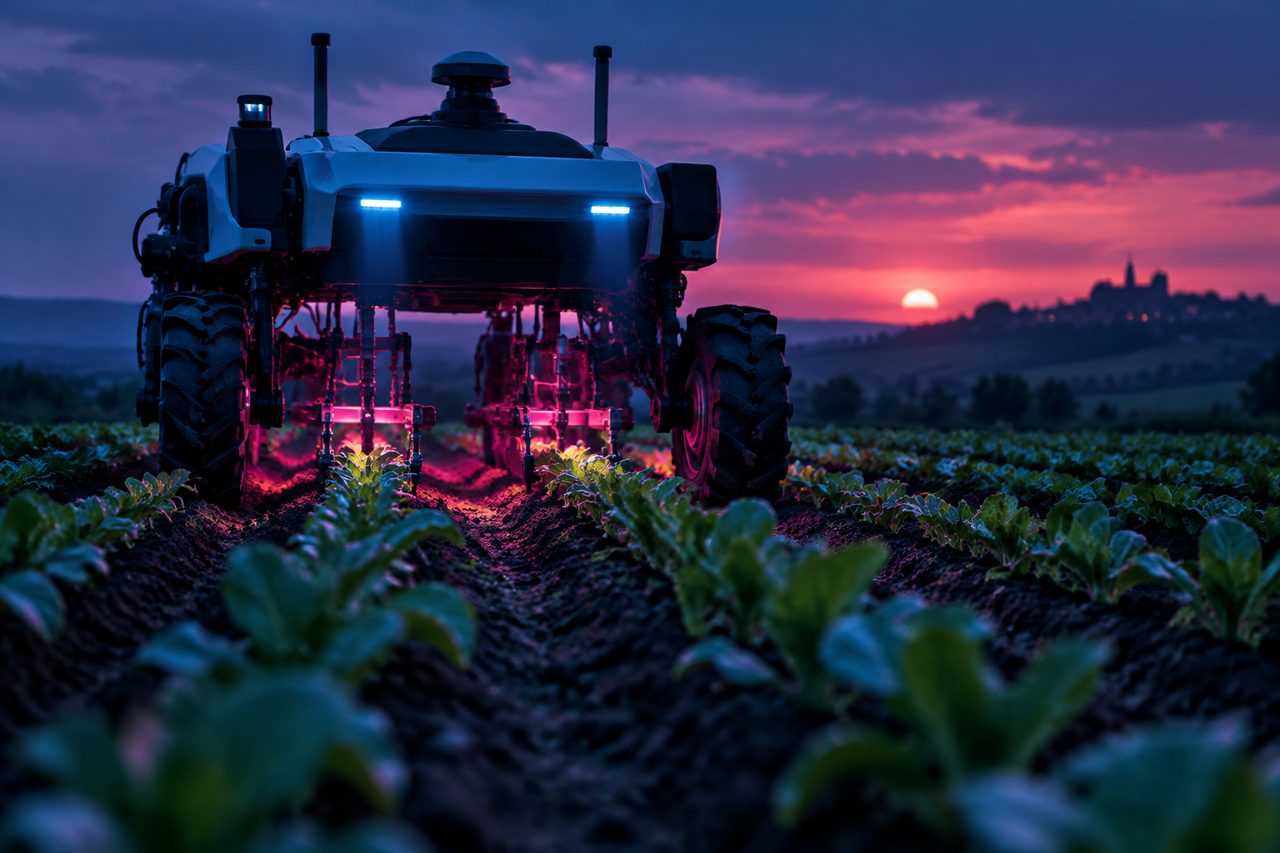
In a vegetable field, a camera spots a seedling, software makes a decision, and a blade moves within a few centimetres of the crop. Elsewhere, a laser targets a weed’s growing point. It is an impressive sight. But for the farmer, the question remains down to earth: how many hectares will be weed-free before the next rain, and at what cost? Looking ahead to September 2026, robotic weeding is less in search of a proof of concept than a replicable business model. This analysis draws on technologies and deployments already documented; the developments envisaged for 2026 remain projections.
Identifying a plant is not enough
Precision weeding brings together three tasks: seeing, deciding and acting. Cameras observe the soil; computer vision models distinguish crops from weeds; a tool acts in the right place. The whole system must work despite shadows, dust, overlapping leaves and changes in soil colour. A demonstration on a few uniform rows therefore does not guarantee a productive day in a variable field.
Two categories coexist. The first primarily automates movement and carries hoeing tools. The second adds plant-by-plant intervention, sometimes between two crop plants in the same row. France’s Naïo Technologies has developed robots for market gardening, arable farming and vineyards. FarmDroid combines sowing and weeding using recorded positions, a reminder of a simple fact: a camera is not always essential to know where to act.
Other companies focus directly on visual recognition. Carbon Robotics has brought its LaserWeeder to market, while Ecorobotix has developed ultra-targeted spraying with ARA. The latter still involves applying chemicals, rather than herbicide-free weeding. Nor is all this equipment autonomous: a smart implement attached to a tractor is a form of precision automation, but does not eliminate the driver.
Mechanical tools or lasers: two different economic equations
The blade: effective, but dependent on soil conditions
Fingers, knives and small blades can uproot, cut or bury weeds. Their advantage is well established: physical action without herbicides, using parts that farm workshop staff can often readily understand. Computer vision allows this action to take place closer to crop plants. But working near the row requires control over positioning, depth and the delay between detection and movement.
The outcome also depends on agronomic conditions. Overly wet soil can sometimes allow uprooted weeds to re-establish themselves; hard soil, stones or residues make operations more difficult. Wear gradually changes how the tool behaves. The robot therefore does not eliminate adjustments: it shifts some of the expertise towards calibration, monitoring components and choosing the right window for intervention.
The laser: precise, but not without constraints
A laser concentrates energy on part of a plant without disturbing the soil. It can be useful where crops are closely spaced or mechanical action risks damaging roots. However, each target requires treatment time. The more numerous or mature the weeds, the more demanding the trade-off between speed and effectiveness becomes.
Other requirements include power supply, cooling, clean optics and safety systems. Having no parts that work the soil does not mean having no maintenance. Performance claims made by a manufacturer must be considered in the context of their test conditions: species present, weed growth stage, density and actual forward speed.
The real test: the cost of a weed-free hectare
Comparing the purchase price of a robot with that of a conventional hoeing implement provides an incomplete picture. A meaningful calculation adds up depreciation, financing, energy, maintenance, transport, supervision and any follow-up work. That total must then be divided by the area actually weeded to the required standard. A hectare covered is not necessarily a hectare cleared of weeds.
High-value crops that require extensive manual weeding are a logical starting point. In vegetable production, replacing some of the strenuous work for which labour is hard to recruit can make a substantial difference to the bottom line. In arable farming, areas are larger, but the margins available per hectare and competition from fast alternatives often make the equation more difficult. Organic certification further changes the available options.
Work rate is central. It includes turns, moves between fields, cleaning, replenishment and stoppages, not just the stated speed. A machine capable of working long hours can offset its slow pace, provided safety, weather and operational arrangements allow it. Close human supervision inevitably reduces the anticipated labour savings.
A breakdown at the wrong time costs more than a spare part
Weeding depends on short windows of opportunity. Waiting several days for a sensor or a service visit can allow weeds to grow beyond the stage at which the tool works well. The cost of a breakdown then includes an additional pass, manual work or increased competition for the crop. The availability of a technician sometimes matters more than an impressive software feature.
Before investing, farmers should check a few practical points:
- Who provides in-season support, with what spare parts inventory and what replacement solution?
- Which tasks can they carry out themselves without prolonged downtime?
- Are updates, subscriptions and remote diagnostics included?
- What happens to the machine if the supplier goes out of business?
Field maps, incident logs and records of settings can also become essential working tools. Being able to export them reduces dependence on the supplier. For a farm, long-term support is not an optional convenience: it is part of the equipment’s value.
Buy, share or pay for a service?
Individual ownership provides control over scheduling, but concentrates the financial risk. Joint ownership, notably through French farm machinery cooperatives known as CUMAs, spreads the burden without automatically solving scheduling conflicts: several members may need to weed at the same time. Transport between farms and the diversity of crops also complicate sharing.
A per-hectare service could encourage adoption by transferring some of the technical risk to a specialist operator. However, that operator must guarantee the capacity to carry out the work and factor heavily infested fields into its pricing. A commitment to results would require precise criteria: which weeds, what tolerance, and by what date? Looking ahead to 2026, this model appears plausible, but its viability will depend first and foremost on a sufficiently geographically concentrated customer base.
What next? The most credible scenario is not a universal robot replacing every field operation. It is specialised equipment integrated into a strategy combining crop rotations, stale seedbeds, hoeing and targeted interventions. The next advances could come as much from after-sales service and the organisation of fieldwork as from artificial intelligence. When choosing, observing a full season under comparable conditions will be more useful than a few minutes of demonstration: the right robot will be the one that arrives on time, works consistently and leaves the farmer a profit margin.