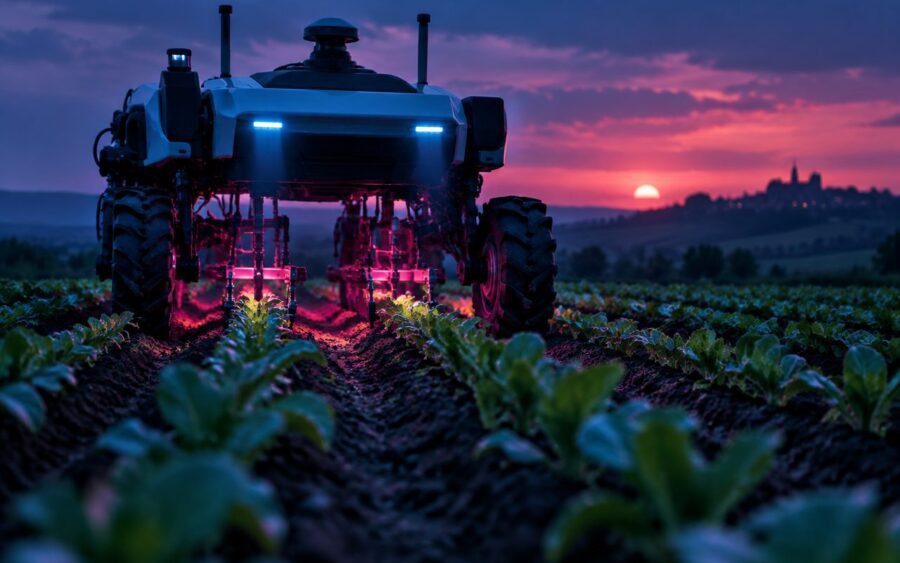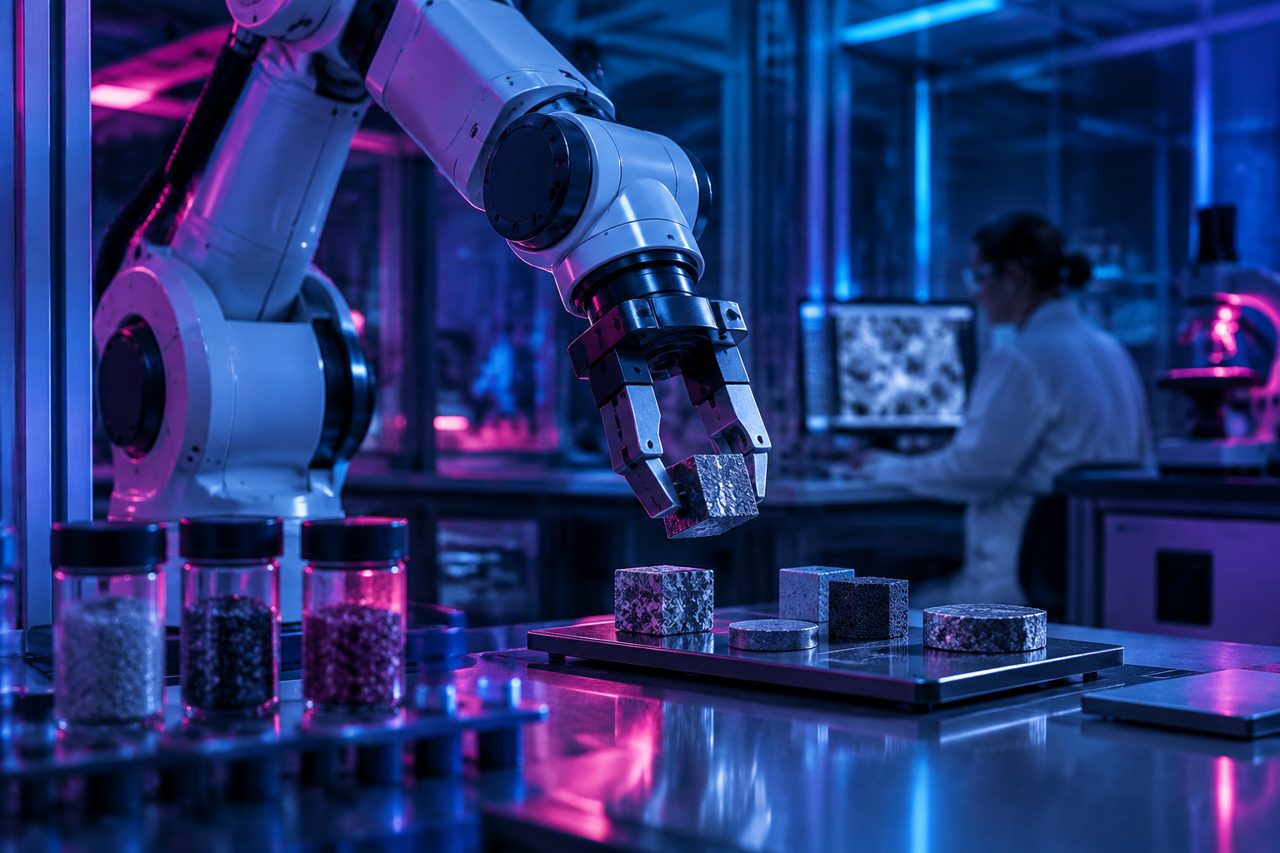
In the laboratory, no one is holding the pipette. A robotic arm prepares a mixture, an instrument measures its properties, and software then decides on the next experiment. This scene already exists: it embodies the ambition of autonomous laboratories, capable of cycling through hypotheses, procedures and analyses. Looking ahead to September 2026, however, their promise deserves to be framed without hype: not guaranteed discovery of a miracle material, but more learning with fewer unnecessary experiments. Established public demonstrations, notably those from 2020 to 2024, help explain this trajectory; the developments considered here remain prospective.
A laboratory that chooses its next move
Automation is nothing new in experimental science. Machines have long processed batches of samples according to predefined protocols. The closed-loop laboratory adds one decisive difference: results reshape the plan for subsequent experiments. If a composition looks promising, the system explores similar ones. If an approach fails, it can change the temperature, proportions or preparation method.
Imagine searching for a battery electrolyte. Substances must be combined, their conductivity tested and their stability checked. Exploring every formulation quickly becomes unrealistic. Machine learning then helps make a choice: should the best known formula be improved, or should a poorly understood region be explored? Methods such as Bayesian optimization manage this trade-off between exploitation and exploration, accounting for uncertainty in the predictions.
The setup relies on a complete chain: robotic preparation, measurement, data processing and selection of a new experiment. A brilliant algorithm alone is therefore not enough. The system must also be able to transfer a powder without contaminating it, clean a container and detect a faulty sensor. Much of genuine autonomy depends on these unglamorous details.
Concrete demonstrations, narrow scopes
In 2020, a team at the University of Liverpool presented a mobile robotic chemist in Nature, capable of moving around a laboratory and conducting research on photocatalytic mixtures designed to produce hydrogen. Its significance went beyond the mechanical arm: the system used its results to guide its experiments. It showed that a learning loop could work with physical equipment, not just in a simulation.
Another milestone, presented in 2023, was A-Lab, developed at Lawrence Berkeley National Laboratory with the University of California, Berkeley. This platform combined calculations, knowledge extracted from publications, learning and robotics to attempt to synthesize inorganic materials. It tackled challenging territory: solids, whose formation depends not only on the ingredients, but also on heating and transformation steps.
These projects also underscored the importance of scientific scrutiny. The identification of the resulting phases and the interpretation of some A-Lab results prompted critical discussion. The point is crucial: producing a signal consistent with an expected structure is not always enough to establish that a new, pure and reproducible material has been synthesized. Automated discovery remains subject to the same standards of evidence as any other kind.
Predicting a structure is not the same as making a material
That same year, Google DeepMind’s GNoME project illustrated machine learning’s ability to propose a vast set of potentially stable crystal structures. This type of tool expands the pool of candidates. But calculated stability is neither a manufacturing recipe nor a guarantee of performance in a battery, solar panel or electronic component.
Several obstacles remain between a computer file and a useful object. A material may be difficult to produce, degrade in air or require expensive elements. Its properties may depend on crystal defects absent from the model. The value of the closed loop lies precisely in testing predictions against matter: it resists, surprises and forces hypotheses to be revised.
The real gain: learning from experiments, including failures
Productivity is not measured solely by the number of samples prepared. A machine can generate redundant experiments very quickly. What matters instead is the information gained per experiment, per euro or per quantity of material consumed. An experiment that conclusively rules out a hypothesis can be more valuable than a slight improvement achieved without understanding why.
Failures then become a resource. In publications, successful recipes generally take center stage; dead ends often remain in laboratory notebooks. A well-designed platform can systematically record these negative results. But a scientific failure must still be distinguished from a technical incident: an impossible reaction does not teach the same lesson as a clogged pump.
When evaluating these systems, a few criteria matter more than an impressive demonstration:
- Compare performance against a credible baseline experimental strategy.
- Include preparation, maintenance and verification time.
- Confirm results using new samples, ideally in another laboratory.
- Document data, uncertainties and human interventions.
The researcher does not disappear: the work shifts
Choosing the objective remains a human decision with significant consequences. Optimizing only an electrolyte’s conductivity can mean overlooking its toxicity or flammability. Searching for the most active catalyst without considering its lifetime can lead to an industrial dead end. The system optimizes what it is asked to, not necessarily what truly matters.
Teams must therefore define multiple objectives, set safety limits and decide when to halt an exploration. They also investigate anomalies: an exceptional result, contamination or instrument drift? Credible autonomy includes the ability to flag uncertainty and hand back control. It does not require pressing ahead at any cost.
From prototype to factory, another leap
For a company, setting up such a system involves more than buying robots. Different instruments must be connected, software made reliable and traceability maintained for every batch. A platform that performs extremely well for one family of reactions may become of little use when the chemistry changes. Versatility comes at a cost, while overly narrow specialization limits applications.
Scaling up also remains a separate test. A recipe that works on a small sample may behave differently as volumes increase: heat transfer, mixing and impurities do not always scale predictably. With deployment in 2026 and beyond in mind, the most useful systems may therefore be those that incorporate manufacturing constraints early, rather than those that accumulate candidates.
What next? The most plausible trajectory is not a universal laboratory without scientists, but specialized islands of autonomy linked to teams capable of verifying and interpreting results. Their success will be judged by reproducible materials, reusable data and better-informed decisions. Robots can accelerate research; they do not make validation optional. Indeed, it is precisely because they multiply the possibilities that rigorous science becomes more valuable.