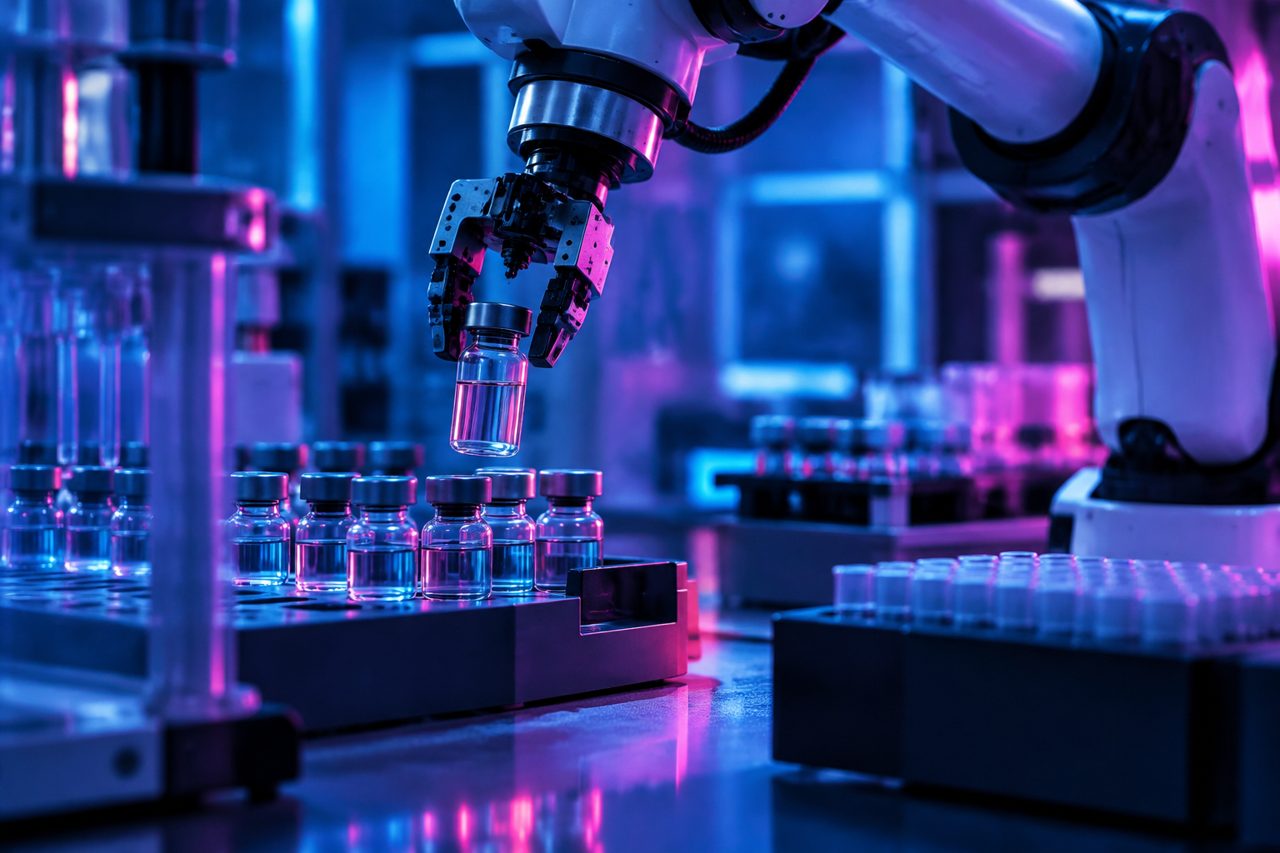
A robotic arm dispenses a powder, a furnace starts its program, and an instrument analyzes the resulting product. Then an algorithm chooses the next recipe. In an autonomous laboratory, artificial intelligence no longer merely comments on results: it plays a role in experimental decision-making. For batteries, catalysts and carbon capture materials, the promise is considerable. But this acceleration raises a question: is a discovery made without constant human intervention easier, or harder, to reproduce?
The real innovation: closing the loop
Scientific automation is not new. Machines have long dispensed liquids, performed successive measurements and processed batches of samples. The change lies in the decision loop: prepare, measure, interpret, then select the next experiment based on what has just been observed. Where conventional automated equipment follows a predetermined program, an autonomous laboratory adapts its course.
Consider a battery electrolyte. Researchers must choose solvents, salts and their proportions, then check conductivity, stability and compatibility with the electrodes. Exploring every combination would be unrealistic. An active learning algorithm can prioritize tests that look promising, or those that will reduce uncertainty the most. It does not replace the laws of chemistry: it organizes a search within constraints.
This autonomy remains bounded. Scientists set the objective, the available ingredients, the safety rules and the instruments that can be used. They also decide what qualifies as a success. The machine generally makes choices within a space designed by humans, rather than freely inventing a scientific research program.
Demonstrations that changed the debate
In 2020, a University of Liverpool team presented a mobile robotic chemist in Nature, capable of moving between different pieces of equipment and conducting a campaign of experiments on photocatalytic mixtures intended to produce hydrogen. Its significance went beyond the mechanical arm: the system used previous results to guide its tests, while working over a period difficult to sustain manually.
In 2023, A-Lab, developed through work at Lawrence Berkeley National Laboratory and the University of California, Berkeley, illustrated another approach: combining calculations, knowledge extracted from the literature, machine learning and robotics to synthesize inorganic materials. Powder preparation, heat treatments and X-ray diffraction analysis formed part of an automated experimental loop.
That same year, Google DeepMind’s GNoME research highlighted the potential of machine learning to propose vast numbers of theoretically stable crystals. The two approaches are complementary, but distinct. Predicting a material is not the same as making it; making it does not yet demonstrate that it has a useful property, or that it can be produced on an industrial scale.
These examples represent milestones documented before September 2026, not evidence that widespread adoption had been achieved by that date. The credible prospect is a proliferation of specialized platforms. Imagining a universal laboratory that moves effortlessly from a catalyst to a battery cell remains an extrapolation.
Speeding things up—but which part of the work?
The most obvious gain comes from continuity. A facility can perform repetitive operations in succession, maintain constant parameters and quickly make use of each measurement. Active learning can also avoid devoting too many tests to unpromising regions. For some well-defined problems, this combination substantially shortens the search for a formulation or protocol.
But the clock must start at the right point. Designing the platform, adapting the instruments, making powder handling reliable and programming checks all take time. A robot may excel with free-flowing liquids and fail when faced with a sticky paste. A precipitate, a clogged nozzle or a moisture-sensitive powder can be enough to bring the smoothly running machinery to a halt.
It is therefore important to distinguish between experimental throughput, exploration efficiency and scientific value. Producing more samples does not mean discovering more useful materials. Optimizing an easily measured metric can even lead away from the actual need: excellent initial performance alone says nothing about durability, cost or toxicity.
Reproducibility: the true test of maturity
Automation has an advantage: it can precisely record quantities, temperatures, timings and decisions. Where a laboratory notebook sometimes leaves gaps, a properly instrumented platform produces a detailed record. It can also repeat checks without tiring. This is an opportunity to document science better, not an automatic guarantee of quality.
Machines also repeat mistakes. A poorly calibrated balance, a drifting sensor or an overconfident analytical model can compromise an entire campaign. The danger becomes particularly subtle when the same system selects experiments and interprets their success: a systematic error can steer subsequent tests and reinforce itself as the loop continues.
Scientific discussions prompted by A-Lab have focused in particular on identifying crystalline phases and on the criteria for declaring a synthesis successful. They underscore a familiar challenge in solid-state chemistry: a signal consistent with an expected structure is not always enough to rule out a mixture or an alternative interpretation. Autonomy does not eliminate the need for expertise.
What must be shared
For another laboratory to verify a result, publishing only the best recipe is not enough. Raw data, analytical methods, software versions and the relevant characteristics of reagents must be made accessible. Unsuccessful trials matter too: they explain the path taken and prevent an isolated success from being presented as a robust result.
Transferability between equipment is just as critical. Two furnaces set to the same temperature do not necessarily subject a sample to the same thermal history. The vessel’s geometry, the atmosphere and the cooling process can change the final product. A truly reproducible recipe must therefore describe more than a sequence of instructions sent to a robot.
Humans: less hands-on, more accountable
These platforms shift scientific work toward defining objectives, maintenance, critical assessment of data and independent validation. Language models can help extract protocols or operate interfaces, but their proposals must remain subject to verifiable constraints. A chemically plausible instruction is not necessarily safe.
Access to these tools also raises an economic question. Robots, instruments and integration favor well-funded teams. Shared platforms could broaden access, provided they do not lock results inside proprietary systems that cannot be audited. The ability to export an experiment then becomes almost as important as the ability to run it.
What comes next? For the rest of 2026 and beyond, the most convincing advance would not be another avalanche of announced candidates, but results reproduced across several independent platforms. That is a prospect, not an achievement already secured. The autonomous laboratory will fulfill its promise when its speed serves more verifiable science—not merely the faster production of appealing results.