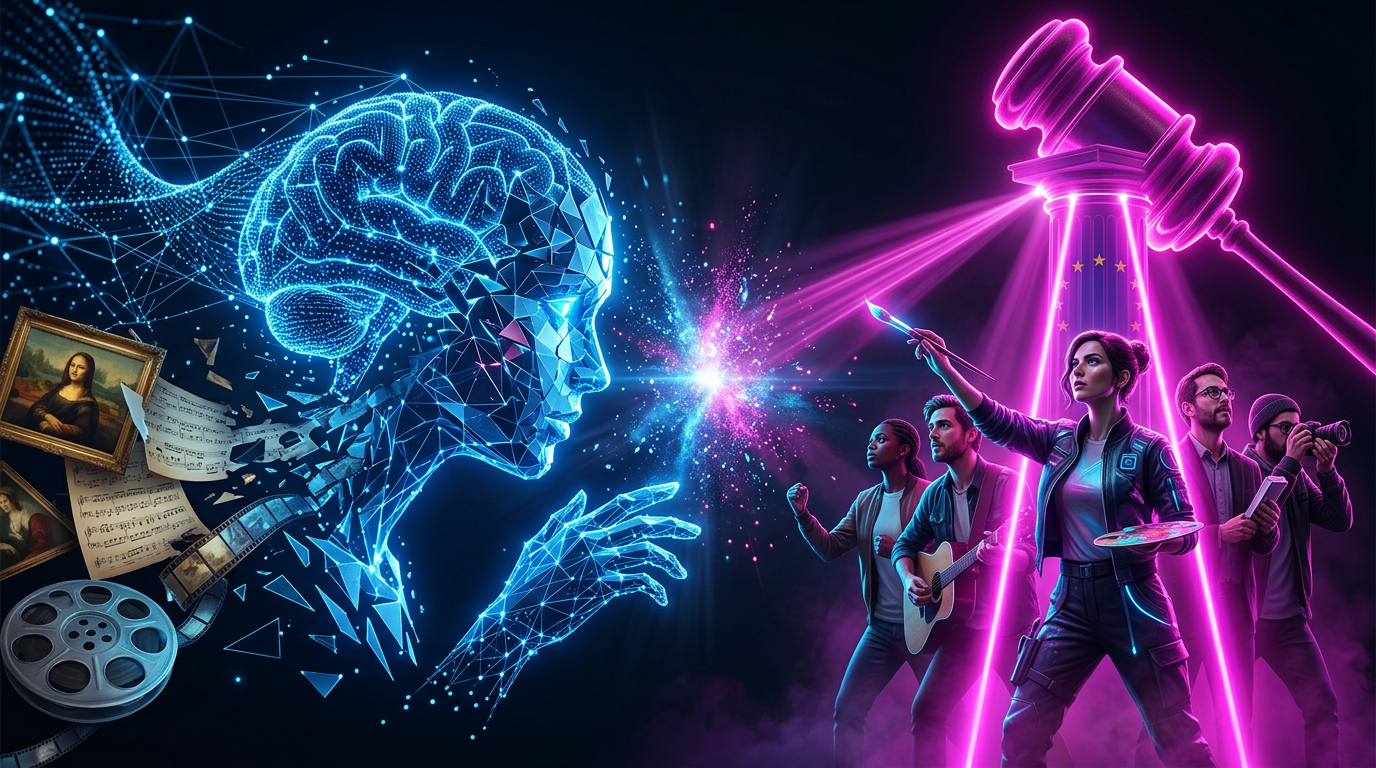
It is a standoff that could redraw the contours of the creative economy. Since the explosion of ChatGPT and Midjourney, tension has been steadily rising between Tech giants and rights holders. At the heart of the dispute: web scraping, the practice of vacuuming up billions of pieces of data, images, and texts to train language models without the explicit consent of the original authors.
The Legal Blur of TDM
Until now, Silicon Valley companies relied on exceptions related to Text and Data Mining (TDM). In Europe, the 2019 copyright directive allows this practice for research purposes or if rights holders have not explicitly expressed their refusal. But this regulation, designed before the generative AI tsunami, is showing its limits.
Creators today denounce abusive commercial exploitation. The principle is simple: if an AI can generate an illustration “in the style of” without remunerating the artist whose style it ingested, it constitutes unfair competition fueled by the work of others. The justice system is beginning to look into the matter, with several complaints filed in France and Germany by photographers’ unions and press agencies.
The AI Act: A First European Response
In the face of this discontent, the new European regulation on AI (AI Act) attempts to provide a first layer of regulation. The text now imposes transparency obligations on providers of general-purpose AI models. They must notably:
- Publish a detailed summary of the content used for training.
- Implement policies to respect European copyright law.
- Facilitate the exercise of the right to object (opt-out) for creators.
However, the devil is in the details. How can one verify the presence of a work in a database containing petabytes of information? Watermarking techniques are progressing, but their effectiveness remains contested against the transformation capabilities of algorithms.
Towards a New Licensing Model?
The industry is gradually moving towards a contractual model. Press groups such as Le Monde or Axel Springer have already signed direct agreements with OpenAI. These partnerships allow publishers to receive royalties in exchange for the use of their archives. For small independent creators, the situation is more complex. The risk is the emergence of a two-speed market where only large groups manage to monetize their data.
Regulation will therefore have to decide a philosophical as much as a technical question: is the output of an AI model a derivative work or an original creation? The survival of many cultural sectors will depend on the response of European courts. For 24h00.info, it is clear that 2024 will be the year of jurisprudence: the time of wild experimentation is coming to an end, giving way to that of legal responsibility.