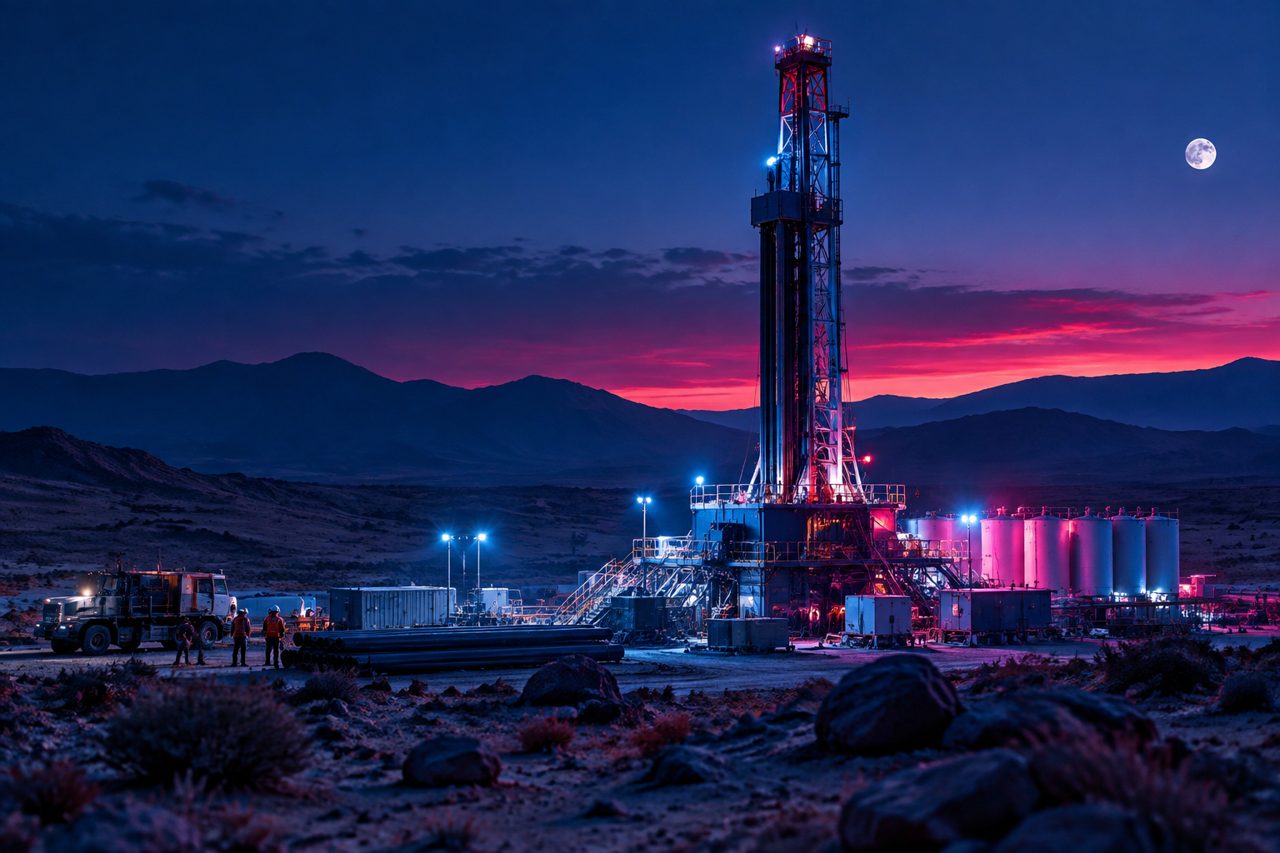
A drilling rig, steel pipes, powerful pumps: the scene brings an oil field to mind. Yet no barrels are being sought here. The target is heat stored in rocks several kilometres underground. In September 2026, deep geothermal energy deserves particular attention: techniques refined by the oil and gas industry could extend its reach. Fervo Energy embodies this American bet. But between a convincing demonstration and a competitive industry, there are still wells to drill—and risks to manage. The dated achievements below are documented milestones; the industrial outlook remains a set of projections, not established results.
Heat is not the only hurdle
The Earth holds an immense reserve of heat on a human scale. The challenge is extracting it at an acceptable cost. Conventional geothermal electricity generation mainly relies on favourable conditions: hot rock, naturally occurring fluid and sufficient permeability for that fluid to circulate. These requirements explain its presence in volcanic or tectonically active regions, from Iceland to Kenya.
Enhanced geothermal systems, commonly known by the English acronym EGS, aim to ease this constraint. Wells are drilled into hot rock with insufficient natural fluid circulation, and its permeability is then improved by working on fractures. Injected water heats up underground before returning to the surface through another well. At the surface, its heat powers an electricity generation facility.
The idea is not new: experiments have been conducted for decades, notably in the United States and at Soultz-sous-Forêts in Alsace. What is new is the combination of this geothermal experience with industrial tools that have become much more effective in the oil and gas sector.
What Fervo borrows from oil drilling
Horizontal drilling allows a well to extend laterally through the target layer. Rather than briefly passing through the hot rock, it increases the length available for heat exchange. Multi-stage stimulation then allows different sections of the well to be treated. Sensors, including fibre-optic instruments, help monitor temperatures and fluid circulation.
Fervo Energy delivered a tangible milestone in 2023 with its Project Red in Nevada. The company announced that a circulation test had demonstrated the potential to generate 3.5 megawatts of electricity. The project subsequently began supplying electricity to the grid under a partnership intended to support Google’s power supply. It is an important demonstration, but not yet proof that large-scale deployment can be profitable.
Its Cape Station development in Utah targets a very different scale. In 2024, Southern California Edison announced contracts for 320 megawatts from the development, with deliveries scheduled for a later date. These commercial commitments demonstrate buyer interest. They should not, however, be confused with capacity already available or a guarantee that schedules will be met.
Electricity that does not depend on the wind
The appeal for electricity grids is clear: underground heat remains accessible when the sun disappears and the wind drops. A well-designed geothermal power plant can generate electricity steadily, subject to maintenance shutdowns and reservoir behaviour. It could therefore complement variable renewables and reduce some of the need for storage or backup fossil-fuel generation.
This continuity is particularly attractive to industrial businesses and data centre operators. But continuous generation does not mean unlimited flexibility. Rapidly adjusting a facility’s output depends on its design, its surface equipment and subsurface constraints. Geothermal energy is therefore not automatically a natural battery that can be charged and discharged at will.
Costs are determined downhole
Before the first kilowatt-hour can be sold, funding is needed for studies, permits, wells, stimulation, the power plant and the grid connection. Drilling accounts for a large share of the risk: a campaign can be expensive before usable flow rates and temperatures are confirmed. Hot rock alone is not enough; it must also allow sufficient water to circulate without requiring excessive pumping.
Developers are banking on industrial learning. Drilling successive wells from a single pad, retaining crews, standardising equipment: the formula echoes that of shale oil and gas. Fervo has reported improvements in drilling speed. Their economic significance must nevertheless be assessed across multiple wells and over the full operating life, not simply on the basis of a record.
Subsurface conditions also present distinct challenges. Hot crystalline rocks wear down tools; high temperatures put electronics, cement and casing under strain. Above all, a poorly distributed fracture network can create a shortcut: water returns too quickly, without absorbing enough heat. The real measure is the cost of sustained generation, after accounting for pumping energy, maintenance and any additional drilling.
Water circulates, but it still has to be accounted for
In an enhanced system, the aim is to recycle most of the fluid between injection and production. This does not guarantee a perfectly sealed loop. Some water may be lost into the formation; the system also needs to be filled initially, and certain losses must be replenished. The choice of surface cooling technology matters too: air cooling reduces water requirements, with trade-offs in performance and cost.
In the American West, where water resources are under severe pressure, this becomes a local and political issue. Where does the water come from? What volumes of make-up water will be needed? Can a non-potable source be used without causing corrosion or deposits? These facilities must be distinguished from closed-loop geothermal systems, in which the fluid remains inside sealed pipes: their technical constraints are not the same.
Seismicity: a question of trust
Injecting fluid changes the pressure within fractures and can make it easier for a fault to slip. Most induced events are minor, but the risk cannot be dismissed out of hand. The shutdown of the Basel project following the tremors of 2006, and then the 2017 Pohang earthquake, linked to an enhanced geothermal project, are reminders of the possible consequences of a poorly managed interaction with the subsurface.
The response involves site selection, an understanding of faults, seismic monitoring before and throughout operations, and procedures for reducing or stopping injection. These measures reduce the risk without guaranteeing its absence, particularly after operations have stopped. Publishing data, defining responsibilities and keeping nearby residents informed are therefore prerequisites for industrial development, not merely communications exercises.
What happens next? The next step will be to demonstrate, across several sites and over several years, that flow rates, temperatures and costs remain under control. If that repeatability is confirmed, oil industry techniques could turn geothermal energy into a major complement to other renewables. Otherwise, they will mainly have expanded a niche. The verdict will depend less on capacity announcements than on electricity actually delivered, water consumed and the trust maintained around the wells.