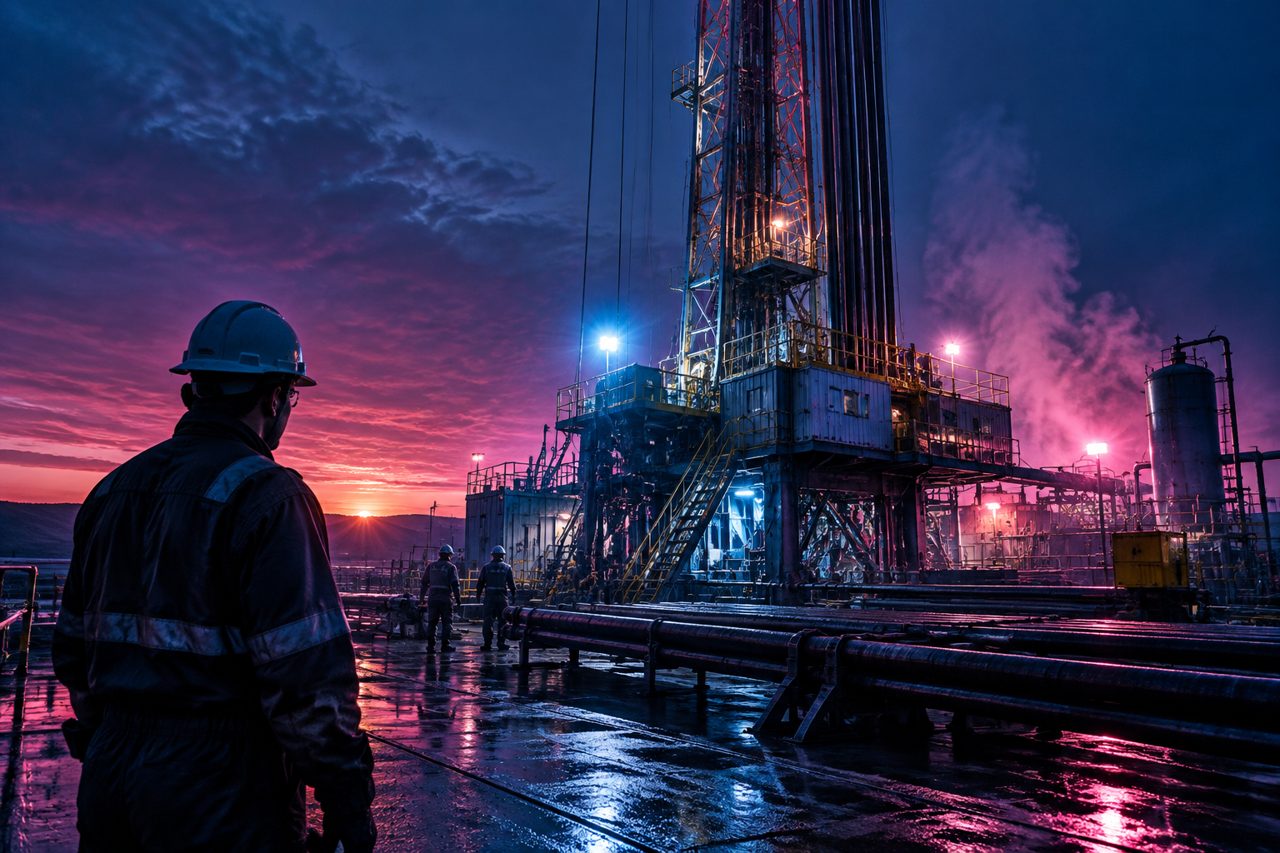
A drilling rig, kilometres of pipe, a team monitoring pressure: the scene resembles an oil drilling site. Yet no barrels of oil are expected to surface. The target is underground heat, available regardless of wind or sunshine. To assess prospects for its development through September 2026, this article draws on achievements documented up to mid-2024; subsequent developments are presented as possibilities. The question is whether tools from the hydrocarbon industry can make accessible an energy source that still depends heavily on local geology.
The resource is vast; suitable reservoirs are far scarcer
Temperature increases with depth, but not at the same rate everywhere. Above all, finding heat is not enough: it must be recoverable at a sustainable flow rate. Conventional deep geothermal energy taps naturally permeable formations containing hot water. One well produces this water; another reinjects it after its heat has been extracted. In the Paris Basin, the Dogger aquifers have supplied district heating networks in this way for decades.
This proven model depends on a favourable combination of temperature, permeability, water volume and proximity to consumers. An excellent reservoir far from demand can make for a poor heating project. Conversely, beneath a city with high demand, the rock may be hot but too dense. This is precisely the limitation that enhanced geothermal systems, commonly known by the English acronym EGS, seek to overcome.
What the oil industry really brings
The oil and gas industry knows how to steer a drill bit several kilometres underground, deviate a well and then extend it horizontally. It has also mastered measurement while drilling, cementing and the organisation of repeated drilling campaigns. Applied to geothermal energy, these skills allow operators to target formations more precisely and increase the length of contact between the well and the reservoir. They can also reduce incidents and downtime, both costly elements of drilling operations.
Progress comes as much from this industrial discipline as from any spectacular invention. More durable tools, better removal of cuttings and analysis of drilling parameters can speed up drilling. But transferring these techniques presents a challenge: hot crystalline rocks are often abrasive and place heavy demands on equipment. High temperatures weaken electronics, seals and materials. A record set in an oil basin therefore does not automatically translate into repeatable performance in geothermal drilling.
Creating pathways for water
Where water cannot easily circulate through rock, stimulation aims to improve connections between fractures, or even create new ones. Depending on the site, it involves hydraulic injections, chemical treatments or thermal effects. Some approaches adopt the staged stimulation used in the hydrocarbon industry: successive sections of the well are treated to distribute flows rather than concentrate all circulation in a single zone.
The comparison with oil industry fracturing is therefore sometimes justified, but it does not describe all geothermal energy. A conventional hydrothermal doublet is not an EGS system. And in a stimulated reservoir, the aim is not to release gas: it is to circulate water long enough to extract heat. An overly direct pathway between injection and production would cause premature cooling. Success is measured over decades, not just during a flow test.
Credible demonstration projects, but not yet a universal formula
At Soultz-sous-Forêts in Alsace, decades of research have shown that heat can be harnessed from deeply buried fractured granite. In the United States, the Utah FORGE field laboratory is working on the methods needed for stimulated reservoirs. In 2023, Fervo Energy announced a successful test in Nevada combining horizontal wells and stimulation. These advances make an oil-industry-inspired path to industrialisation credible, without proving that every region has an economically viable reservoir.
Another family of technologies proposes closed loops: a fluid circulates through sealed underground pipes, with no intentional exchange with water in the formation. This design reduces dependence on permeability and can limit certain injection-related risks. However, it must overcome a physical obstacle: transferring enough heat through the rock and pipe walls. Long drilled routes, their cost and thermal performance remain decisive.
Seismicity: a central constraint, not a footnote
Injecting water changes pressure in fractures and can facilitate slip on a fault already under stress. Most induced events are tiny; some are not. In Basel, a project was halted after tremors in 2006. In Pohang, South Korea, investigations linked the destructive 2017 earthquake to operations at an experimental geothermal project. These precedents rule out treating stimulation as a mere formality.
Prevention begins before drilling: mapping faults, understanding stresses and establishing baseline seismicity. During operations, sensor networks track events, while procedures provide for slowing, adjusting or stopping injections. These traffic-light systems are necessary, but they do not guarantee the absence of damaging earthquakes. Pressure can continue to redistribute after injections stop, so monitoring must continue.
To decarbonise, start with the right use
Media coverage often focuses on the promise of electricity. Yet intermediate temperatures are best suited to heating: homes, public facilities, greenhouses or compatible industrial processes. Generating electricity generally requires a hotter resource and leaves more heat unused if there is no outlet to put it to use. In some projects, a heat pump can raise the available temperature, at the cost of additional electricity consumption.
The carbon footprint depends on construction, pumping, fluid treatment and any gases present in the reservoir. It is therefore not zero by definition. But replacing a fossil-fuel boiler over the long term is a robust way to cut emissions. The economic challenge comes at the outset: studies and drilling commit substantial sums before the resource is confirmed. Geological risk insurance, supply contracts and nearby customers matter just as much as a faster drill bit.
What next? Looking ahead to September 2026 and beyond, the most credible scenario is progress through well-characterised sites, rather than geothermal energy everywhere. Oil industry techniques could expand the range of viable locations and make drilling operations more predictable. That promise will need to be judged on lasting results: heat actually delivered, full costs, reservoir behaviour and transparency on seismicity. The subsurface offers a major resource; efforts to accelerate its development will succeed if they respect local differences.