In a steel tank, microorganisms turn sugar into proteins. The promise is appealing: obtaining certain milk or egg ingredients without livestock farming. But between a successful sample and regular deliveries to an industrial customer, a reliable production chain must be built. Looking ahead to September 2026, this is where the credibility of precision fermentation will be tested: in pipes, filters, energy bills and regulatory submissions. The developments considered here remain forward-looking, based on trends already documented.
A familiar protein, a different manufacturing process
Precision fermentation involves programming a microorganism, usually a yeast, bacterium or fungus, to produce a specific molecule. This platform can produce enzymes, fats or proteins used as ingredients. It differs from traditional fermentation and biomass production, in which the microorganism itself constitutes the food.
The process is not entirely new. Chymosin, an enzyme used to make cheese, has long been produced by genetically modified microorganisms. Today’s ambition is primarily a change in scale: supplying functional proteins for ice cream, beverages or food preparations. Perfect Day has commercialized fermentation-derived whey proteins; other companies are working on egg proteins and caseins, among other targets.
These ingredients appeal to manufacturers for their functional properties: foaming, emulsifying, gelling and providing texture. Their value therefore cannot be measured in grams of protein alone. An ingredient capable of replacing several additives or improving a formulation can justify a higher price. Conversely, competing with an inexpensive agricultural protein requires exceptional industrial efficiency.
The fermenter bottleneck
In a laboratory, a high-performing strain can sometimes appear to have won the battle. In a large tank, the constraints change. Oxygen must reach every part, nutrients must be distributed properly and heat must be removed. An overly viscous liquid makes mixing more difficult. Microorganisms may experience different conditions depending on their position in the reactor, with consequences for yield.
Scaling up is therefore not simply a matter of multiplying volumes. The final product concentration, production rate and substrate conversion efficiency must all be maintained. A strain that excels on one measure may disappoint on others. Contamination can force a batch to be discarded, followed by costly cleaning and a restart of production.
Capacity is not interchangeable
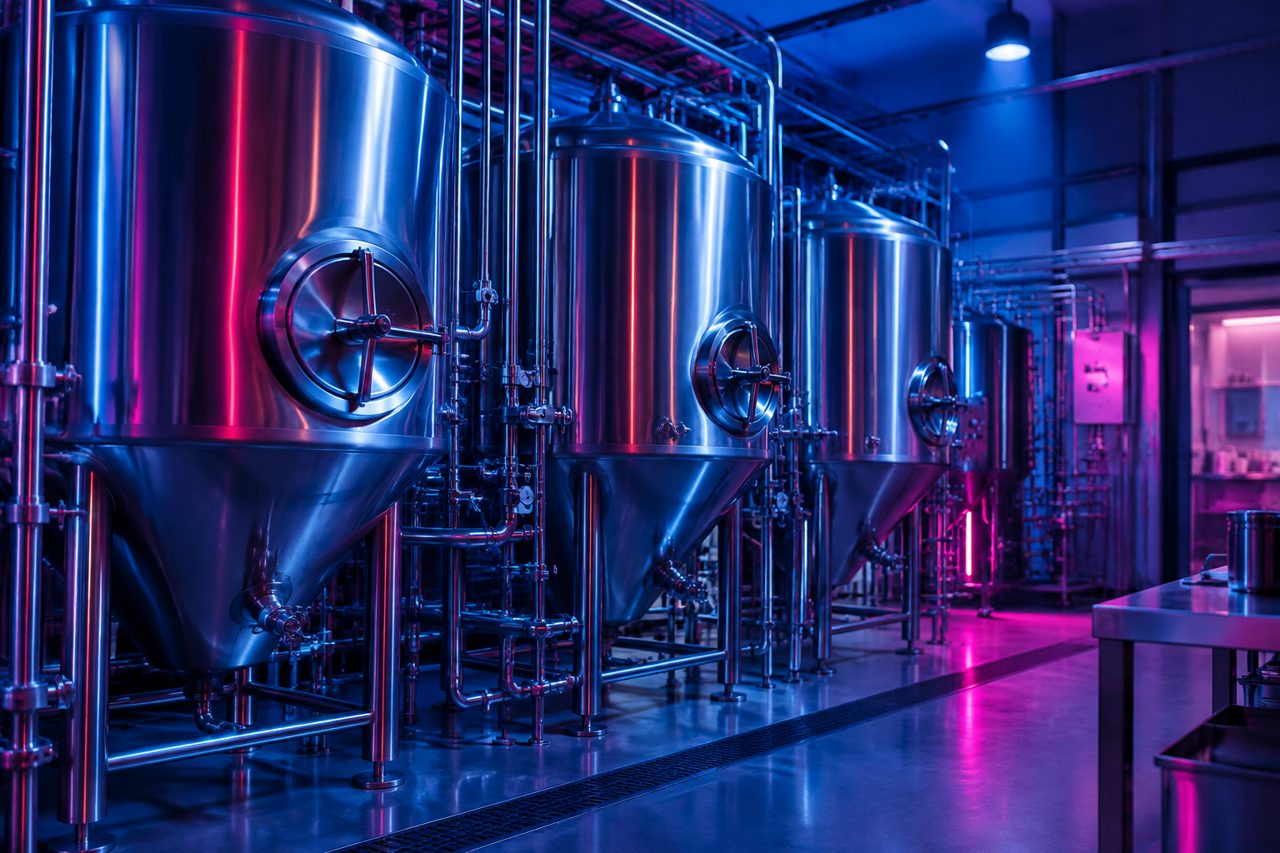
The industry already has fermenters, but not all are suitable. A facility designed for beer does not necessarily provide the required aeration, containment or separation equipment. At the other extreme, a pharmaceutical plant may offer technical standards whose cost is incompatible with food ingredients sold in large volumes.
The challenge is not simply to find available liters of capacity: it is to find the right equipment, in the right place and at the right price. Outsourcing can limit the initial investment, but creates dependence on the contractor’s schedule and capacity. Building a dedicated factory offers more control, while committing capital before orders are secured.
After the tank, the costs keep coming
Fermentation broth is not an ingredient ready to be added to a beverage. It contains cells, salts, residual nutrients and various compounds. It must undergo separation, clarification, concentration and sometimes further purification, before the product is stabilized. Centrifuges, membranes and dryers then become as strategically important as the fermenter.
Each operation consumes resources and can cause losses. A protein secreted into the medium presents different challenges from a molecule retained inside cells, which must be broken open. Some applications tolerate a mixture; others require a tightly controlled composition, a neutral taste and good solubility. The required purity depends on the product and its use.
This is why announcing a fermentation yield is not enough to demonstrate competitiveness. The decisive figure is the cost of the usable ingredient after processing and quality control. High output loses its appeal if recovery is poor or drying alters the properties the customer expects.
Sugar, energy, water: a reality check
These proteins do not come from nothing. Microorganisms consume a carbon source, often agricultural sugars, as well as nitrogen and minerals. The availability and price of these inputs matter. Using co-products may seem ideal, but their variability or impurities could complicate fermentation and purification.
Energy is involved at every stage: agitation, air compression, cooling, sterilization, concentration and drying. Low-carbon electricity improves the climate footprint without automatically solving the cost issue. Water and wastewater treatment also weigh heavily in site selection. A factory must fit into an industrial ecosystem, not merely have a building.
The environmental benefit must be demonstrated, not assumed. Life cycle assessments depend on the electricity mix, yield, raw materials and the product being replaced. Comparing a fermented ingredient with whole milk or with a purified protein does not answer the same question. Promising modeling results need to be confirmed with industrial data.
Regulatory approval, part of the business model
A protein resembling a familiar food protein is not exempt from safety assessment. Authorities examine the production organism, the process, the composition and any potential impurities, among other factors. In the European Union, depending on the product’s characteristics and history of consumption, the novel foods framework may require authorization before it can be marketed.
In the United States, some companies have used the GRAS procedure, whose mechanisms differ from those of European authorization. Status obtained in one market is not a global passport. These differences influence commercial priorities, funding needs and launch timelines. Regulatory submissions must therefore progress alongside the industrial process, not after it.
Labeling matters too. A milk protein produced without a cow may still be allergenic to people allergic to dairy proteins. “Animal-free” does not mean “allergen-free.” Clearly explaining production methods, uses and precautions will be essential to prevent technical innovation from becoming a source of confusion.
The next battle: consistent sales
As the sector develops, ingredients with high functional value could advance ahead of commodity proteins. Partnerships with established manufacturers offer a route to market, formulation expertise and sometimes infrastructure. But customers will demand regular deliveries, consistent quality and predictable prices: a pilot plant guarantees none of these three things.
What comes next? Looking ahead to September 2026 and beyond, the most credible scenario is not an instant replacement of livestock farming, but targeted adoption. Companies able to align biological performance, resource-efficient purification, industrial financing and regulatory market access could secure a place in certain formulations. To assess their progress, it will be more useful to examine full costs and repeat orders than simply the size of the tanks they announce.