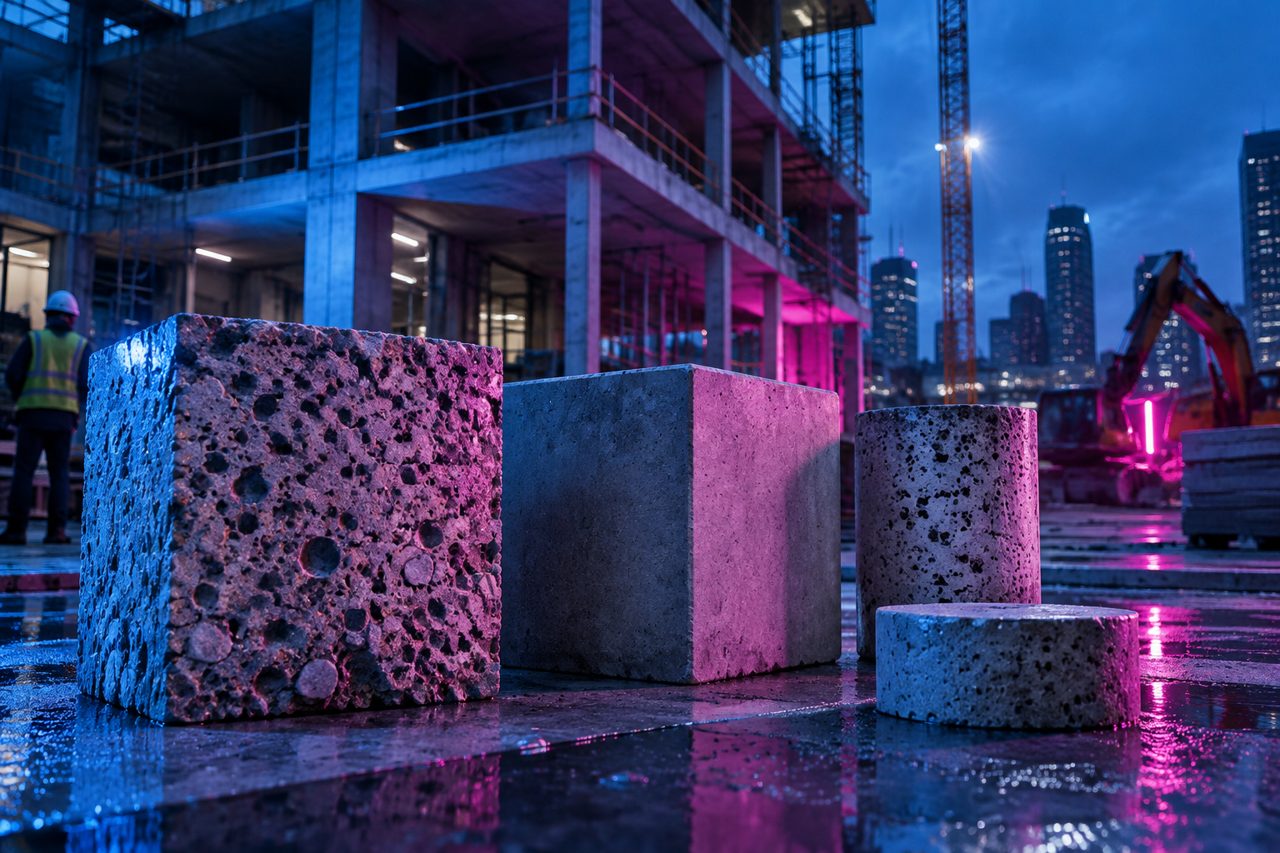
Concrete can boast an attractive carbon footprint while making life difficult for the site manager. If it hardens too slowly, formwork remains tied up; if it requires more careful curing, crews must adapt their practices. Looking ahead to September 2026, the challenge for low-carbon cement lies in this gap: turning an industrial promise into a reliable, available and insurable material. The technologies already exist, at varying levels of maturity. Their widespread adoption depends less on a miracle formula than on their ability to pass the test in the field.
Clinker, the heart of the problem
Clinker is produced by heating raw materials, notably limestone and clay, to around 1,450 °C. Its manufacture emits CO₂ for two reasons: the energy required by the kiln and, above all, the decarbonation of limestone. Replacing fossil fuels therefore does not eliminate process emissions. Cement accounts for around 7–8% of global CO₂ emissions, depending on the boundaries used in the calculation.
The most direct approach is to reduce the proportion of clinker by incorporating other constituents. But comparing two cements solely per kilogram sold would be misleading. The resulting concrete must be assessed: the dosage required, strength at the required age, transport, service life and exposure conditions. A lower-emission binder can lose some of its advantage if more of it is needed to perform the same function.
Slag and fly ash: effective, but constrained
Granulated blast-furnace slag, a co-product of steelmaking, is a proven solution. Finely ground, it can replace a substantial share of clinker in certain cements. It promotes low heat of hydration, which is useful for mass concrete structures, and can improve resistance to certain forms of chemical attack. Its key limitation is well known: early strength development can be slower, particularly in cold weather.
Fly ash from coal-fired power stations also has a long history in concrete. It can improve workability and long-term performance. However, its availability is declining in regions that are closing their power stations. Slag production, meanwhile, depends on blast furnaces: the transition to other steelmaking processes threatens this resource in the longer term.
These materials remain valuable, but they are not a universal answer. Importing a co-product over long distances adds costs, emissions and logistical dependence. Environmental assessments must also explain how impacts are allocated between steel and slag. A resource derived from an existing industry is not, by definition, available without limits or impacts.
Calcined clays and limestone: the bet on scale
Calcined clays offer a prospect for broader deployment. The principle is to heat a suitable clay to a temperature lower than that used for clinker, making it reactive. Combined with finely ground limestone, it can substantially reduce the clinker content. The family of cements known as LC3 illustrates this approach, with commonly studied formulations containing around half clinker.
The advantage is geological: clays are far more widespread than steelmaking co-products. But not all are suitable. Their mineralogical composition, particularly their kaolinite content, influences reactivity. Deposits must be characterised, calcination controlled and grinding adjusted. Locally available clay is not automatically a usable industrial raw material.
In the mixer, these formulations can alter water demand and compatibility with admixtures. Their mechanical strength may be suitable for structural applications, but their robustness must be verified using the aggregates, equipment and climatic conditions of the construction site. Limestone alone primarily provides a filler effect and favourable interactions in certain combinations: it cannot replace the function of clinker indefinitely.
Alternative binders: changing chemistry, changing methods
Alkali activation: promising but variable
Alkali-activated binders use a precursor, such as slag or calcined clay, and a chemical activator. Some belong to the geopolymer family, although the two terms are not interchangeable. They can achieve high strengths and sharply reduce reliance on clinker. Their environmental footprint nevertheless depends on the precursor, the activator and any heat treatment required.
The silicates and hydroxides used have their own environmental footprint and require handling precautions. Setting, shrinkage, efflorescence and reinforcement protection must be studied for each formulation. Industrial production appears particularly well suited to precasting, where dosage, temperature and curing are more closely controlled. Ready-mixed concrete requires greater tolerance of variations in site conditions.
Other clinkers and CO₂ curing
Sulfoaluminate cements offer another pathway. They can provide rapid setting and require less intensive firing than traditional Portland cement. But the availability of alumina-rich raw materials, cost and suitability for each application limit broad generalisations. A chemistry that works well for rapid repairs does not automatically become the best solution for every structure.
Other processes harden certain products through a reaction with CO₂. They are of interest for manufactured components produced under controlled conditions. However, a distinction must be made between the carbon actually bound, the manufacturing emissions avoided and the emissions associated with capturing, transporting or conditioning the gas. These solutions cannot be directly applied to every slab cast on site.
Certification, the real route to scale
In Europe, the EN 197 series of standards governs different cement families; EN 197-5 has extended the framework to compositions with lower clinker content. But the existence of a product standard is not enough to authorise every use indiscriminately. Concrete is also subject to EN 206 and national provisions, with requirements relating to exposure classes, composition and durability.
For binders outside conventional pathways, technical assessments may be required, depending on the product and its intended use. In France, an ATEx assessment can, for example, support a targeted trial. It is neither a universal approval nor an automatic guarantee of insurability. The client, engineering consultancy, technical inspector and insurer must share the available evidence and understand the limitations on use.
Strength at 28 days does not settle the matter. Carbonation, chloride penetration, freeze–thaw resistance, shrinkage and reinforcement behaviour matter over several decades. Accelerated tests must be interpreted cautiously when the chemistry changes. Environmental declarations, while essential for comparing impacts, do not in themselves demonstrate technical suitability.
The right material in the right place
Comparisons must therefore start with the schedule and the structure. Mass concrete can benefit from slow hydration; daily formwork cycles require early strength. The relevant price includes testing, storage, curing and potential delays, not just the cost per tonne of cement. An instrumented pilot project can then provide more useful information than an isolated carbon-reduction record.
What next? Looking ahead to September 2026 and beyond, the most credible scenario is a portfolio of solutions: proven substitutes where available, calcined clays to expand volumes, and alternative binders in controlled applications. Their progress is likely to depend on shared evidence, appropriate certification and trained teams. Low-carbon cement will succeed when specifying it becomes repeatable practice, rather than a heroic exception.