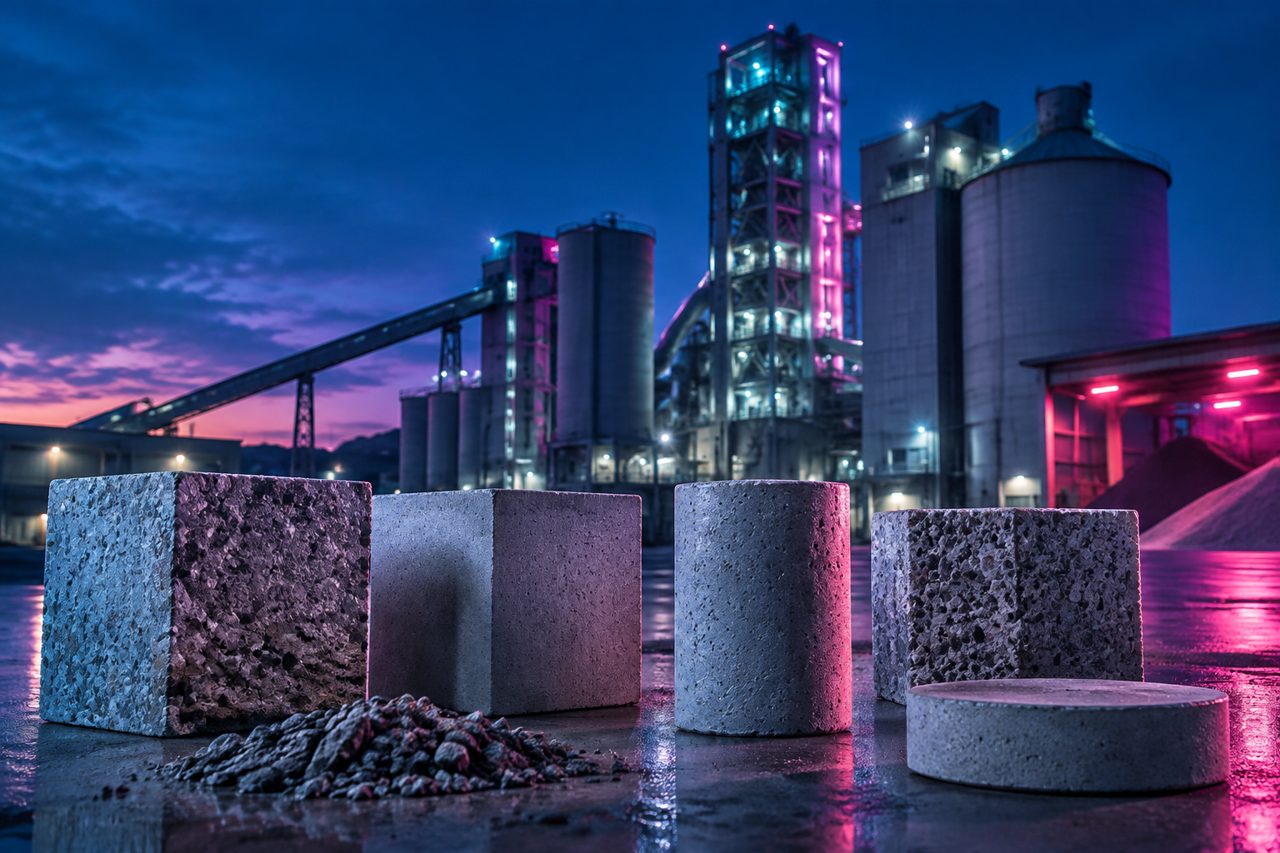
On a construction site, nobody orders a chemical innovation. They buy concrete that arrives on time, pumps properly, hardens at the expected rate and will last for decades. That is the challenge facing low-carbon cement: cutting emissions without weakening this chain of trust. Behind the announcements of new formulations, a less spectacular battle is being fought through standards, contracts and insurance documentation. Looking ahead to September 2026, changes in these areas could carry as much weight as advances in the laboratory.
Clinker, the heart of the problem
Cement is not concrete: it is the binder that holds aggregates together with water. Its climate footprint comes primarily from clinker, produced by heating a mixture consisting mainly of limestone and clay. Firing requires a great deal of energy, but it also releases the CO₂ contained in the limestone. Even with fully decarbonised heat, these process emissions would remain. Depending on the boundaries used, the cement industry as a whole is generally estimated to account for around 7 to 8% of global CO₂ emissions.
The first lever is to use less clinker per tonne of cement. Some of it can be replaced with blast-furnace slag, fly ash, limestone or calcined clays. These substitutions are not new. What is changing is the ambition: increasing their share, diversifying resources and adapting formulations to their intended uses. The best cement is not necessarily the one with the lowest clinker content, but the one that enables a structure to be built with the lowest emissions over its lifetime.
Different chemistries, different constraints
Cements combining clinker, calcined clay and limestone, often grouped under the LC3 label, illustrate this shift. They can significantly reduce emissions compared with clinker-rich Portland cement. Their appeal stems in particular from the potential availability of clays. But not all clays are suitable: mineral composition, heat treatment and consistency must be controlled. A resource that appears abundant on a map does not automatically become a reliable industrial supply.
Other approaches move further away from traditional cement: alkali-activated binders, formulations based on clays and industrial co-products, or processes using different chemical equilibria. Their potential is real, but a “new binder” does not automatically mean “low-carbon”. The production of activators, transport and the quantities required must all be taken into account. Durability must also be demonstrated for the relevant exposure conditions: freezing, marine chlorides, sulphates or carbonation.
Finally, CO₂ capture targets emissions that are difficult to avoid at cement plants. Projects such as the one in Brevik, Norway, have put this technology at the heart of European industrial strategies. However, it requires a complete chain: capture, energy, transport and permanent storage. Looking towards September 2026 and beyond, its deployment should be viewed as a pathway dependent on infrastructure and funding, not as a solution that is already widespread.
Standards: an apparent obstacle, an invisible infrastructure
A test specimen that is strong after twenty-eight days is not enough to authorise every use. Standards establish a common language between cement manufacturers, concrete producers, engineering consultancies and contractors. They define product families, measurable properties and checks. In Europe, the EN 197 series governs cement in particular, while EN 206 sets out requirements for concrete, supplemented by national provisions. This framework makes products comparable and responsibilities clearer.
Its downside becomes apparent when a formulation falls outside recognised categories. Composition-based rules can restrict the use of a material even when it performs well. So-called performance-based approaches seek to place greater emphasis on the results achieved, particularly in terms of durability. But they require relevant tests, shared criteria and the ability to relate accelerated measurements to actual ageing. Relaxing a recipe does not remove the need to demonstrate safety.
The EN 197-5 standard, published in 2021, thus established a framework for composite cements with lower clinker content. It is a step forward, not a universal passport. Publication of a standard, regulatory harmonisation, conditions for placing products on the market and acceptance under national rules of use are separate issues. A formulation may therefore have a reference standard without being immediately usable in every part of a building.
Insurers look beyond the pilot project
In France, ten-year construction liability gives this issue a very practical dimension. For a contractor, adopting an unfamiliar binder means checking the terms of cover with its insurer. Depending on the product and its use, technical evaluations or specific assessments can help support the case. They replace neither appropriate design nor the necessary contractual agreement. The real issue is knowing who is liable for a defect, supported by what evidence and what track record.
This is why early markets often develop around clearly defined applications. Precasting can make it easier to control mix proportions, curing and quality. On site, slower early strength development may require formwork removal to be delayed or concrete to receive additional protection in cold weather. These constraints do not rule out the material. They simply need to be factored into the schedule and price, rather than discovered at the foot of the crane.
Resources are available, but not everywhere
Clinker substitution also faces an industrial limit: traditional additions are not infinite. Fly ash depends on coal-fired power stations, whose closure is reducing supply in several European countries. Slag depends on blast-furnace iron production, which is itself set to change as steelmaking decarbonises. Relying exclusively on these co-products would mean building a transition on resources that are sometimes shrinking or already in high demand.
Calcined clays, certain natural pozzolans and fines from recycling broaden the possibilities, with varying levels of maturity. But each supply chain requires characterisation, preparation, storage and logistics. Transporting an addition over very long distances can erode its climate and cost advantages. The geography of low-carbon cement will therefore be regional: it will depend on deposits, existing facilities, available energy and proximity to markets.
Buying performance, not a label
For project owners, the right question is no longer simply: “What cement do you use?” Concrete mixes that fulfil the same function must be compared using verified environmental declarations and consistent assessment boundaries. Strength, exposure, service life, material quantities and maintenance all affect the balance. A claimed saving per tonne of cement may be reduced if the formulation requires more binder. Public procurement and major clients can accelerate the transition by setting carbon targets compatible with explicit technical requirements.
What happens next? The next acceleration could come less from a miracle recipe than from alignment between producers, standards bodies, specifiers and insurers. Shared testing, documented site experience and secure supplies would make low-carbon solutions easier to specify. The challenge over the coming years will be to turn exceptions approved on a case-by-case basis into repeatable practice, without lowering safety requirements. Low-carbon cement will succeed when it becomes an ordinary choice that can be substantiated and insured.