In a data center, artificial intelligence also makes its presence felt through the heat it generates. Accelerators packed tightly into racks, intensive computing and heat that must be removed continuously: moving ever more air is no longer enough in every setting. Liquid is therefore moving closer to the chips. But this shift is not simply a matter of replacing a fan with a pipe. It requires a rethink of the building, its power supply, its water resources and its ties to the surrounding area. To understand what is at stake looking ahead to September 2026, it is important to distinguish developments already documented from deployment prospects.
AI concentrates heat, not just computing power
The problem is not just a data center’s total energy consumption. It is also how concentrated that consumption is. A facility may have enough electricity and overall cooling capacity yet still be unable to cool a particularly dense row of servers. Training large models, as well as running certain inference services, brings together powerful accelerators that release substantial amounts of heat in small spaces.
Air cooling is far from obsolete, however. Hot- and cold-aisle containment, better-controlled airflow and the use of outside air when the climate permits still give operators effective options. But in the densest configurations, moving enough air requires more energy and space. The fans themselves consume power, while hot spots become harder to manage.
An industry signal was already visible in March 2024, when Nvidia unveiled its GB200 NVL72 system, a rack-scale architecture designed with liquid cooling. This does not mean every server must follow that model. It does show, however, that for some AI platforms, the thermal system is becoming a design requirement, rather than equipment added as an afterthought.
Two main approaches, several trade-offs
Bringing liquid into thermal contact with chips
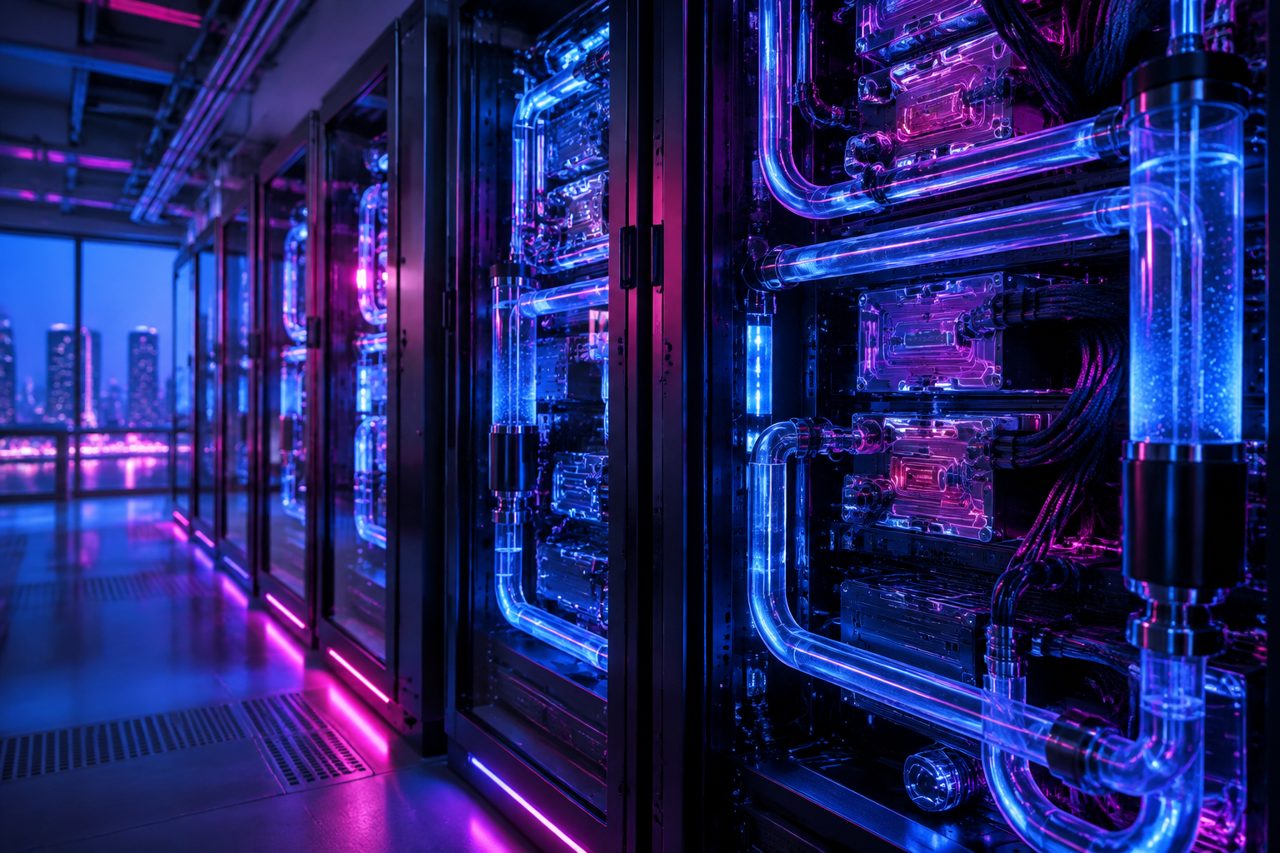
The approach known as direct-to-chip uses cold plates attached to the hottest components. A fluid circulates through them, carrying heat to a heat exchanger. A distribution unit, often called a CDU, provides the interface between the IT equipment loop and the building’s cooling loop. Depending on the architecture, some components remain air-cooled.
This approach allows a gradual transition but requires precision plumbing: fittings, flow control, leak detection and fluid quality management. It also requires checks on material compatibility and maintenance procedures. A fitting that is easy to handle during a demonstration must remain reliable after years of operation and repeated servicing.
Immersing the equipment
Immersion takes the concept further: equipment is submerged in a dielectric, or electrically insulating, fluid. Depending on the technology, the fluid either remains liquid or changes phase. The thermal benefits are real, but the operational changes are significant: specialized tanks, different handling methods, component compatibility, warranty checks and end-of-life fluid management.
Rear doors fitted with heat exchangers offer another option, particularly for capturing heat as it leaves the racks. No technique automatically wins on every criterion. Equipment power, the existing building, available skills and ease of repair matter just as much as the advertised thermal performance.
Liquid cooling does not mean wasting water
The misunderstanding stems from the terminology. Circulating a liquid close to chips does not necessarily mean continuously consuming water. A closed loop can operate with little replenishment. Consumption depends primarily on how the heat is ultimately rejected: evaporative towers, dry cooling equipment using outside air, chillers or a combination of systems.
The trade-off can be uncomfortable. Evaporation can reduce electricity requirements but consumes water. A dry system reduces this direct consumption, while potentially requiring more electricity during very hot weather. Then there is any water used to generate electricity: shifting consumption off-site does not necessarily make it disappear.
Energy efficiency, water use and local conditions must therefore be considered together. PUE compares a site’s total energy use with that of its IT equipment; WUE measures water use relative to that activity within a scope that must be specified. Neither metric is sufficient on its own. A liter consumed in a water-stressed basin does not have the same consequences as one consumed elsewhere, especially during a drought.
Heat recovery: a matter of proximity
Liquid offers another advantage: it can capture heat at a higher, more usable temperature than a diluted stream of air. Supplying a district heating network, heating a neighboring building or preheating water then becomes feasible. Heat recovery projects were already in place before the current AI boom, particularly in Northern Europe.
But available heat is not automatically useful heat. It requires a user close enough to the site, pipelines, a commercial agreement and often a heat pump to reach the required temperature. That heat pump consumes electricity. Seasonal mismatches also matter: servers keep running in summer, when demand for heating declines.
Innovation therefore also involves connecting two infrastructures. A local authority, a network operator and a data center operator must agree on temperatures, potential interruptions and financing. Promising future heat recovery is no substitute for identifying a user. The choice of site can matter as much as the choice of cold plate.
The real challenge is industrial
For existing sites, the difficulty lies in making changes without interrupting operations. Installing pipes, reinforcing certain areas, adding heat exchangers and training teams all require careful planning. Many operators may favor hybrid spaces: liquid for dense racks, air for conventional workloads. This coexistence appears more plausible than a wholesale conversion in the near term.
Procurement is changing too. Comparing server prices alone obscures the cost of pumps, fluid distribution, maintenance and building modifications. Conversely, a properly sized thermal infrastructure can make it easier to accommodate subsequent generations of hardware. Modularity and interoperability are therefore becoming practical concerns in avoiding excessive dependence on a single supplier.
What next? Looking ahead to September 2026, the most credible outlook is not a wholesale abandonment of air cooling, but the growing use of liquid where density justifies it. Its success will need to be measured across the system: actual energy savings, water conserved locally, reliability maintained and heat effectively delivered. The next decisive innovation may be less spectacular than a new chip: a data center designed from the outset to work with its surroundings.