In a data center dedicated to artificial intelligence, the challenge is no longer just securing electricity. Heat must also be removed, as close to the processors as possible. Behind the supercomputer announcements, a quiet revolution is unfolding in pipes, heat exchangers and fittings. Liquid cooling is becoming strategic infrastructure, rather than equipment reserved for a handful of exceptional machines. Looking ahead to September 2026, here are the challenges surrounding this shift, drawing on documented developments and explicitly identified projections.
When air reaches its practical limits
For a long time, the formula was relatively simple: blow cool air into the front of servers, collect warm air at the back, then repeat. Aisle containment and improved fans helped optimize this model. But computing clusters used to train or run large AI models now concentrate far more power in a small space.
The shift is visible in announced products. In 2024, Nvidia unveiled the GB200 NVL72, an architecture bringing together 72 Blackwell GPUs in a liquid-cooled rack. AMD, meanwhile, announced its Instinct MI325X accelerator with a maximum board power of 1,000 watts. These examples do not represent every server, but they illustrate a trend: each slot can become a substantial source of heat.
Air does not suddenly become unusable. It becomes more demanding: high airflow rates, power-hungry fans and hot spots that are difficult to control. Water carries much more heat per unit of volume than air. Bringing liquid close to the hottest components therefore shortens the thermal path between the chip and the system responsible for removing its heat.
From cold plates to immersion baths
Liquid collects heat directly from the chip
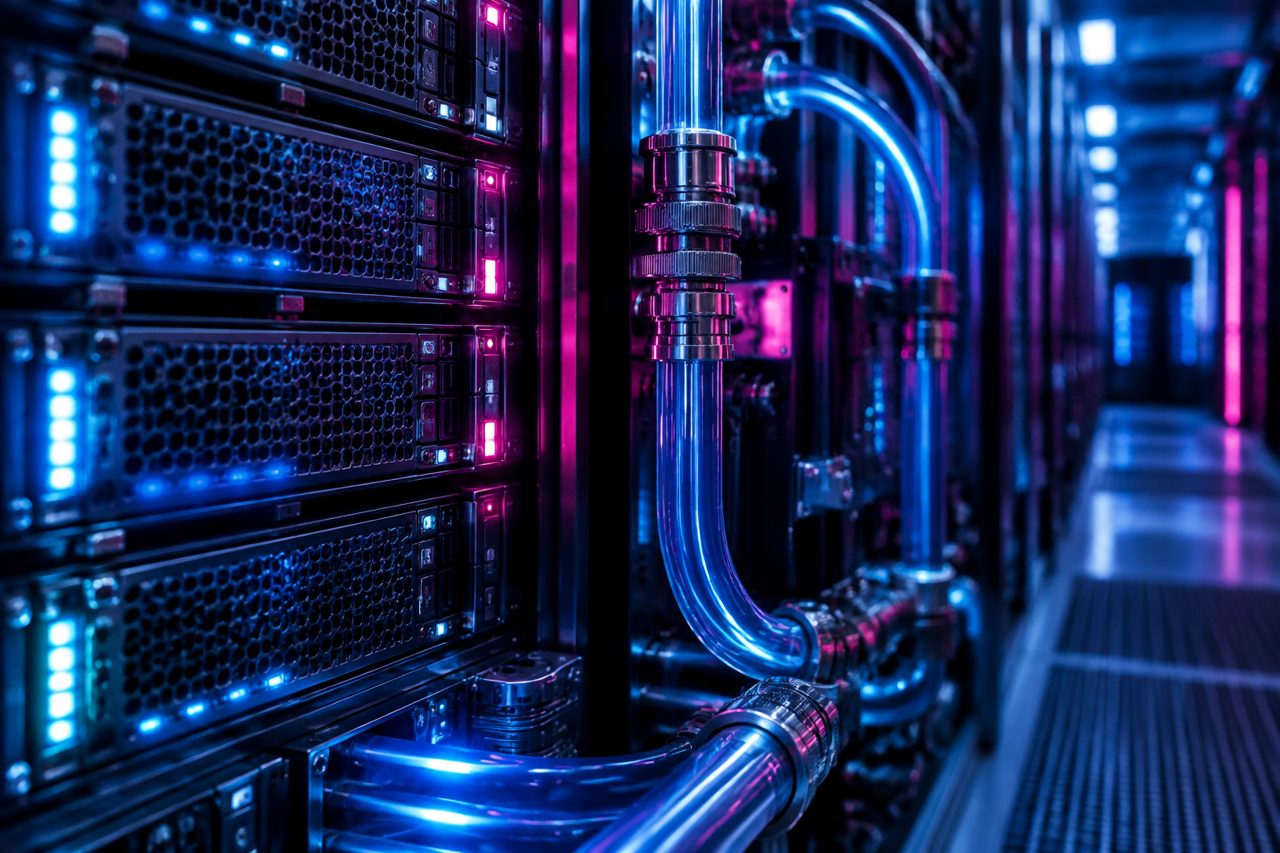
The solution most readily compatible with rack-mounted servers is direct component cooling, often called “direct-to-chip.” Metal plates containing small channels are attached to processors and accelerators. A fluid circulates through them, carrying away heat. In this configuration, it does not come into direct contact with the electronic circuits.
The network includes manifolds, flexible hoses and a coolant distribution unit, or CDU. This generally handles heat exchange between the IT loop and the building loop, while regulating circulation. Some components often remain air-cooled: adopting liquid therefore does not necessarily mean eliminating every fan.
Immersion requires a bigger change in practices
Another approach is to submerge equipment in a dielectric fluid, which does not conduct electricity. In single-phase immersion, the liquid remains liquid and transfers heat to a heat exchanger. In two-phase immersion, it boils on contact with hot surfaces; the vapor is then condensed. The two methods involve different architectures and constraints.
The bath can greatly reduce the need for ventilation at server level. But it transforms maintenance: removing a board, allowing equipment to drain, and checking the compatibility of cables and seals become routine operations. The choice of fluid also has implications for its service life, cost and environmental impact. Regulatory uncertainty surrounding certain fluorinated substances notably complicates the assessment of two-phase solutions.
The real work begins behind the server
Installing cold plates is not enough. Heat must pass through an entire chain: the IT loop, a heat exchanger, the building circuit and, finally, an outdoor heat rejection system. A room designed for conventional racks may lack electrical capacity, space for piping or sufficient heat removal infrastructure. In existing facilities, retrofitting sometimes resembles an industrial construction project more than a simple IT upgrade.
A new category of risks must also be addressed. Quick-disconnect fittings, leak detection, pressure control, fluid quality and metal compatibility become essential. Poor water chemistry can encourage corrosion or deposits. Reliability therefore depends as much on procedures and teams as on the advertised performance of heat exchangers.
For operators, the issue becomes contractual: who steps in if a loop serves equipment from several different suppliers? Who guarantees the connections? Work by the Open Compute Project and organizations such as ASHRAE is helping establish common practices. But claimed compatibility is no substitute for validating an entire chain under real operating conditions.
Less energy does not automatically mean less water
The energy benefits can be substantial: less intensive ventilation and, depending on fluid temperature and climate, less reliance on chillers. Circuits running on relatively warm water can make cooling with outside air easier. Pumps still consume electricity, however, and the outcome depends on the entire installation, not just the server.
Liquid cooling and water consumption are not synonymous. A closed loop recirculates its fluid. Water consumption depends primarily on how heat is ultimately rejected: evaporative towers, dry coolers or hybrid systems. A facility can therefore cool its chips with water while sharply limiting evaporation, at the cost of other technical and energy trade-offs.
PUE, which compares a site’s total energy use with that of its IT equipment, is therefore not enough to assess its environmental footprint. Water consumption, the source of electricity and actual machine utilization must also be examined. Even highly efficient infrastructure can substantially increase local demand if its computing capacity grows rapidly.
The new economics of density
Liquid cooling comes at a cost: piping, CDUs, engineering studies, building modifications and training. In return, it can allow more computing power to be installed within the same footprint and keep components operating at their intended performance levels. For some high-density platforms, the goal is no longer simply to reduce operating costs: their design requires this cooling method.
Putting waste heat to use offers another avenue. Water leaving the system at a sufficiently high temperature makes it easier to transfer that heat to a heating network or an industrial application, sometimes with a heat pump. But this requires a nearby customer, compatible demand and a viable business model. Heat recovery is not an automatic benefit that can be factored into every project.
What next? The most plausible outlook for September 2026 is coexistence: air for some workloads, cold plates for dense AI systems, and immersion in selected projects suited to the approach. The pace of adoption will depend on retrofits, standards and available expertise. For operators, the challenge will be less about choosing an eye-catching technology than about mastering the entire thermal chain. AI is sold on computing power; its growth will also be negotiated in plant rooms.