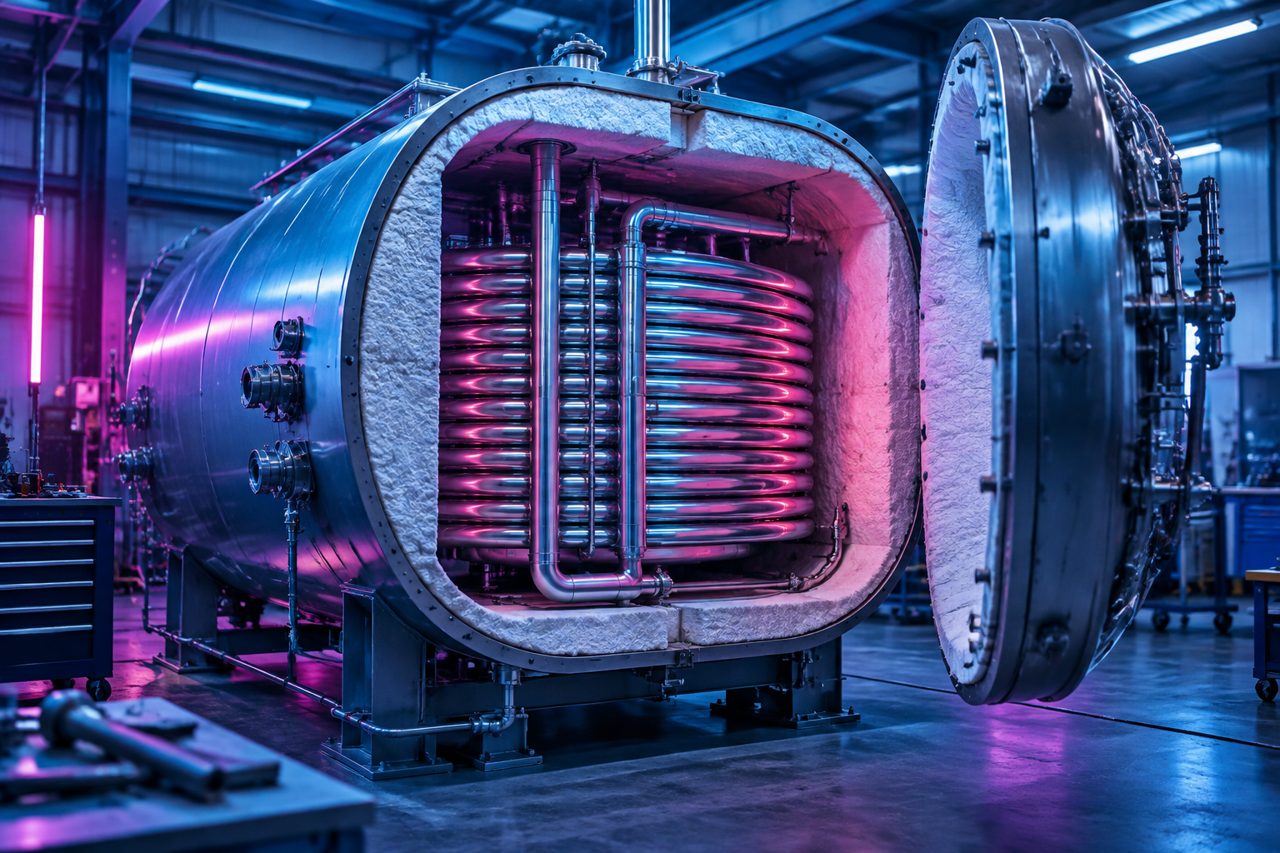
In a factory, the energy transition can take the form of a chamber filled with scorching-hot bricks. Heating elements turn electricity into heat, insulation limits losses, and a circuit releases that energy several hours later. Nothing particularly spectacular at first glance. Yet storing heat rather than systematically converting energy back into electricity could change the economics of certain industrial processes. To inform decisions in September 2026, here is a look at established technologies and prospects that should be distinguished from commercial promises.
The problem: the furnace does not follow the weather
Drying paper, producing steam, heating a bath or firing a material: heat accounts for a large share of industrial energy needs. Even today, these uses rely heavily on burning gas, coal or petroleum products. Electrifying them seems logical as electricity becomes less carbon-intensive. But a production line does not simply stop because the wind drops or electricity prices rise.
Thermal storage introduces a time shift. A factory buys or generates electricity at certain hours, converts it into heat and uses that reserve according to its own schedule. This allows it to reduce its power demand during periods of strain on the grid. The benefits increase with variable solar and wind generation, without depending exclusively on them: suitable supply contracts can also make this flexibility valuable.
The distinction is essential: a thermal battery is not necessarily an electrical battery. If the desired output is steam or hot air, delivering heat directly avoids an additional conversion step. Conversely, generating electricity again requires a heat engine or another converter, bringing additional losses and costs.
Three ways to store energy
Refractory bricks: keeping it simple, but very hot
The principle resembles that of a storage heater, adapted for industry. Heating elements warm solid materials capable of withstanding high temperatures. Air then circulates through the system, carrying heat to a heat exchanger, a steam generator or, where the process allows, directly to the point of use.
Companies such as Rondo Energy have developed this approach; a first commercial installation at US biofuel producer Calgren was announced in 2023. Other companies, including Antora Energy, are working on ultra-high-temperature carbon blocks. These developments demonstrate real industrial deployment, but they are not enough to prove universal profitability or an identical service life in every environment.
Solid materials offer advantages: potentially abundant resources, a relatively straightforward system design and no large tank of scorching-hot liquid. But the details determine performance: heating uniformity, resistance to cycling, expansion, insulation and heat output. A reserve that is still hot may become inadequate if it can no longer deliver heat at the required rate.
Molten salts: experience already gained in solar power
Concentrated solar power has provided a practical application for molten-salt storage. At plants such as Gemasolar in Spain, solar heat is stored in salts, then used to produce steam and drive a turbine. Storage allows generation to continue beyond daylight hours.
For industry, these salts can also absorb electrically generated heat. In a common configuration, the fluid circulates between a relatively cold tank and a hot tank. The technology benefits from operational experience, but significant constraints remain: solidification if temperatures fall too low, corrosion, pumping and equipment compatibility. Common nitrate mixtures also have an upper temperature limit; going higher requires other formulations and additional precautions.
Phase change: storing energy around a target temperature
A third category harnesses the heat absorbed or released when a material changes state, often between solid and liquid. Rather than simply raising its temperature, the system makes use of melting. The benefit is particularly compelling when a process requires heat delivered within a narrow temperature range.
Paraffins, salt hydrates, salts and metal alloys suit different applications. No single material works for everything. Thermal conductivity, stability after repeated cycles, containment and behavior during solidification determine the outcome. Some systems are commercially available, particularly at low or medium temperatures; for more demanding industrial applications, maturity depends heavily on the material–process pairing.
Lithium is not always the right comparison
Pitting these technologies against lithium-ion batteries would be misleading. An electrical battery powers motors, automation systems or a grid; a thermal store primarily meets a need for heat. For a factory, the real choice may be between a gas boiler, an electric boiler, a heat pump and several forms of storage.
At moderate temperatures, a heat pump often deserves consideration before resistance heating: it can supply several units of heat per unit of electricity consumed by drawing on an available heat source. It can also be paired with storage. At higher temperatures, heating elements and refractory materials become relevant, but waste-heat recovery should still be assessed first.
Profitability lies in the timing
The price of bricks or salt alone does not determine the cost of the system. Heating elements, heat exchangers, insulation, civil engineering, safety equipment and the grid connection all need to be financed. Rapidly charging a large store requires substantial power capacity, which may not be available on site without upgrades.
Then comes the operating profile. A few hours of very cheap electricity do not guarantee a profitable investment: the installation must be used enough to recover its cost. Grid tariffs, energy taxation, gas prices and carbon prices all change the equation. The useful metric is the cost of heat actually delivered, at the required temperature and power output.
The climate assessment demands the same rigor. Electric heating is not automatically low-carbon: everything depends on the electricity consumed, particularly during charging hours. Thermal losses, equipment manufacturing and the fuel actually displaced also matter. Finally, backup systems and maintenance must safeguard production continuity.
From demonstration project to standard industrial practice
What happens next? For September 2026 and the years ahead, the credible outlook is not a wholesale replacement of batteries, but greater specialization of technologies. Sites with steady heat demand, a suitable grid connection and competitively priced low-carbon electricity could form the first solid markets. Scaling up will be judged on verifiable operating data: availability, aging, maintenance costs and actual savings. Sometimes the best innovation will be the one that performs an ordinary task — supplying steam on time — without burning fuel.