More than half of the population lives in cities today. It is now well established that in 30 years, 70% of the population will be settled in urban environments. It is therefore of great importance to rethink cities in order to properly prepare for this population growth in increasingly concentrated points and to help them prepare for the consequences that this entails:
- Traffic congestion issues,
- Energy issues (electricity, gas, fossil fuels) and management of natural resources (water) which will become increasingly scarce, implying a rise in prices,
- Issues related to greenhouse gas emissions and fine particles,
- Issues related to the increase in waste produced (collection, treatment),
- Economic growth and employment issues,
- City supply issues.
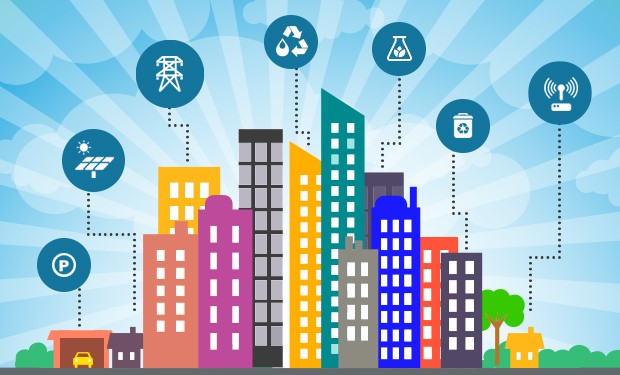
The city of the future must therefore organize itself to transform these constraints into opportunities. Because cities are at once at the heart of problems and solutions. True hubs of the global economy, at the meeting point of all flows, they are now the engines of global economic development (the 300 largest cities in the world generate 50% of global GDP).
Their central and strategic situation gives them full legitimacy to imagine new models, boost private and collective initiatives at the service of new solutions, new uses and therefore new forms of growth. It is in this context that the concept of “smart city” has been developing for several years.
Smart cities are defined as cities using information and communication technologies to improve the quality of urban services or reduce their costs and to improve the quality of life for the inhabitant. This encompasses:
- a type of urban development capable of responding to the evolution or emergence of the needs of institutions, businesses and citizens, both economically, socially and environmentally,
- investments in human and social capital, in energy infrastructure (electricity, gas), flows (human, material, information) that fuel sustainable economic development and a high quality of life, with wise management of natural resources, through participatory governance and efficient and integrated use of ICT.
When cities decide to develop this type of concept, they mainly seek to increase the visibility and attractiveness of the territory, improve quality of life and strengthen citizen involvement, boost the local economy and optimize public spending[1].
The development of smart cities is a global phenomenon which, while it was first the prerogative of large and very large cities, is now extending to medium and small municipalities.
Cities like Amsterdam, Barcelona, Copenhagen, Helsinki, Manchester and Vienna in Europe, Rio, Chicago, Dubai or Miami in the rest of the world are pioneers.
If we look at the global economic context, between smart water, gas or electricity meters, communicating recycling containers, connected environmental sensors…: the city speaks to us through information delivered by smart objects. This has been a rapidly expanding market for several years. Studies highlight a market with enormous potential.
By 2020, analysts[2] envision more than 50 billion connected objects in the world and more than 3 billion inhabitants owning a smartphone. The perspectives are such that 40% of data on the internet could be produced by connected objects. These objects and associated services could thus represent a market of 7,000 billion dollars.
In the framework of smart cities, Gartner envisions increasing use in a wide variety of fields (see Table 1).
| Subcategories | 2015 | 2016 | 2017 |
| Healthcare | 9.2 | 15.0 | 23.4 |
| Public services | 97.8 | 126.4 | 159.5 |
| Smart buildings | 206.2 | 354.6 | 648.1 |
| Smart home | 294.2 | 586.1 | 1,067.0 |
| Transport | 237.2 | 298.9 | 371.0 |
| Energy | 252.0 | 304.9 | 371.1 |
| Others | 10.2 | 18.4 | 33.9 |
| Total | 1,107.3 | 1,704.2 | 2,674.0 |
Table 1 – Smart Cities: Evolution of the number of connected objects by field of activity between 2015 and 2017. (In millions of units)
All sectors of activity are concerned by their use and Gartner estimates that a sector such as healthcare should represent a market of $38 billion by 2020.
Their use is closely linked to the development of smart cities since the first sector concerned when cities begin this process is energy and consumption control. This notably involves the implementation of sensors in public buildings and the use of smart grids[3].
In conclusion, in an increasingly connected world and with technologies and paradigms like Cloud, Big Data and next-generation networks, taking into account use cases like “Smart City,” we must necessarily think about security “by design.” That is to say, upstream of deployment and mainly taking into account personal data exchanged in this complex system and the resilience of urban infrastructure by avoiding malicious acts.
Sources
[1] Magazine Intercommunautalités, March 2015 • N° 198 • Monthly published by AdCF www.adcf.org
[2] Analysts to Explore the Disruptive Impact of IoT on Business: http://www.gartner.com/newsroom/id/2905717
[3] Smart City Observatory 2015: http://www.tactis.fr/?p=2348