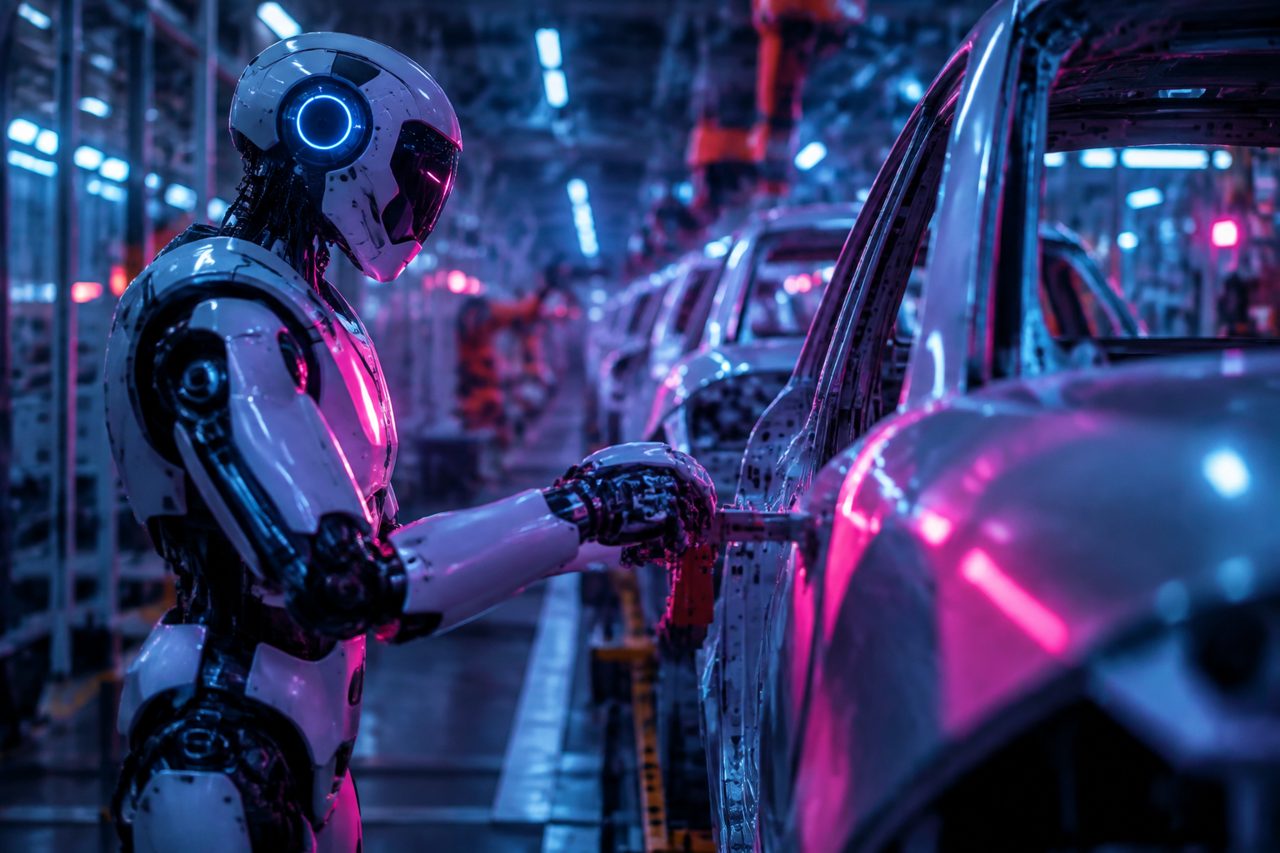
A two-legged robot picks up a metal part and places it in a fixture. The movement seems modest. Yet in an automotive factory, it encapsulates the promise of humanoids: taking over certain repetitive handling tasks without rebuilding the workshop around a specialized machine. BMW and Figure have brought that ambition into an industrial setting. One question remains, less spectacular than their videos: can these robots work long enough, safely enough and at an acceptable cost to become standard equipment?
Looking ahead to September 2026, factories appear to be a serious contender for their first sustainable market, alongside logistics. This analysis draws on publicly documented projects, notably from 2024 and 2025; the outlook discussed here is not a verified assessment of deployments as of September 2026. The challenge is no longer just to perform a movement successfully, but to demonstrate a repeatable industrial service.
BMW and Figure: a specific task rather than a universal worker
In January 2024, Figure announced a commercial agreement with BMW Manufacturing to identify applications in automotive production. BMW subsequently documented a trial lasting several weeks involving Figure 02 at its Spartanburg plant in South Carolina. There, the robot inserted sheet metal parts into fixtures for the next stage of the body manufacturing process.
That choice is telling. The aim was neither to assemble a car single-handedly nor to replace an operator across their entire workstation. The assignment involved a narrowly defined sequence requiring precise handling in a configured industrial environment. BMW highlighted, in particular, the potential of these machines for physically demanding or uncomfortable tasks.
The significance of the experiment must nevertheless remain clear: a trial under production conditions does not prove profitable operation at scale. At the end of this phase announced in 2024, BMW said that no Figure robots remained at the plant at that point and that no definitive timetable for their introduction had been set. This milestone demonstrated a technical capability, not yet an established business model.
Why industry attracts humanoids
Factories offer a decisive advantage over homes: surprises can be kept to a minimum. Parts arrive at defined locations, lighting can be controlled and routes can be marked out. Repeated tasks also provide measurable performance criteria. For a robot manufacturer, this consistency makes learning, diagnosing errors and justifying an investment easier.
The human form has a practical rationale. Many workshops were designed for people, from workbench heights and passage widths to bin positions. A machine equipped with arms and able to move around could access several stations without major alterations. It therefore promises more flexible automation than a fully dedicated installation.
But this logic has its limits. Factories already use industrial arms, cobots and mobile robots. For a stable task, a fixed manipulator may be faster and easier to maintain. On a flat floor, wheels may suffice. A humanoid must justify its complexity against these alternatives, not simply impress when compared with a human.
The first applications share common ground
The most credible applications involve feeding machines, transferring containers, presenting parts and certain material-handling operations. Their appeal often stems from a combination of repetition, ergonomic constraints and local recruitment difficulties. Highly variable handling tasks in cluttered spaces remain far more challenging.
Other programs illustrate this task-by-task progression. In 2024, Mercedes-Benz announced a collaboration with Apptronik involving Apollo, notably to explore delivering parts to operators and logistics applications in manufacturing. Here again, the documented objective was to assess industrial applications, not to establish the existence of a versatile replacement already ready for deployment everywhere.
Logistics provides another reference point. In June 2024, GXO and Agility Robotics announced a multiyear agreement to deploy Digit at a facility serving the Spanx brand in Georgia, following a pilot. The work involved moving bins between mobile robots and conveyors. This commercial case suggests that the first market could be structured material handling, spanning warehouses and factories, rather than complex assembly.
The evidence videos do not provide
Keeping pace, even when things go wrong
A successful sequence says nothing about a full working day. Manufacturers need to know the variability of cycle times, the frequency of stoppages and how long it takes to resume operation. A slightly misaligned part, a damaged container or a change of part type can sometimes be enough to turn routine handling into an incident.
The decisive figure is therefore not simply the number of movements completed. It is the amount of work that meets requirements with an acceptable level of assistance. How many human interventions are needed? Does the robot detect an incorrect grip? Can it recover from an error on its own? A supervised demonstration and autonomous operation are not the same product.
Proving safety and organizing maintenance
A humanoid combines several risks: movement, balance, moving arms and the load it carries. Safety also encompasses abnormal conditions, such as a fall, a loss of power or a dropped part. Depending on the application, segregated areas, speed limits and shutdown procedures may be necessary. These safeguards sometimes reduce the flexibility promised by working alongside employees.
Maintenance must also be provided. Grippers, joints, sensors and batteries are components subject to wear and stress. A factory is also buying availability: spare parts, trained technicians, response times and diagnostics. A capable robot left idle while awaiting repairs quickly becomes a weak link.
Profitability depends on more than the robot
Comparing its purchase price with an annual salary would be misleading. The full cost includes integration, workstation modifications, supervision, energy, maintenance and downtime. A rental or service-based payment arrangement can spread some risks, but it does not eliminate the spending needed to keep the system running.
To establish a sustainable market, suppliers will need to demonstrate repeat orders, expansion across multiple sites and comparable results beyond their initial showcase. Operator involvement will also matter: operators know the exceptions, defective parts and everyday workarounds that specifications rarely describe.
What next? The most plausible scenario is gradual adoption for a handful of clearly defined tasks, not a sudden invasion of production lines. Factories could become a first sustainable market if humanoids prove that they genuinely reduce constraints without shifting problems to supervision and maintenance. The decisive signal will not be a new video: it will be a customer placing a repeat order and entrusting the robot with more work.