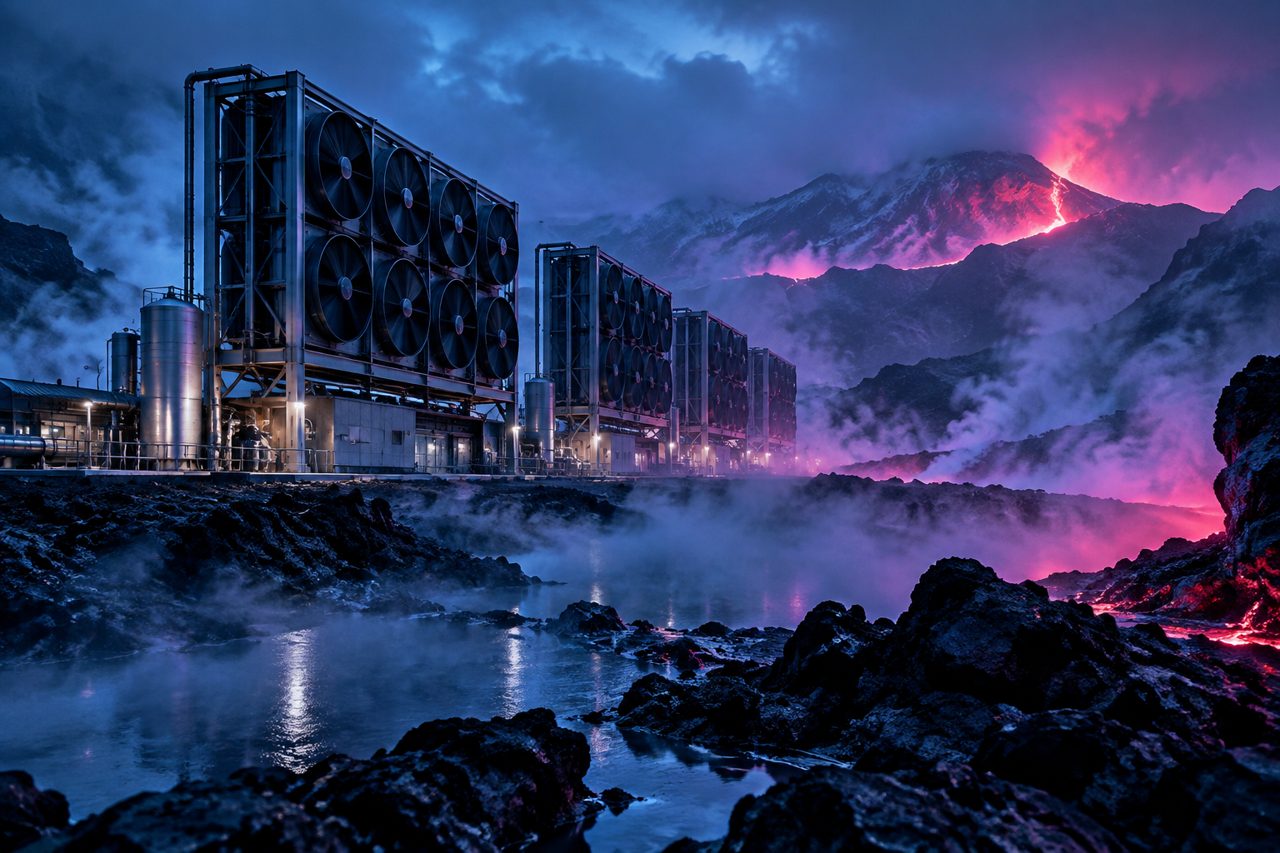
Giant fans, modules lined up on Icelandic rock, carbon destined to be locked away underground: direct air capture of CO₂ now has its iconic images. With Climeworks, the idea of cleaning up the atmosphere has moved beyond the laboratory. A less photogenic question remains: how many tonnes are actually removed, using how much energy and at what price? An inaugurated plant is not yet a climate result.
Looking ahead to September 2026, the sector’s credibility will hinge on this distinction. This analysis draws on facts documented up to June 2024; subsequent developments are considered as prospects, not as an established account of operations in 2026.
In Iceland, a promise becomes infrastructure
In September 2021, Climeworks inaugurated Orca, near the Hellisheiði geothermal power plant. Its announced nameplate capacity: 4,000 tonnes of CO₂ per year. In May 2024, the Swiss company opened Mammoth, also in Iceland, with an announced design capacity of up to 36,000 tonnes annually once fully deployed. The increase in scale is tangible: more collectors, pipes and processing equipment.
The principle sounds simple. Fans draw air across a material that traps CO₂. Once the material is saturated, the module is closed and heated to release a concentrated gas. Icelandic partner Carbfix then handles its injection: dissolved in water, the CO₂ is sent into basalt formations, where chemical reactions allow it to mineralise.
This chain therefore combines two distinct activities: extracting carbon from the atmosphere and storing it durably. Success in the first does not automatically guarantee the second. And the stated capacities of Orca or Mammoth are neither annual production records nor certificates of net removal.
Three metrics that must no longer be confused
Interpreting the sector’s announcements requires separating three measures. Nameplate capacity describes what a facility is designed to achieve under certain conditions. Gross capture measures what it actually extracts from the air. Durable net removal corresponds to the carbon stored after deducting emissions generated across the entire chain.
- Announced capacity: a design specification, dependent on deployment and operating assumptions.
- Volume captured: an operational result, affected by shutdowns, maintenance and material performance.
- Verified net removal: the climate benefit after emissions accounting and storage verification.
Mammoth illustrates the importance of this distinction. Its inauguration in May 2024 marked a phased start-up, not proof of a full year operating at 36,000 tonnes. Multiplying theoretical capacity by the number of years elapsed would therefore produce a misleading result. For Orca, too, only a series of comparable operational data would allow the gap between promise and delivery to be measured.
As early as January 2023, Climeworks had announced its first deliveries of certified removals to customers, including Microsoft, Stripe and Shopify, with independent verification by DNV. This was an important milestone. But certification of a delivery does not, on its own, reveal a site’s total production, utilisation rate or industrial production cost.
Energy, the first decisive test
The challenge begins with dilution. CO₂ makes up only about 0.04% of the air: recovering one tonne requires processing an enormous volume of gas. The fans consume electricity. Regenerating the filters requires heat. Gas processing, transport and storage add to these requirements.
Iceland offers favourable conditions thanks to its geothermal resources, which provide relatively low-carbon heat and electricity. This location makes the demonstration more convincing from a climate perspective. It does not, however, prove that the model can be replicated everywhere with the same carbon footprint. A facility powered by emissions-intensive energy could lose much of its value.
Alternative uses for this energy must also be considered. A low-carbon resource is not necessarily available without constraints. Elsewhere, it could decarbonise heating, replace fossil-fuel power generation or supply an existing industry. The right calculation is not just about the energy consumed, but also about the emissions it could otherwise have helped avoid.
Future projects will therefore need to publish their electricity and heat requirements separately, specify the temperatures required and document their supply sources. An aggregate consumption figure, without these details, says little about local feasibility. Water availability and subsurface characteristics also matter: the Icelandic approach is not a universal formula.
A selling price is not an industrial production cost
Direct air capture remains expensive. Public offers and estimates available before mid-2024 frequently placed durable removal in the hundreds of dollars per tonne, or even higher depending on contracts and processes. These amounts are not directly comparable, however: some include storage, verification and a margin, while others describe only one technical stage.
Advance purchases by large companies support the first facilities. They fund learning and give developers commercial visibility. But a contract for future tonnes proves neither that they have already been removed nor that their production cost is under control. The order book and the removal registry must remain two separate documents.
To bring costs down, Climeworks and its competitors are banking on better materials, standardised equipment and optimised operating cycles. This trajectory is plausible, not guaranteed. Savings on collectors could be absorbed by spending on energy, filter replacement, financing or storage infrastructure.
Transparency as a condition for growth
A credible dashboard should present, for each site and each year, gross capture, actual storage, life-cycle emissions and certified net removals. It should also disclose downtime, changes in methodology and the share of capacity actually available. Without this, comparisons remain dominated by inauguration press releases.
This requirement does not diminish the potential usefulness of direct air capture. The IPCC’s work recognises a role for CO₂ removals in offsetting certain residual emissions and, depending on the pathway, subsequently reducing atmospheric concentrations. It does not justify treating them as a substitute for rapid emissions reductions. Thousands of tonnes removed do not neutralise a fossil-fuel economy.
What next? From September 2026, the decisive test should be the regular publication of comparable results: net tonnes delivered, energy used and documented costs. If facilities improve both availability and efficiency, the sector will be able to strengthen its position. Otherwise, the gap between ambition and performance will force timelines to be revised. Carbon removal must become a verifiable metric, rather than remain an industrial promise.