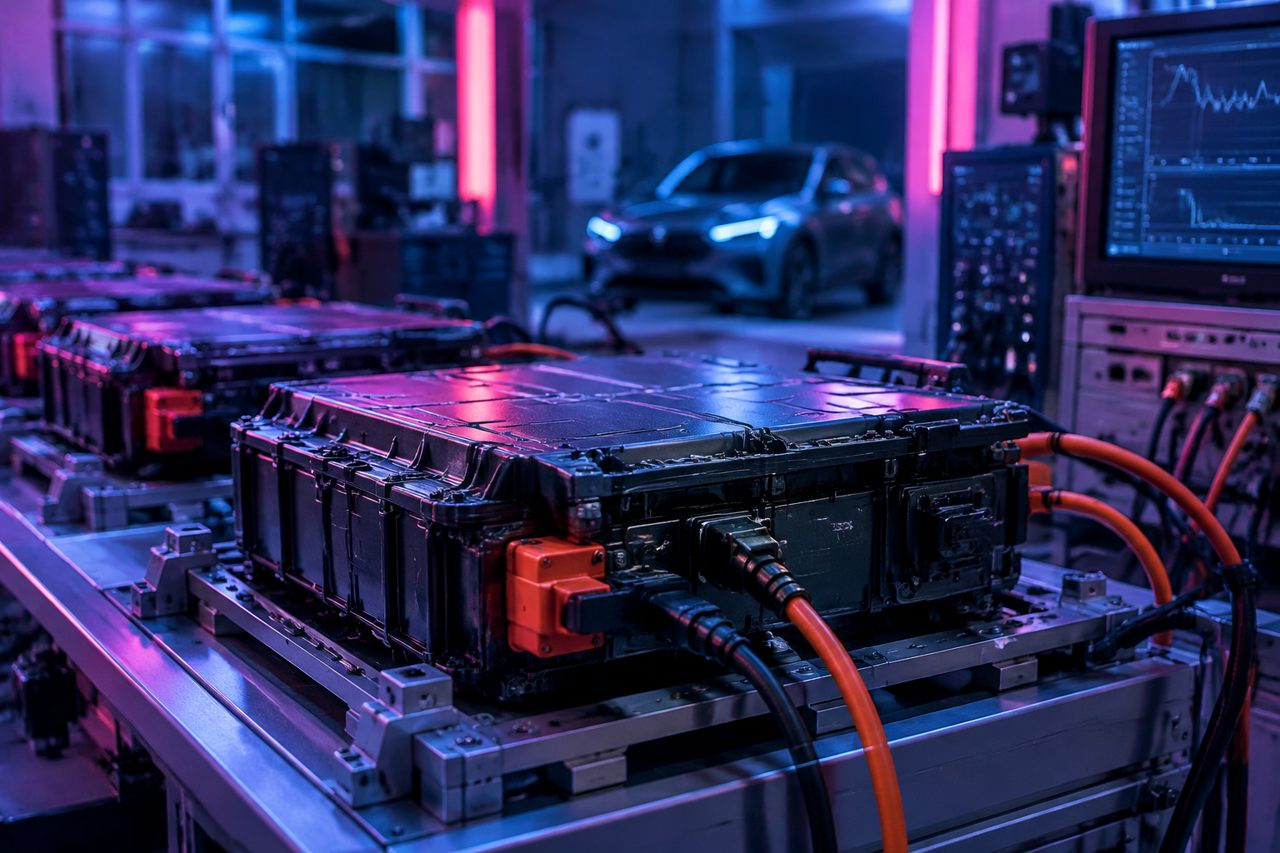
Yesterday beneath a car’s floor, tomorrow behind a warehouse storing solar electricity: giving batteries a second life looks like the ideal scenario. It extends the use of an expensive asset and delays its treatment as waste. But a battery removed from a vehicle does not automatically make a good stationary battery. Looking ahead to September 2026, the decisive question is no longer purely technical: when is reuse genuinely preferable to recycling? Industrial trends already documented provide a framework for making that decision; their future development remains uncertain.
A battery can leave the road without being exhausted
For a car, losing capacity means losing range. For a building equipped with solar panels, it may simply mean storing electricity for a shorter period. Stationary storage also accommodates greater weight and bulk. This is why a battery that has become less attractive to a driver can still provide several years of service in a less demanding application.
This possibility is not merely theoretical. Nissan and its partners have used second-life car batteries in stationary installations, including at Amsterdam’s Johan Cruijff ArenA stadium, in a system combining new and reused batteries. Renault has also developed storage projects using batteries from electric vehicles. These installations demonstrate feasibility, not universal profitability: each has its own sourcing, integration and operational constraints.
A sound assessment goes beyond remaining capacity
A residual capacity of around 70 to 80% is often cited when discussing the end of automotive use. Yet this benchmark is neither a rule for retirement nor a clean bill of health. A battery can retain substantial energy capacity while exhibiting high internal resistance, an insulation fault or highly uneven cell ageing. Conversely, a lower-capacity but consistent pack may be suitable for moderate stationary use.
Assessments must therefore examine thermal history, fast charging, periods spent at a high state of charge, any accidents and differences between cells. The battery management system, or BMS, provides valuable clues, but its estimates cannot replace every test. When data is missing or difficult to access, refurbishers must compensate with measurements, time and a margin of caution.
Three conditions, three possible paths
- A healthy, documented and consistent pack: reuse of the entire pack deserves consideration, particularly if its electronics remain usable.
- A few faulty modules in an otherwise healthy pack: repair may make sense, provided disassembly and matching remain affordable.
- Significant damage or an uncertain history: recycling may be the safest route, once the battery has been made safe and arrangements for appropriate handling are in place.
The intended application matters just as much. Occasionally storing surplus solar electricity does not impose the same demands as supplying substantial power to the grid every day. A successful second life starts with matching the equipment’s actual condition to the service required, rather than finding an outlet at any cost.
Refurbishment: much more than changing the casing
A cheap used battery does not necessarily deliver cheap storage. Collection, regulated transport, safety procedures and assessment must all be organised. Depending on the project, these are followed by disassembly, component replacement, cooling modifications and the integration of a new control system. The finished system must also meet the safety, insurance and grid connection requirements applicable to its installation.
The economic trap lies in diversity. Packs from different generations have different dimensions, connectors and software. Some bonded or highly integrated assemblies make separating modules more difficult. An operation receiving a steady supply of a familiar model can standardise its processes at industrial scale; a workshop receiving disparate batteries risks having to perform numerous bespoke tasks.
The relevant price is therefore not the cost per kilowatt-hour recovered, but the cost of the service delivered over time. It must account for efficiency, actual usable capacity, availability, maintenance and potential replacements. A short or limited warranty can also increase financing costs. For an operator, a breakdown can represent more than the value of the cells: it can interrupt operations or result in lost contractual revenue.
The unexpected competitor: the new battery
Reuse is not measured solely against destroying an object that still has value. It competes with new batteries designed from the outset for stationary storage. Lithium iron phosphate cells, or LFP, have become widespread thanks to their competitive cost, durability and favourable thermal stability. They do not eliminate fire risk, but they offer an industrial foundation particularly well suited to many stationary projects.
Price declines across the industry, despite fluctuations, are narrowing the economic scope for refurbishment. A standardised new system can offer clearer warranty terms, consistent performance and simpler integration. If this competitive pressure continues in 2026, some second-life projects could lose their advantage, even when batteries are acquired cheaply. This scenario is not a firm forecast, however: prices vary by market and contractual terms.
Earlier recycling can also make sense
Recycling recovers materials that can return to production. Its economic appeal depends heavily on chemistry: batteries containing nickel and cobalt generally have a higher material value than LFP batteries. The latter remain recyclable, but their processing is harder to finance solely through sales of recovered materials. Processes, available volumes and regulatory obligations therefore all weigh in the equation.
Environmentally, extending use is worthwhile if it genuinely avoids the manufacture of another piece of equipment and provides a useful service. The benefits become less clear when long-distance transport, extensive refurbishment or poor efficiency are involved. Reuse and recycling are, above all, two possible stages in the same chain. Delaying recycling is beneficial only if the additional years of service justify the work required.
Traceability could help determine the best option
The European battery regulation, adopted in 2023, is gradually strengthening sustainability and traceability requirements. The digital passport planned from 2027 for certain categories, including electric vehicle batteries, could make useful information easier to access. It will not provide an automatic diagnosis, but should reduce some of the uncertainty. For businesses involved in reuse, knowing a pack before buying it can matter as much as knowing how to dismantle it.
What next? The second-life sector stands to benefit from becoming more selective, rather than seeking every available pack. Consistent, traceable batches that are easy to integrate remain its best candidates; packs that are too degraded or too expensive to assess can go straight to recycling. Progress will mean directing each battery towards the best demonstrable use, backed by a robust assessment, full cost accounting and a credible environmental evaluation.