On the label, two lines: cotton, polyester. In the factory, a headache. The fibers are twisted together, dyed, stitched, sometimes blended with elastane. A zipper runs through it all. Turning this garment into another takes more than shredding it: recyclers need to know what it contains, then recover materials clean enough to go back into production. The bottleneck in textile circularity lies as much in sorting as in recycling itself. Looking ahead to September 2026, this connection represents one of the sector’s decisive industrial challenges. Here is why, drawing on established facts and clearly distinguished prospects.
The garment: an assembly designed to last
The cotton-polyester blend is no technical aberration. It combines cotton’s comfort and absorbency with polyester’s strength and quick-drying properties. Elastane adds stretch. Surface treatments can improve colorfastness or make fabric water-repellent. These are all useful qualities that become obstacles when each component needs to enter a separate processing stream.
The problem goes beyond the composition listed on the label. A sweatshirt may have a mostly cotton body, synthetic seams, elastic ribbing and a printed design. A coat adds a lining, membrane and padding. The label describes certain parts, but does not necessarily provide the chemical map a recycler needs. And on a used garment, it may have disappeared or become illegible.
It is also important to distinguish between recycling loops. Turning a T-shirt into a rag or insulation makes use of a resource without producing a new textile fiber. Fiber-to-fiber recycling sets a higher bar: obtaining material that can be made into new yarn. Purity, fiber length and polymer properties then become decisive.
Sorting quickly is not enough: accuracy matters
At a sorting center, the first decision should still concern reuse: a wearable garment is generally better worn again than destroyed to recover its material. For items that cannot be reused, a second, much more technical selection process begins. Each recycling process accepts a different mix and has a different tolerance for unwanted components.
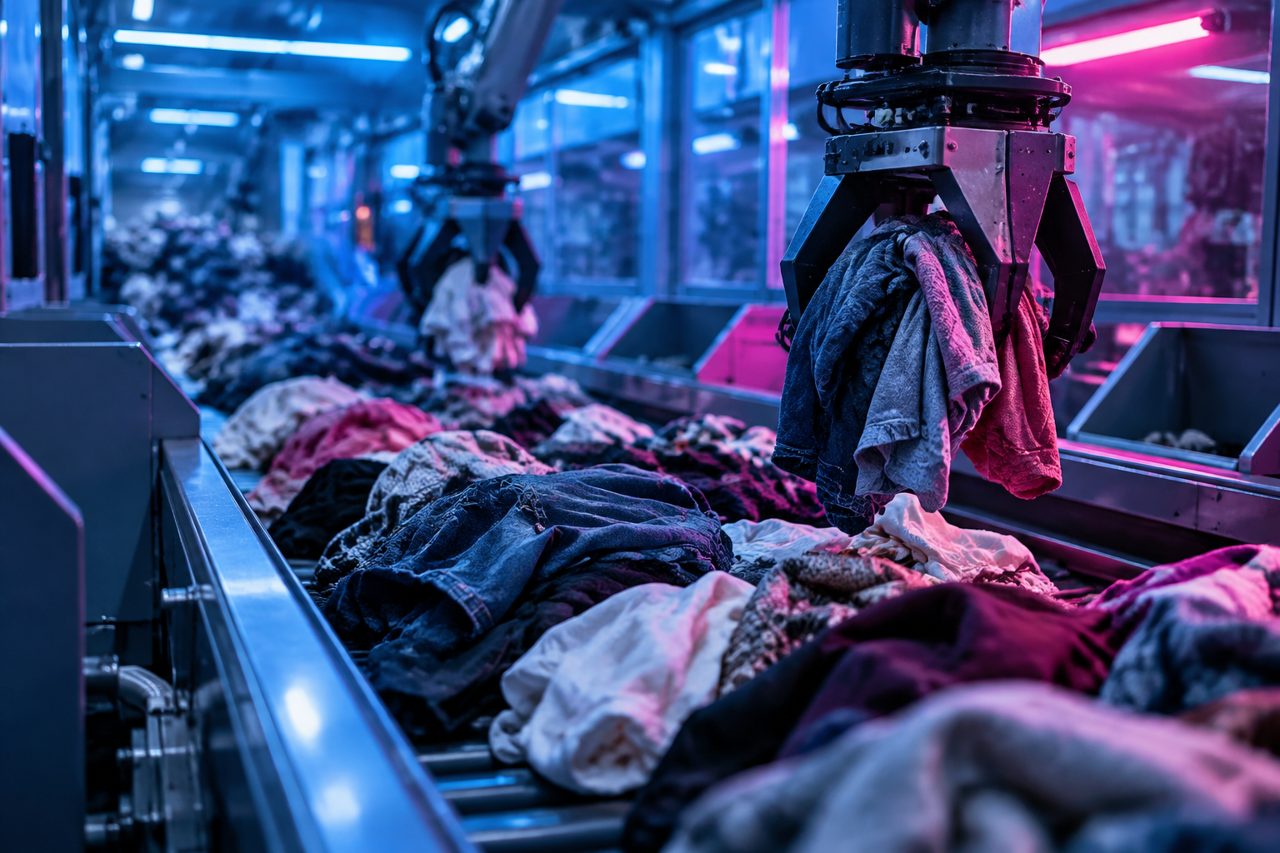
Near-infrared spectroscopy is among the technologies already used to identify materials. It illuminates the textile and analyzes its spectral response, a kind of signature that allows certain fibers to be identified. Coupled with conveyors and ejection systems, it can speed up an identification process that would be impossible to carry out at scale simply by reading labels.
But the sensor is not all-knowing. It mainly examines accessible surfaces. Multilayer fabrics, coatings and certain colors can complicate the analysis. Distinguishing pure cotton from a blend is one thing; reliably measuring a small proportion of elastane is another. Machine vision helps identify shapes, accessories and colors, but does not replace composition analysis.
The Siptex industrial facility, inaugurated in Malmö in 2020, illustrates this expansion of automated sorting. Above all, it shows that the challenge is not simply to identify textiles: it is to produce consistent batches that meet recyclers’ needs. A bale of well-characterized material becomes an industrial product; a bale of uncertain composition remains a risk.
Chemical separation: several routes rather than a single formula
Recovering fibers without degrading them too much
Mechanical recycling opens up and shreds fabrics. Relatively straightforward, it often shortens fibers, particularly cotton fibers. To produce sufficiently strong yarn, manufacturers may need to incorporate virgin fibers. Blends also remain in the recovered material: shredding does not spontaneously turn a cotton-polyester fabric into two separate stocks.
Chemical approaches seek to overcome this limitation. Some dissolve the cellulose in cotton to prepare a material for manufacturing new cellulosic fibers. Others break polyester down into intermediate molecules, which are then purified and repolymerized. Still others use selective separation: treating one component while preserving the other as much as possible. These categories encompass processes with different levels of maturity and performance.
The real challenge: everything that comes with the fiber
In these operations, dyes do not magically disappear. They must be extracted, broken down or managed in residual streams. Finishes, adhesives and prints can disrupt reactions or contaminate the resulting material. Buttons, rivets and zippers, meanwhile, often require mechanical preparation, with fabric lost around the areas removed.
Elastane is a particularly troublesome unwanted component for certain processes. Even a small amount can sometimes complicate purification or compromise the expected quality. There is therefore no universal threshold for “recyclability.” A blend accepted by one facility may be rejected by another. The right question becomes: recyclable by which process, at what yield and for which end use?
A factory cannot survive on demonstration projects
Renewcell’s trajectory is a reminder of the gap between technical success and economic viability. The Swedish company, which converted cellulose-rich textiles into pulp for regenerated fibers, filed for bankruptcy in February 2024. Its assets were acquired a few months later by Altor, under the name Circulose. This episode does not discredit the technology; it highlights the fragility of a market whose entire value chain must move forward together.
A recycling facility needs reliable supplies, but also buyers willing to qualify its material and commit to purchasing it. When competing with virgin fibers produced on a vast scale, collection, sorting and purification costs weigh heavily. The European requirement for separate textile collection from January 2025 addresses the first link in the chain, without automatically guaranteeing fiber-to-fiber end markets.
Then there is the environmental footprint. Dissolving, heating, washing and purifying consume energy, water and reagents. The benefits of a process must be assessed against its yields, solvent recovery, energy supply and the virgin material it actually replaces. A successful demonstration using clean offcuts does not prove equivalent performance on heterogeneous used garments.
Designing for tomorrow’s machines
The most credible prospect for 2026 is therefore not a universal machine that swallows every garment. It is a set of specialized, better-coordinated processing chains: identifying compositions, removing disruptive elements and directing each batch to the right treatment. Upstream, limiting unnecessary blends, making disassembly easier and documenting materials could reduce the work required of factories.
What next? The next decisive advance could be less spectacular than a new solvent: contracts linking brands, sorters and recyclers around shared specifications. If this coordination takes hold, automated sorting will become the tool that truly feeds circularity. Otherwise, collecting more risks doing little more than shifting stockpiles elsewhere. Separating fibers ultimately begins with reconnecting the players.