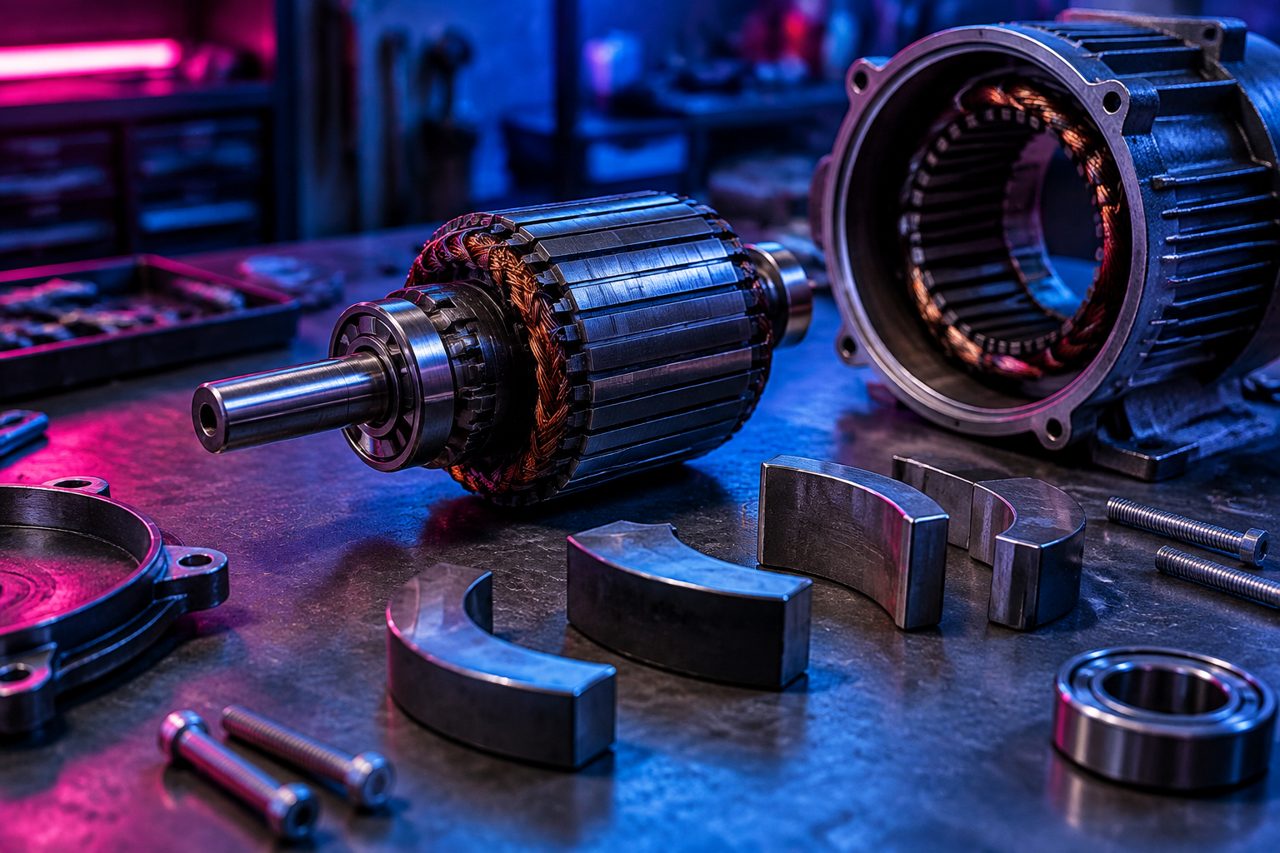
The next rare earth mine may be found in a motor from a crashed vehicle, a dismantled wind turbine or a forgotten hard drive. Inside are magnets, tiny or massive, that are essential to many types of electrical equipment but are rarely recovered to become magnets again. By September 2026, this resource could start to play a greater role. But scattered waste still needs to be transformed into reliable industrial feedstock. The main bottleneck is not just chemical: it is also logistical, economic and commercial.
An unobtrusive component, a strategic dependency
Neodymium-iron-boron permanent magnets, known as NdFeB magnets, deliver strong magnetic power in a compact form. They are used in certain electric car motors, wind turbine generators, robots and electronic equipment, among other applications. Neodymium and praseodymium contribute to their properties; dysprosium or terbium can improve their resistance to high temperatures. These elements belong to the rare earth family.
This dependency stems less from a geological absence than from industrial concentration. China holds a dominant position in rare earth separation and magnet manufacturing. Opening a mine elsewhere is therefore not enough: the entire supply chain must be mastered, through to alloys and qualified components. China’s 2023 restrictions on exports of certain processing and manufacturing technologies underscored the strategic importance of this expertise.
Recycling could diversify part of the supply, without relying solely on new mining projects. But oversimplification should be avoided: not all electric cars and wind turbines use rare earth magnets. Some designs do without them. Assessing the available resource requires knowing which technologies are used in the equipment, not simply counting vehicles or installed megawatts.
The resource exists, but it will not arrive on its own
Imagine a motor delivered to a treatment facility. Its housing contains aluminium, its windings copper and its mechanical parts steel. Established recovery channels exist for these materials. The magnets, however, may be glued in place, enclosed within the rotor or difficult to identify. If the entire assembly is shredded without targeted extraction, their specific value may be lost in metal fractions destined for other uses.
The problem therefore begins before recycling. The right equipment must be identified, transported and opened safely, and the magnets then removed without adding excessive labour hours. Their magnetic pull makes handling more difficult; adhesives, coatings and geometries vary. An operation that is profitable for a uniform batch can become costly for a mixture of unfamiliar motors.
Waste streams with widely varying accessibility
Manufacturing scrap is the simplest starting point: it is concentrated, relatively clean and of known composition. Next come certain commercial batches, such as hard drives from data centres. Small devices scattered across households are harder to collect. Large machines, meanwhile, can contain substantial amounts of material, but are replaced infrequently.
This timing matters. A car or wind turbine can operate for a long time before becoming waste. Current sales therefore do not represent an immediately recyclable stock. Over the next few years, industrial scrap and equipment already nearing the end of its life are likely to remain crucial. Recycling alone will not be able to meet demand driven by the expansion of the installed base.
Two routes to recovering value
Returning to the chemical elements
One group of processes involves treating magnets to recover their rare earths, notably through hydrometallurgy. Following preparation, chemical solutions dissolve the materials; several subsequent stages separate and purify the target elements. Thermal processes may also be involved. This approach offers some flexibility in handling waste, but requires careful management of reagents, effluents, energy and impurities.
The result is not automatically a new magnet. Depending on the process, the output may be oxides, for example, which must still be converted into metals and then alloys. The recovery yield therefore tells only part of the story. The entire chain, its resource consumption and its end markets must be examined, rather than presenting every kilogram recovered as a kilogram ready for immediate reuse.
Preserving the alloy, shortening the process
Another route seeks to retain more of the original value. Some processes use hydrogen to break magnets down into powder, which is then prepared for manufacturing new magnets. These short-loop approaches, explored in European programmes such as SUSMAGPRO, avoid routinely starting again from separated elements. They could reduce certain resource requirements, depending on the quality of the feedstock and the treatments needed.
They come with a demanding constraint: the material must be understood and controlled. Corrosion, adhesives, coatings or mixtures of alloys can compromise the result. The composition sometimes needs to be adjusted with virgin material. And a carmaker does not simply buy recycled powder: it demands reproducible magnetic performance, proven heat resistance and demonstrated durability.
Europe sets a framework, but collection is not yet automatic
The European Critical Raw Materials Act, which entered into force in 2024, sets a 2030 benchmark for recycling capacity equivalent to at least 25% of the Union’s annual consumption of strategic raw materials. This figure covers a range of materials: it is neither a rate already achieved nor a uniform recycled-content requirement for every magnet.
The legislation also provides for phased information requirements on permanent magnets in certain product categories. Identifying their presence, composition and location is intended to make recovery easier. This is a practical lever: a recycler works more effectively with dismantling documentation than with an unidentified rotor. Over time, equipment design should increasingly account for this second life.
Profitability depends on both the workshop and the contract
An efficient plant is not enough if it lacks feedstock. Operators need predictable volumes, while manufacturers want consistent quality and competitive prices. Yet rare earth prices fluctuate: a fall in virgin material prices can undermine an industry still scaling up.
The most resilient model could combine collection contracts, specialised dismantling and long-term purchase commitments. Reusing a functioning motor nevertheless remains preferable to destroying it for its magnets. The challenge is to recover the material at the right time, once reasonable repair or reuse options have been exhausted.
What next? By September 2026, the decisive advance may come less from a new laboratory formula than from complete supply chains capable of tracking a magnet from dismantling through to its incorporation into a certified product. Projects will need to be judged on the volumes they actually process, their environmental performance and their customers, not just their announced capacity. This mine already exists; the task now is to organise its operation without promising that it will replace all the others.