At a time of the democratization of the Internet of Things, associated technologies and with Arduino Day 2016 approaching, it is useful to reflect on the place of the Internet of Things in the possible digital transformation of Africa and its capacity to address the challenge of information production in particular and content in general.
While it is undeniable today that Africa is the continent that has benefited most from the rise of mobile phones and invented mobile payment, it is legitimate, in the face of ambient self-satisfaction, to wonder if the digital revolution in Africa will stop at the smartphone? Or not?
The near-ubiquity of mobile and the significant increase in the number of application developers has caused an explosion in the number of mobile and web platforms in Africa, as well as an automatic increase in the number of their users.
Professional sectors and trades have unfortunately not yet truly benefited from this mobile explosion. Very few platforms have developed in Agriculture, telehealth, weather, or corporate logistics, to name but a few. A recent flagship report from the World Bank entitled “Digital Dividends” highlights the fact that, despite the democratization of mobile on the continent, the benefits of digital technologies have not spread sufficiently into the African economy and have not yet affected the lives of a significant number of Africans through innovation, inclusion, and efficiency.
In the age of today’s semantic web, it is unfortunately notable to see that Africa has so far stopped at the social internet. Moreover, it is easy to observe that 90% of access to the network of networks in Africa in recent years corresponded to a connection to social media.
The main shortcomings remain linked to the issue of local content, the reliability of data produced by users with low literacy, a nascent digital culture, and who unfortunately still only have episodic access to this global wonder that is the Internet.
The main gap to fill is therefore unfortunately that of the automatic production and acquisition of reliable data generating value for professional sectors such as soil moisture, temperature, river levels for agriculture, and presence for logistics, to name but a few.
The sad reality is that the mobile, a formidable tool today, remains associated with data access and transmission, and to complete its digital revolution, Africa and its young engineers will have to turn irremediably towards the data production and capture industry, industries without which technology sectors such as task automation, big data, artificial intelligence, deep learning, and machine learning will remain inaccessible to the black sub-continent.
It is precisely here and in such a context that the Internet of Things and related technologies (sensors, low-bandwidth networks) take on their full meaning in the completion of digital appropriation by African peoples. The business models that have dominated the digital sector over the past ten years are those that consider data as a superior asset, and all technologies that, like connected objects, contribute to producing it are inexorably called upon to develop.
It is therefore properly speaking a matter of staying in tune with the times and adapting to the requirements of the world for Africa regarding the appropriation of the Internet of Things.
The connected object: what is it, and what are its uses?
A connected object is equipment capable of providing physical data autonomously and automatically via the Internet, without user intervention. Autonomy, automation of data supply, and the absence of intervention by any user are among the characteristics that distinguish a connected object from a smartphone or even Google Glass, which are strictly speaking only web interfaces or object-interfaces.
Connected objects have taken on a new dimension in recent years, with the appearance of the semantic web, in fields such as agriculture, logistics, quantified self, equipment life monitoring, health, etc. They are at the base of the evolution of certain trades (livestock, agriculture, health) or transforming certain industries (tracking, logistics) and beyond, the very relationship of the company with its customers through the now famous concept of the product-service.
Diverse and varied uses range from real-time livestock supervision to measuring user satisfaction, collecting real-time weather data, detecting environmental phenomena such as floods and earthquakes, supervising chronic pathologies (diabetes, heart failure, kidney failure) in African rural areas, parcel tracking, hygrometry measurement for smart irrigation, tracking a cashew nut delivery truck, elevator monitoring, user assistance, parking space management, optimization of public bin collection routes, etc.
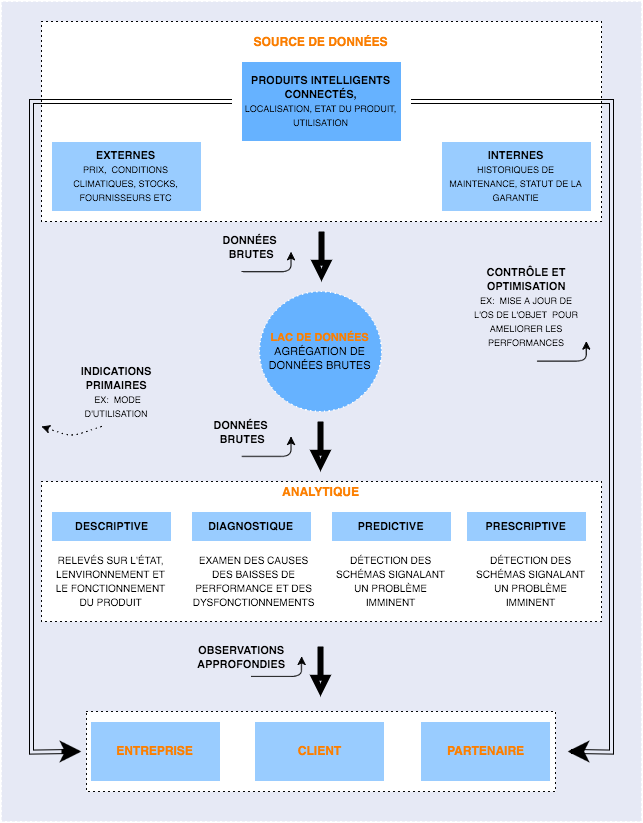
In a continent where organizational structures do not concern themselves with reporting statistical information, where digital-based information systems are often non-existent and where customer knowledge is not yet a reality, data collected by smart connected objects generates information that will allow customers, companies, and partners to optimize performance.
Simple analytical tools applied by each product to its data provide a first level of benchmarks. More advanced analytics, often outside the connected object, allows for more advanced observations, based on data drawn from both the products and the internal and external resources of the organization.
The Internet of Things, the opportunity for a technological leap for Africa
The democratization of the Internet of connected objects therefore represents a major opportunity for African societies in view of the potential glimpsed and future uses.
This democratization involves in particular the mastery of related technologies such as electronics, sensors, and disciplines related to data storage and manipulation, the development of integrated applications and operating systems, analytics, etc… and by setting up an appropriate technological infrastructure consisting of high-performance low-bandwidth data networks, datacenters, and a continuous, stable, and high-quality energy supply.
This, it seems to me, is the price to pay to accomplish Africa’s digital revolution and perform the technological leap that we all hope for.