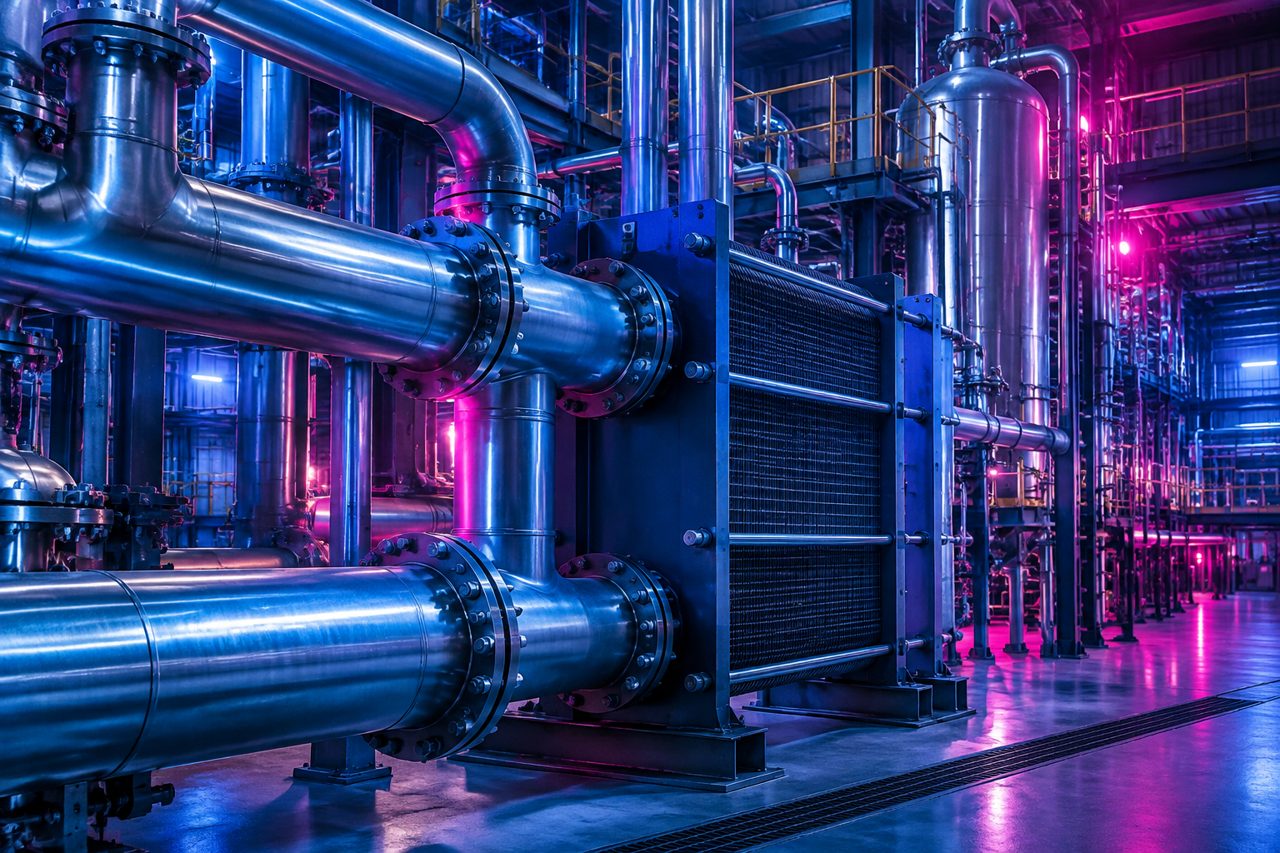
In a factory, heat sometimes escapes through chimneys. But it also leaves, less visibly, through wash water, cooling circuits or humid air from dryers. Long regarded as waste, this energy can become a resource. Industrial heat pumps promise to recover it to supply other operations at a higher temperature. Looking ahead to September 2026, the challenge is no longer simply to prove that this works: it is to identify configurations in which this loop becomes technically robust and economically compelling.
A machine that raises the temperature of available heat
The principle resembles that of a domestic heat pump: extract energy from a relatively cool source, then release it at a higher temperature using an electricity-driven thermodynamic cycle. In industry, the source is not necessarily outdoor air. It may be process water that is already warm, which improves the energy balance.
Imagine a dairy that cools certain products while heating water for cleaning. Rather than rejecting heat from the first operation and burning gas for the second, a system can connect the two. The same reasoning applies to a brewery, a paper mill or a food processing plant, with different hygiene and operational constraints.
The first question, however, remains: can this heat be reused without a heat pump? A heat exchanger is sometimes enough. This less complex form of direct recovery should be considered before adding a machine. A heat pump becomes relevant when a temperature gap must be bridged that passive heat exchange cannot overcome.
The temperature barrier is starting to give way
Equipment capable of producing hot water at moderate temperatures already has a solid operating track record. Advances are now taking place at higher temperatures: commercial offerings and demonstration systems are targeting applications between 100 and 160 °C, or even higher depending on the technology. These levels are relevant to drying, certain distillation processes and low-pressure steam production.
The European DryFiciency project, in particular, demonstrated heat recovery for drying processes at temperatures reaching around 160 °C. This work helped move high-temperature technology beyond the laboratory. It does not, however, mean that a standard machine can replace any boiler, anywhere, without adaptation.
Reaching still higher temperatures remains demanding. Refrigerants, compressors, lubricants, heat exchangers and seals must withstand new conditions. Some designs use multiple stages or combine several cycles. Mechanical vapour recompression, already used in industry, also belongs to this family of solutions that upgrade available heat rather than generating it entirely from scratch.
It is therefore important to distinguish between a stated temperature, measured performance and availability demonstrated over several years. The outlook remains promising for low- and medium-temperature heat. Cement kilns and certain steelmaking processes, however, do not become immediate applications through simple extrapolation.
The real work lies in connecting operations
On the ground, a project starts less with a catalogue than with a map: where is the heat, at what temperature, for how many hours, and how far from where it is needed? A source that is abundant on Monday does not necessarily serve a process that runs mainly at weekends. An annual average can conceal these mismatches.
Integration then requires practical decisions. Should the system heat a process directly, preheat boiler feedwater or supply a shared loop? Lowering the temperature required by an operation may be more cost-effective than seeking an ever-hotter machine. A thermal storage tank, meanwhile, can absorb some mismatches between production and consumption.
Effluents also impose their own constraints: fouling, corrosion, particles or hygiene requirements. An intermediate circuit sometimes protects the installation, at the cost of an additional heat exchange step and a loss of performance. Finally, a factory cannot always shut down for construction work: connections, testing and maintenance must fit into its schedule, with backup where continuity requires it.
Electricity versus gas: the decisive equation
The coefficient of performance, or COP, is the ratio of useful heat delivered to electricity consumed. A COP of three means that one unit of electricity delivers three units of heat, with the remainder coming from the recovered source. This is not miraculous efficiency: the machine moves energy that is already present.
The greater the temperature gap to be bridged, the more this advantage tends to diminish. A COP quoted for favourable conditions is therefore no guarantee of annual performance. Load variations, auxiliary pumps, shutdowns and changing temperatures must all be included in the calculation. What matters is the performance of the complete system in operation.
A simplified comparison involves dividing the electricity price by the COP, then comparing the result with the fuel price adjusted for boiler efficiency. Investment, maintenance, electrical connection and, depending on the site, carbon costs must also be added. If electricity is expensive relative to gas, even excellent technology can remain difficult to finance.
Conversely, regular use, a stable heat source and a suitable electricity contract strengthen the business case. Subsidies can reduce the initial investment, but they cannot provide a lasting fix for poor integration. Initial studies should test several price scenarios rather than treating one year’s energy market conditions as a certainty for the next fifteen years.
Decarbonising without shifting the problems elsewhere
The climate benefit depends on the fuel displaced and the electricity used. In a relatively low-carbon electricity system, such as France’s, replacing a fossil-fuel boiler with an efficient heat pump generally offers a substantial benefit. Elsewhere, the balance warrants closer scrutiny. The refrigerant and any leaks also matter.
The 2024 revision of the European regulation on fluorinated gases makes this choice even more important. So-called natural refrigerants, such as ammonia, CO₂ or certain hydrocarbons, offer options, but each comes with constraints: toxicity, high pressures or flammability. The best refrigerant depends on the process, the site and the expertise available to operate the system.
Scaling up also requires teams capable of bringing together refrigeration engineering, industrial processes and energy operations. To convince a factory manager, a promise of lower emissions is not enough. There must be a clear commitment on availability, verifiable performance and a maintenance organisation that remains effective after the project team leaves.
What next? For September 2026 and the years that follow, the most credible scenario is targeted expansion, not wholesale boiler replacement. Food processing, paper manufacturing and certain chemical processes could see a growing number of projects where waste heat and demand coincide. Higher operating temperatures will broaden the scope, but the main winners will be sites capable of rethinking their heat flows and securing competitively priced electricity.