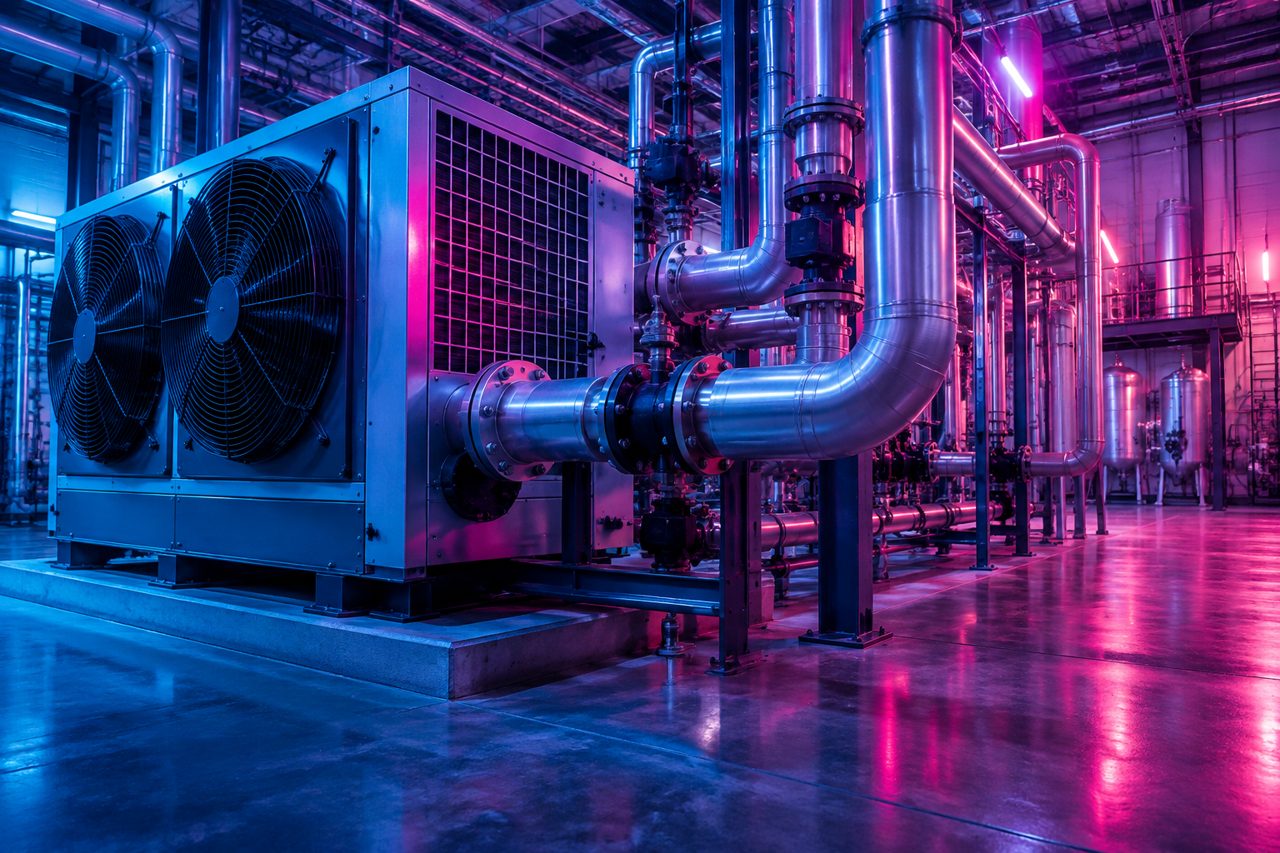
In a dairy, heat escapes while the boiler keeps running. On one side, refrigeration units cool products; on the other, gas heats the water needed for cleaning or processing. The industrial heat pump offers a way to connect these two worlds. Looking ahead to September 2026, its appeal extends far beyond heating buildings: turning lukewarm waste heat into a productive resource. Developments already documented point to a new phase in industrial electrification; the pace of deployment, however, remains an open question.
Waste heat becomes a raw material
The principle resembles that of a refrigerator operating in reverse. A fluid captures heat at a low temperature, then a compressor increases its pressure and temperature. This energy can then be delivered to an industrial process. Electricity is therefore not used simply to generate heat: its main role is to move that heat to a level where it becomes useful again.
The source may be cooling water, an effluent stream, exhaust air or heat rejected by a refrigeration system. This waste heat, inevitably generated by a process as it currently operates, is not automatically available, however. It may be dispersed, corrosive, intermittent or too far from where it is needed. Before choosing a machine, operators must map the flows, their temperatures and their operating schedules.
The first rule is not to complicate what can remain simple. If a heat exchanger can directly preheat water using a hot waste stream, it will often be preferable. A heat pump comes into play when this direct recovery is no longer sufficient, particularly because the required temperature is higher than that of the source.
Raising temperatures without promising the impossible
Industrial equipment supplying hot water at moderate temperatures is nothing new. Innovation is focused on higher temperatures, large capacities and the ability to operate reliably over time in demanding environments. The International Energy Agency’s work on high-temperature heat pumps has documented this diversification, with commercial offerings and demonstration systems whose maturity varies by application.
Solutions exceeding 100 °C already exist. At around 150 °C, the possibilities are expanding, but track records, working fluids and system designs must be assessed on a case-by-case basis. At around 200 °C and above, some technologies are still progressing through demonstrations and initial applications. A stated temperature is not a universal guarantee of performance.
The decisive factor is the gap between the source temperature and that of the heat delivered. Recovering a stream at 80 °C to meet a demand at 120 °C is generally more favorable than starting with water at 20 °C. The greater this temperature lift, the more work compression requires. Producing steam adds constraints involving pressure, control and integration into the existing network.
Three industries, three practical applications
Food processing: bringing heating and cooling together
Dairies, breweries and processing plants are promising settings: they often need cooling and heat simultaneously. A heat pump can harness energy from the refrigeration circuit to produce hot water for cleaning, preheating or certain heat treatments. The benefits become particularly attractive when both services are genuinely useful at the same time.
The difficulty lies less in the principle than in day-to-day operation. Production runs change, cleaning creates peaks in demand, and hygiene requirements call for strict separation of circuits. Hot-water storage can bridge a gap of a few hours between heat recovery and use. It cannot, however, solve a prolonged lack of demand for that heat.
Paper: tackling drying
In papermaking, drying is a major energy consumer. Moist exhaust streams and water circuits offer opportunities for heat recovery, but harnessing them requires dealing with fouling and the temperature levels needed by the machinery. The aim is often to reduce a portion of steam consumption rather than immediately replace the entire boiler plant.
Mechanical vapor recompression, already used in certain evaporation processes, follows the same principle of upgrading heat. It compresses vapor to make its heat usable again. This is not a sudden breakthrough: innovation also lies in extending its applications and integrating it with other equipment.
Chemicals: targeted opportunities
The chemical industry encompasses a wide range of needs. Preheating, evaporation and certain separation processes can benefit from a heat pump; reactions requiring temperatures of several hundred degrees do not magically become accessible. A detailed analysis of heat exchanges can identify points where a few dozen additional degrees make a waste stream useful. Material compatibility and safety remain critical.
Profitability hinges on two meters
The coefficient of performance, or COP, is the ratio of heat supplied to electricity consumed. A COP of three means that three units of heat are delivered for one unit of electricity. This figure must nevertheless be assessed under real-world conditions: variable temperatures, part-load operation and auxiliary power consumption can significantly alter the overall balance.
An illustrative example clarifies the trade-off. With electricity three times more expensive than gas per unit of energy and a COP of three, the energy cost of the heat approaches that of the fuel before boiler efficiency is taken into account. Boiler losses and carbon costs can favor the heat pump. But capital expenditure, maintenance and the electrical connection still have to be financed.
There is therefore no single payback period that applies to every factory. An installation running almost all year round recoups its equipment costs more easily than a seasonal production facility. Energy contracts, network tariffs and available electrical capacity matter as much as the stated efficiency. The climate impact also depends on the electricity consumed and the fuel being replaced.
The real challenge: integration, guarantees and operation
Beyond the compressor, a project includes piping, heat exchangers, automation and sometimes storage. Refrigerants must balance performance, safety and regulatory compliance, particularly in the context of tighter European rules on fluorinated gases adopted in 2024. A fluid with a low climate impact may require other precautions because of flammability, toxicity or high pressure.
For industrial operators, continuity of production remains the priority. Retaining a backup boiler can safeguard the transition and cover peak demand. Contracts are better served by guaranteeing performance across an operating range rather than efficiency measured at a single ideal point. The expertise of maintenance teams then becomes an essential component of innovation.
What next? The most plausible path forward involves targeted installations combining available waste heat, steady demand and a reasonable temperature lift. If high-temperature equipment becomes more reliable and the ratio between electricity and fuel prices becomes favorable, more processes will be able to make the switch. The next advance will not necessarily be a record temperature: it will be recovered heat delivered with guaranteed performance at a competitive cost for years.