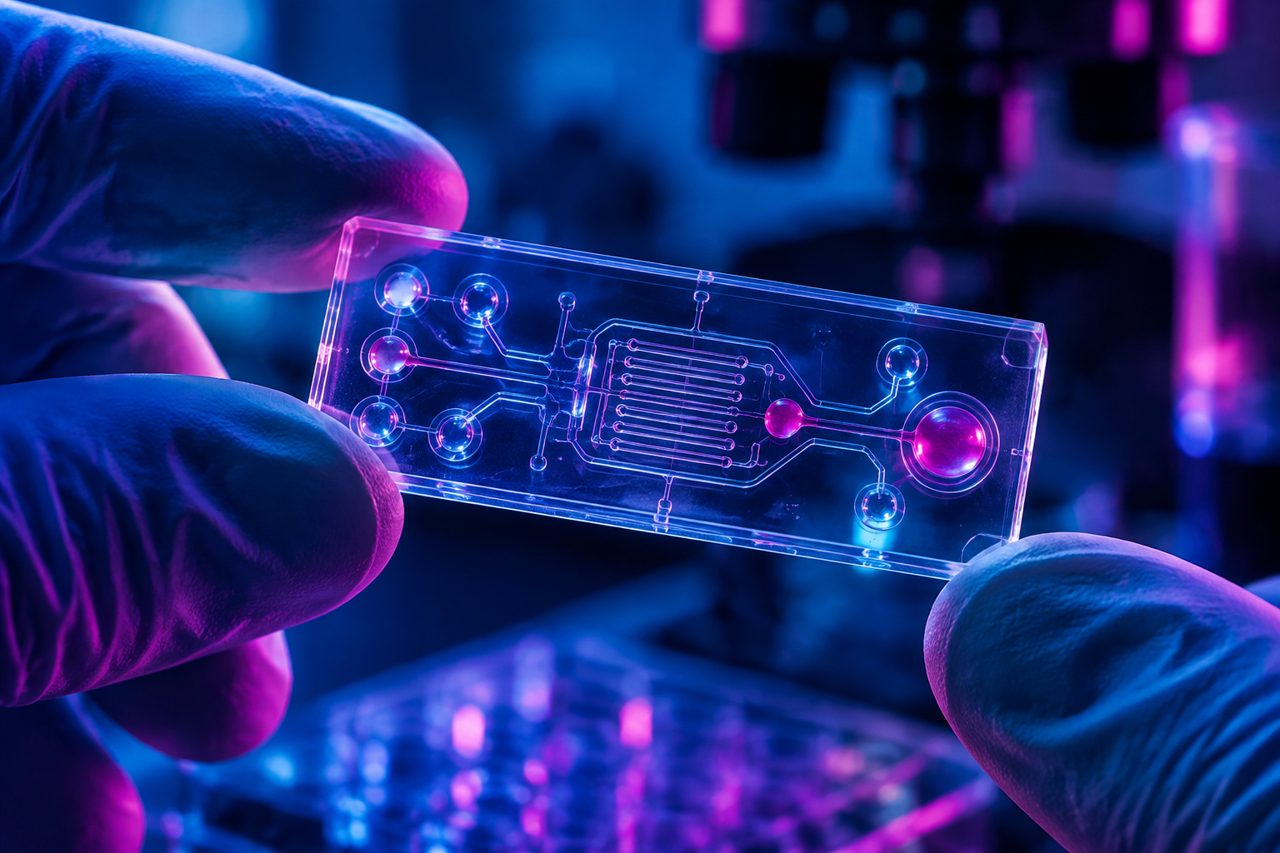
A fragment of lung that stretches, a liver supplied with nutrient-rich fluid, an intestinal barrier exposed to a drug: these experiments fit onto devices just a few centimeters across. Organs on chips are neither complete organs nor electronic gadgets. They aim to bring laboratory testing closer to human physiology. For the pharmaceutical industry, the stakes are concrete: identifying dangerous or ineffective compounds earlier, before exposing volunteers and launching costly trials. Looking ahead to September 2026, their future depends less on miniaturization than on proving their usefulness.
Living tissue, not a processor
The word “chip” brings silicon to mind. Here, it generally refers to a small, transparent platform threaded with microscopic channels. Human cells are grown on it, sometimes on a membrane separating two compartments. Fluid circulates to deliver nutrients, carry a substance or remove waste. Depending on the organ being studied, the device adds mechanical movement, an oxygen gradient or several cell populations.
In a lung on a chip, an air–liquid interface can sit alongside lung and vascular cells, while a membrane deforms to mimic certain effects of breathing. In a liver on a chip, researchers focus in particular on maintaining the cells’ metabolic functions. The goal is not to replicate an entire organ, but to reproduce the functions relevant to a specific question.
These systems differ from organoids, small three-dimensional clusters of cells capable of self-organization. The two approaches can nevertheless be combined. An organoid placed in a microfluidic environment benefits from controlled circulation; a chip can accommodate tissue more complex than a simple layer of cells.
Why change the tests?
A compound that looks promising in a culture dish may disappoint in humans. Cells grown in flat layers sometimes lose certain properties; animals do not always metabolize substances as we do. Existing models remain useful, but none fully captures the disease, patient diversity and conditions of exposure to treatment.
Organs on chips seek to bridge part of that gap. Fluid circulation makes it possible to study changing exposure rather than simply bathing cells in a drug. Interactions between cells can reveal inflammation, barrier impairment or toxicity that is difficult to observe in conventional culture. Their potential value therefore lies in their biological relevance, not just in reducing animal testing.
The liver is a particularly important area of focus: it processes many drugs and can sustain damage that does not appear in initial tests. A study published in 2022 in Communications Medicine evaluated a liver-on-a-chip platform using a set of drugs with known clinical profiles. It showed encouraging performance in detecting certain forms of liver toxicity. This is a meaningful finding, but not a blanket validation of all chips.
Predicting, rather than reproducing after the fact
The decisive test is easy to state: would the chip have enabled a better decision before the outcome in patients was known? Reproducing an already documented effect is a first step. Correctly predicting the behavior of new compounds in an independent, blinded evaluation sets a higher bar.
It is also necessary to define what “better” means. A device that detects more hazards but rules out too many potentially useful drugs merely shifts the problem. Conversely, missing a serious toxicity can provide false reassurance. Performance must therefore be compared with that of existing methods, using predefined criteria and appropriate reference substances.
The right question, in the right place
An intestinal chip may be relevant for studying the passage of a substance without predicting a systemic immune response. A cardiac model may provide insight into contraction, but not into every heart rhythm disorder. The credible path is to qualify each system for a specific use, rather than promise a “miniature human” capable of predicting everything.
The real obstacle: repeating the same experiment elsewhere
In an expert laboratory, a chip can produce impressive results. But another team must still be able to reach comparable conclusions. The cells’ origin, maturity and storage conditions, the fluid flow rate and the composition of the culture medium all alter tissue behavior. Materials matter too: some polymers can absorb compounds and distort the exposure the cells actually receive.
Reproducibility therefore requires documented procedures, quality controls and measurements of actual exposure. Cells from different donors introduce an additional challenge: their variability may reveal useful differences between people, but it must not mask technical instability. The two must be distinguished.
Automating cell seeding, making pumps more reliable and standardizing readouts can help. This does not eliminate the need for biological expertise. Nor is the relevant cost that of the chip alone: it includes cells, equipment, preparation time, culture failures and analysis. To make a compelling case, a platform must improve a decision important enough to justify that effort.
Regulation opens a door, not a shortcut
In the United States, the FDA Modernization Act 2.0, passed in late 2022, expanded the scope for using non-animal methods to meet preclinical requirements. This development means neither a ban on animal testing nor automatic acceptance of organs on chips. It allows for a broader range of evidence, whose relevance must still be demonstrated.
For a drug developer, the sensible strategy is to discuss the intended use with regulators early on. Is the aim to rule out a compound, explain a toxicity signal or supplement a safety dossier? The scope of the conclusion must remain proportionate to the available validation. Additional data can be useful without, on its own, replacing a regulatory test.
From patient-specific models to organ networks
Cells derived from induced pluripotent stem cells open up the prospect of models carrying some of a patient’s genetic characteristics. Comparing responses to several treatments or exploring rare diseases is conceivable. But cell maturity, production timelines and correspondence with the clinical situation still limit this ambition. Routinely choosing a prescription with the help of a chip remains a prospect, not a widespread practice.
Connecting several compartments—intestine, liver and kidney, for example—could also shed light on what happens to a drug in the body. Each connection, however, adds constraints: compatible culture media, appropriate proportions and controlled circulation. Greater complexity adds value only if it genuinely improves prediction.
What next? For September 2026 and beyond, the most credible scenario is targeted adoption alongside conventional cultures, computational models and other tests. The decisive advances will be prospective comparisons, results reproduced across laboratories and documented decisions. The best chip will not necessarily be the most spectacular: it will be the one that helps abandon a poor compound earlier, without unfairly ruling out a useful treatment.