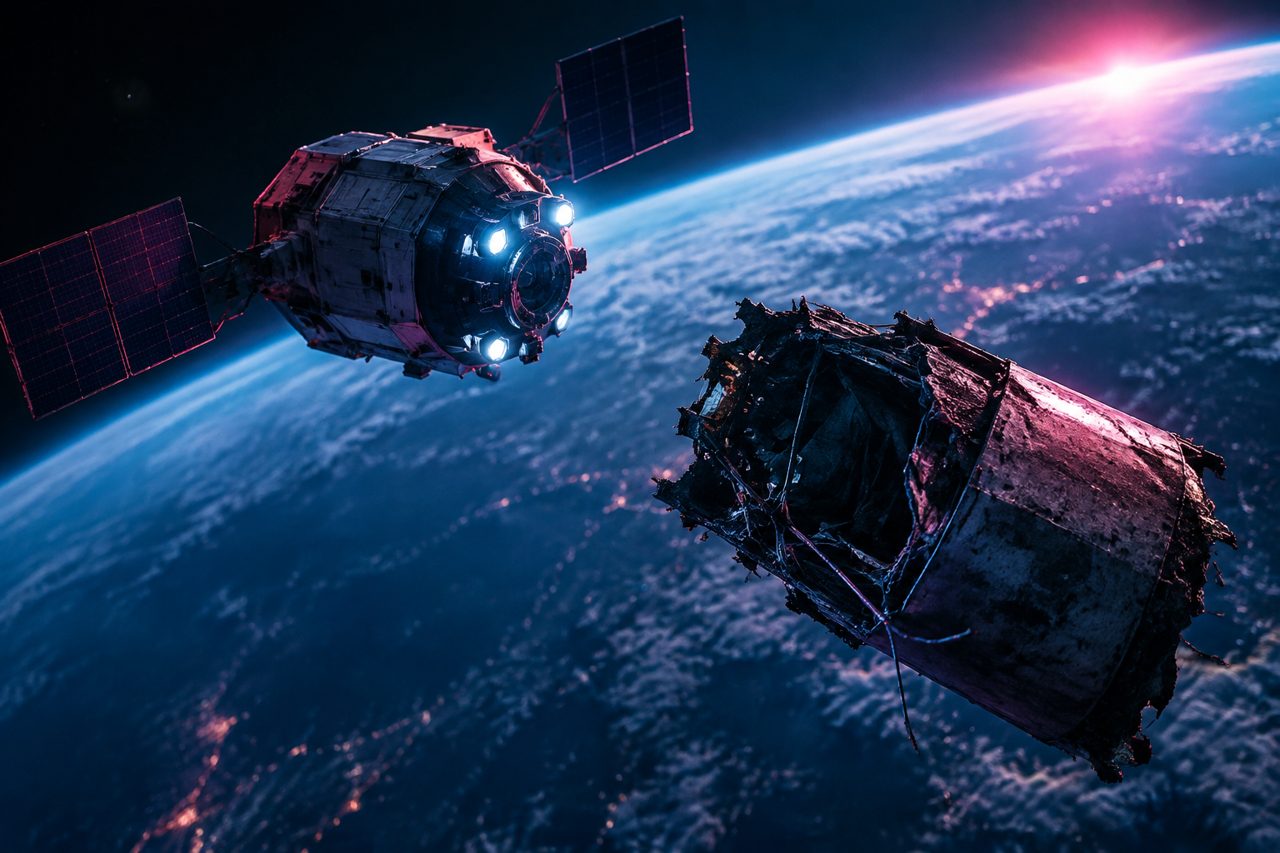
An abandoned rocket stage spins on its axis, with no engine or anyone on board to communicate with. To remove it, another spacecraft must rendezvous with it, understand its movements, attach itself and then arrange its descent without causing a collision. That is the paradox of orbital cleanup: it requires deliberately approaching what every operator is trying to avoid. Astroscale and ClearSpace are tackling this delicate manoeuvre. Their projects show why clearing waste from space is as much a matter of law and money as it is of robotics.
From this September 2026 perspective, the milestones presented below are established events with explicit dates. The developments considered thereafter are forward-looking analysis, not mission outcomes presumed to have been achieved.
A rubbish dump without borders, but not without owners
In low Earth orbit, objects travel at several kilometres per second. A collision can turn two identifiable masses into a multitude of fragments, some too small to track regularly from the ground but fast enough to damage a satellite. The problem therefore extends beyond recently launched spacecraft: old rocket stages and defunct satellites constitute a cumbersome legacy.
Collecting everything would be unrealistic. Active removal strategies instead target objects whose mass, orbit and collision probability make them potential sources of new debris. Removing one large, high-risk object may be more valuable than pursuing a swarm of small fragments. But that still requires choosing an accessible target and obtaining the necessary consent to intervene.
Astroscale: learning to approach before capturing
Japanese company Astroscale reached a milestone with ELSA-d, launched in 2021. This demonstrator paired a servicing satellite with a small target equipped with a magnetic docking plate. Separation and recapture operations tested the concept. But the target had been prepared for the exercise: it did not represent the full difficulty of dealing with genuine legacy debris.
That is precisely what makes ADRAS-J significant. Launched in February 2024 as part of a programme run by Japan’s space agency, JAXA, its mission was to rendezvous with and inspect an H-IIA rocket upper stage abandoned in orbit. Images obtained in 2024 showed a real, non-cooperative object observed at close range. ADRAS-J was an inspection mission, not a capture operation. That distinction is essential to assessing progress without portraying reconnaissance as completed cleanup.
This inspection provides something no old manufacturing records can guarantee: the target’s current condition. Years of radiation, thermal cycling and impacts can alter its surfaces and equipment. Before deciding where to grasp an object, operators need to know how it rotates, which structures remain sound and which parts might break away.
ClearSpace: the challenge of a robotic embrace
ClearSpace, a company that emerged from Switzerland’s space ecosystem, illustrates another approach. The ClearSpace-1 project, commissioned by the European Space Agency in 2020, initially planned to use four robotic arms to capture a Vespa launch adapter left in orbit after a 2013 Vega flight. Unlike a target equipped for docking, this object had not been designed for retrieval.
In 2023, the detection of fragments near this initial target, following what appeared to be an impact, highlighted a harsh constraint: the environment can change while a mission is being prepared. A target selected years earlier must be reassessed. Schedules, configurations and even the objects being targeted can change; a capture concept should not be confused with a service already available on demand.
Capture is only half the job
Synchronising with a silent target
An active satellite transmits its position and can facilitate a rendezvous. Debris provides nothing. The chaser spacecraft must use its sensors to estimate the object’s trajectory and rotation, despite shadows, reflections and a lack of familiar reference points. At close range, guidance and control must incorporate collision-avoidance measures: a mistake could create the very fragments the mission was meant to prevent.
Contact itself changes the entire dynamic. An arm that grabs a fragile structure may break it; an off-centre grip may drag the chaser into the target’s rotation. The forces must be absorbed, the combined spacecraft stabilised and enough fuel retained for the next stage. Nets, harpoons, grippers and magnetic interfaces each suit particular situations, but none offers a universal solution.
Planning a safe exit
Once the object has been captured, its orbit must be lowered or a controlled re-entry conducted, depending on its mass and the risks on the ground. Not everything necessarily burns up in the atmosphere. The mission must also plan for its own failure: a recovery vehicle stranded beside a wreck would add two problems rather than solve one. This safety requirement makes every step more expensive.
Space law has no public rubbish bin
An abandoned satellite is not legally ownerless. The Outer Space Treaty preserves ownership rights over space objects; the state of registry retains jurisdiction and control. An operator therefore cannot decide unilaterally to remove another country’s spacecraft. Authorisations, the owner’s consent and coordination between states become part of the mission.
Who bears the consequences if capture causes a collision with a third satellite? The international liability framework distinguishes, among other things, between damage in space and damage caused on Earth’s surface. Contracts must allocate risks, insurance and obligations without overriding state liabilities. There is also a strategic sensitivity: technology capable of grasping a wreck could also approach an operational satellite.
Who will pay for a safer orbit?
Removal delivers a collective benefit, but the bill falls to a specific party. The owner of a dead satellite no longer earns revenue from it, yet its competitors would also benefit from a less dangerous environment. Public contracts therefore play a driving role: they fund technical learning and help define what a removal service must actually guarantee.
A market could develop around contracts signed before launch, insurance or regulatory requirements. Its profitability should not be taken for granted, however. Reaching multiple pieces of debris requires energy-intensive orbital changes; a single spacecraft cannot easily carry out a series of widely scattered collections. Orbital proximity matters as much as the number of available objects.
Prevention remains less acrobatic than retrieval
The priority is therefore also to stop creating wrecks: reserve fuel for the end of a mission, make deorbiting more reliable, empty tanks and discharge batteries to reduce the risk of explosions. Standardised capture interfaces would make later recovery easier. The US rule adopted by the FCC in 2022, requiring disposal within five years of the end of a low Earth orbit mission where applicable, reflects this growing pressure.
What next? The credible scenario is not a fleet of refuse collectors immediately clearing the skies. It is a progression through inspections, targeted captures and repeatable contracts, accompanied by stricter rules from the design stage onward. Astroscale and ClearSpace could help turn these demonstrations into services. Their success will be measured as much by the objects they remove as by their ability to make orbital debris an exception rather than a routine consequence of launch.