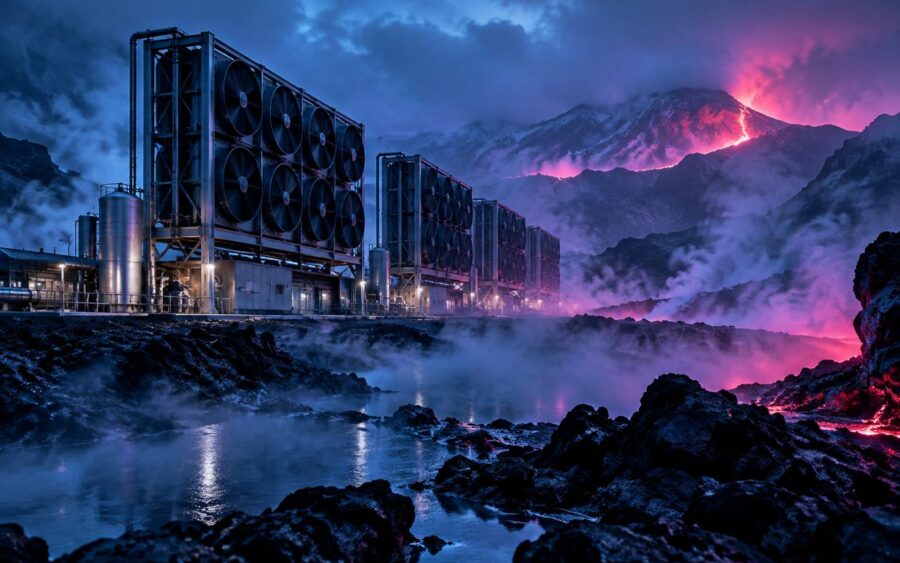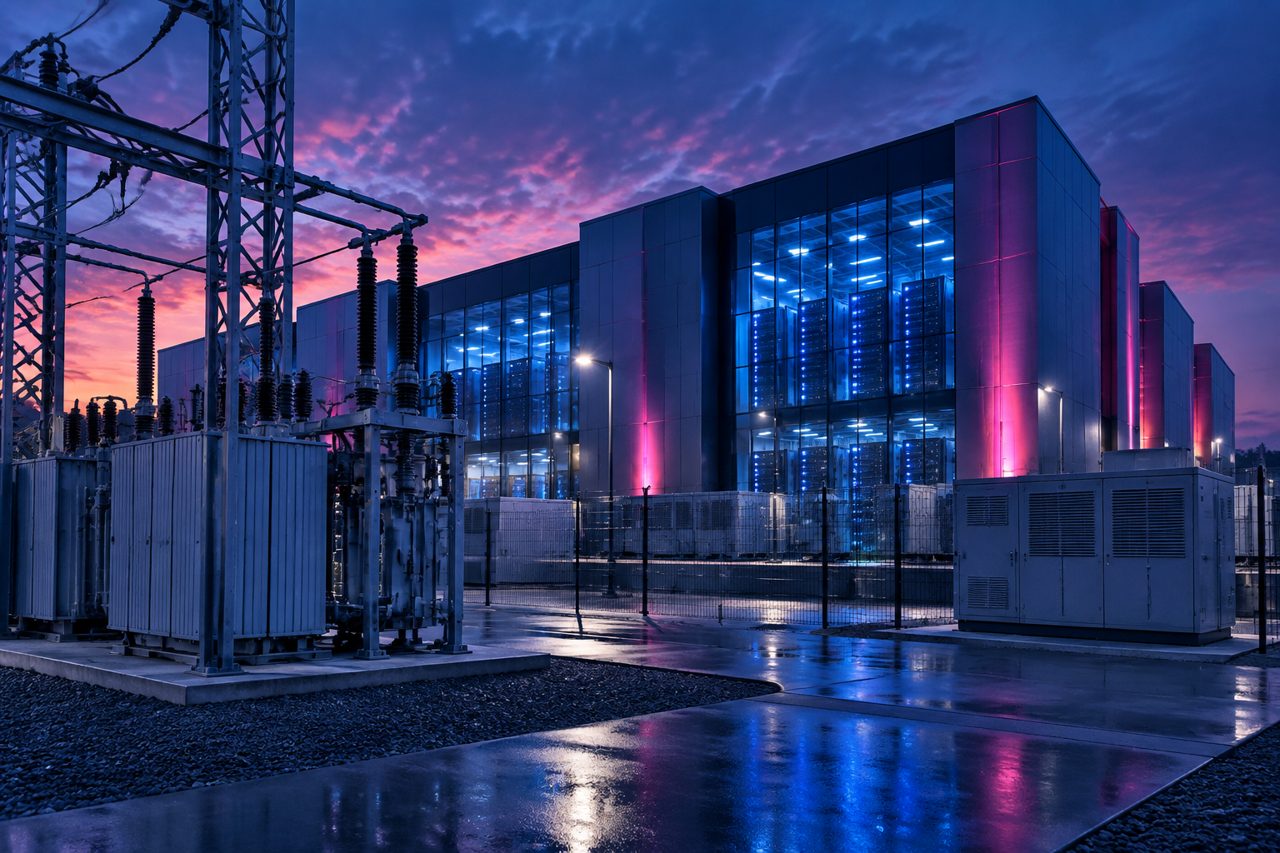
A vast site, fiber-optic cables nearby, billions to invest: that is no longer enough. Without electricity available in the right place at the right time, a data center dedicated to artificial intelligence remains a promise on a blueprint. By September 2026, the balance of power could shift: owning the best chips does not guarantee being able to run them. This prospect, based on announcements and pressures documented in 2024 and 2025, puts electricity grids at the heart of the digital battle.
The power socket before the server
The change stems first from the concentration of demand. Training large models involves clusters of accelerators working together, sometimes for extended periods. Their commercial deployment adds more dispersed but potentially massive demand. Inside data halls, rising power density per rack is also transforming cooling: liquid is gaining ground when air becomes inadequate or too expensive to circulate.
Yet the problem extends beyond the building’s walls. That power must be delivered, transformers secured, substations sometimes upgraded, and a supply guaranteed that meets service continuity requirements. A region can generate large amounts of electricity yet lack available capacity on its local grid. Abundant energy nationwide does not mean an immediately available power connection in a particular municipality.
For developers, the decisive question is therefore becoming less “how much does the land cost?” and more “how much power can actually be delivered, and when?” A less prestigious site that can be connected sooner may beat a location near a major technology hub. Waiting time becomes an industrial cost: expensive equipment sitting idle provides no service.
Connection queues redraw the map
This constraint is far from an abstract hypothesis. In Ireland, the concentration of data centers around Dublin prompted the regulator to tighten connection criteria as early as 2021. Location, grid constraints and the ability to provide flexibility or dispatchable generation all factor into application reviews. The message is clear: access to the electricity system is no longer automatic.
Singapore illustrates another form of scarcity. After pausing the allocation of new capacity in 2019, the city-state selectively reopened development, emphasizing efficiency and sustainability. In the United States, major technology hubs, particularly Northern Virginia, also confront operators with the need for grid upgrades. Buildings can go up faster than the infrastructure that powers them.
By September 2026, the plausible scenario is not a wholesale exodus to rural areas, but a more selective geography. Model training can tolerate some distance from users. Interactive services remain more sensitive to latency, connectivity and data location. Electricity is gaining weight in siting decisions without displacing the other criteria.
The energy contract becomes a strategic asset
Major technology companies have long purchased renewable electricity through long-term power purchase agreements, or PPAs. These can secure a price and help finance new generation facilities. But their existence does not mean that servers receive electricity from the facility concerned at every moment. The distinction between annual accounting and physical supply hour by hour is fundamental.
A solar plant generates power during the day; a data center can operate around the clock. The gap is managed through the grid, other sources of generation, storage or adjustments to consumption. As demand grows, value lies no longer solely in the megawatt-hour purchased, but in its availability when needed. Commercial guarantees eliminate neither congestion nor technical limits.
The renewed interest in nuclear power is part of this search. In September 2024, Microsoft and Constellation announced a long-term agreement intended to support the restart of the Three Mile Island reactor that was not involved in the accident, subject to the necessary approvals. Google announced an agreement with Kairos Power for future small modular reactors. These commitments signal a strategy; they do not constitute an immediately available reserve.
Locating near a power plant does not solve everything
Co-location sounds appealing: bring servers closer to a major source of generation to simplify their supply. In 2024, Amazon acquired a data center campus adjacent to the Susquehanna nuclear power plant in Pennsylvania. But such arrangements raise complex questions about grid use, reserved capacity and cost allocation.
The debate is also political. If a digital facility takes up existing generation, does it add a new resource to the system or simply redistribute one already available? Who pays for essential upgrades and backup capacity? For local authorities, attracting a spectacular investment is not enough: its consequences for the electricity system, land use and other economic activities must be examined.
France has advantages, not a free pass
With largely low-carbon electricity generation thanks to nuclear and renewables, France has a strong selling point. Its European interconnections, industrial expertise and telecommunications networks strengthen its appeal. AI-related investment announcements, particularly around the Paris summit in February 2025, have placed infrastructure at the center of the economic narrative.
Nevertheless, a distinction must be drawn between an announced investment package, a financed project, a contracted grid connection and a site actually receiving power. Every location has its constraints: the capacity of the nearby substation, necessary work, permits, equipment availability and the property development schedule. Several applicants may covet the same favorable area. An attractive national picture never removes the need for a local electrical assessment.
Public acceptance also rests on concrete factors. Cooling must be adapted to the site’s resources and climate. Heat recovery makes sense when a nearby user genuinely exists. As for jobs, permanent employment numbers must be distinguished from construction jobs. These considerations matter more than a generic promise of a “green” center.
Flexibility, the new bargaining chip
Operators could improve their position by accepting less rigid electricity consumption. Rescheduling some computing workloads, distributing tasks across regions or temporarily reducing a load can help the electricity system. Not everything can be shifted, however: interrupting a training run has a cost, and a service used in real time cannot wait for the grid to regain spare capacity.
Batteries can contribute to this flexibility, without single-handedly resolving a persistent power shortage. Negotiations could therefore focus as much on the consumption profile as on peak demand. For a grid operator, flexible demand can be easier to accommodate than a permanent, irreducible commitment.
What comes next? By September 2026, the strongest projects could be those that demonstrate their power delivery timeline before showcasing their computing capacity. The indicators to watch will be secured connections, work underway, additional generation and flexibility commitments. The AI battle is not leaving semiconductors behind: it is expanding to cables, transformers and the sharing of electricity.