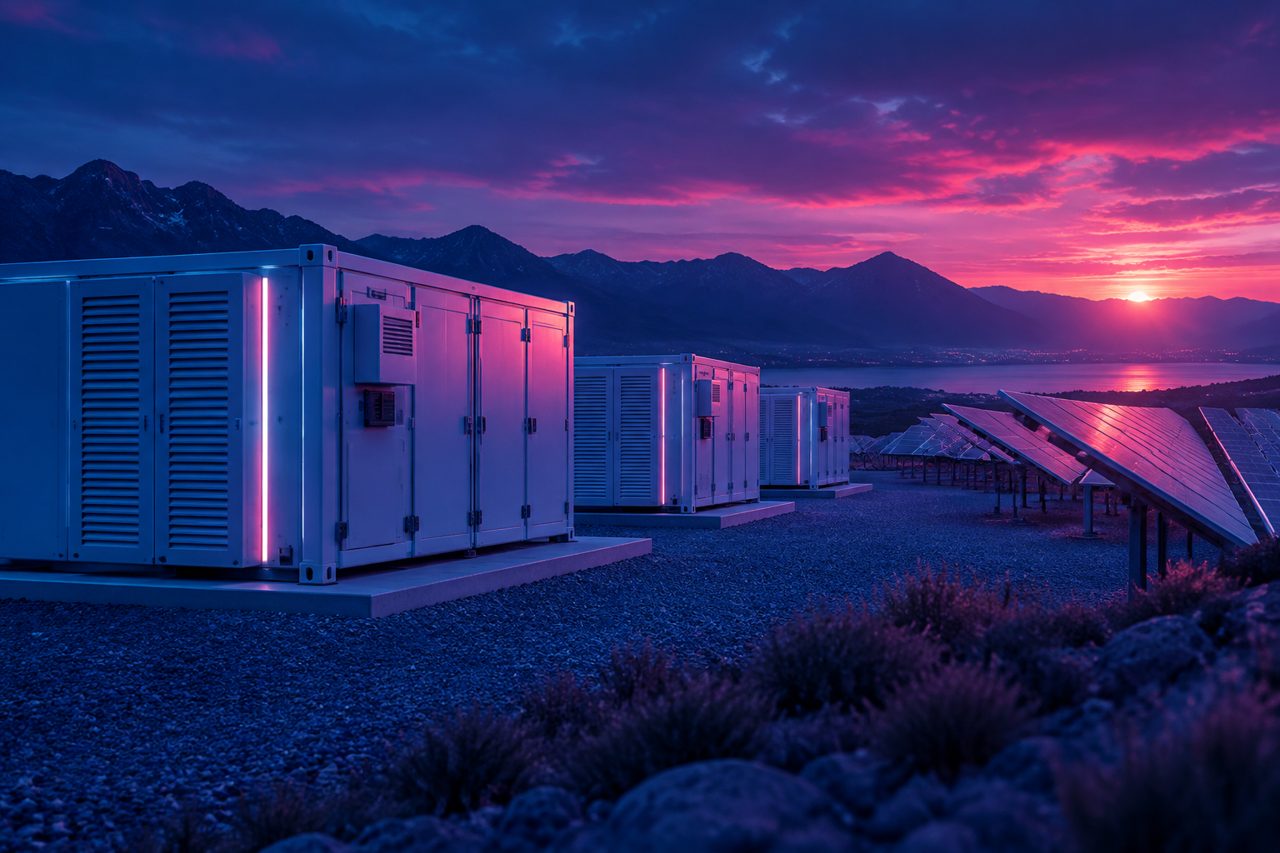
Next to a solar farm, a few containers absorb midday electricity to release it at dusk. Here, nobody asks a battery to power a car for several hundred kilometres. It is asked to last, operate without incident and deliver kilowatt-hours at the lowest possible cost. For sodium-ion batteries, which are less compact than their lithium-based rivals, this could be fertile ground. Looking ahead to September 2026, their breakthrough remains a prospect to assess, not a victory already secured.
Why sodium is back in the race
The principle is familiar: ions move between two electrodes during charging and discharging. Here, however, sodium ions replace lithium ions. Sodium is abundant, widely distributed and already used in many industries. Batteries do not use table salt directly, though: they require processed materials of carefully controlled purity and demanding industrial processes.
The appeal goes beyond replacing one chemical element. Some sodium-ion formulations also avoid nickel and cobalt. They can use an aluminium current collector at the anode, where conventional lithium-ion batteries use copper. The promise is a supply chain potentially less exposed to several critical raw materials, not a battery free from mining or industrial constraints.
This promise gained visibility when China’s CATL unveiled a first-generation sodium-ion battery in 2021. In Europe, companies such as Tiamat, which emerged from French research, and Britain’s Faradion have also helped build the industry. Their technical choices and target markets differ, however: “sodium-ion” describes a family, not a uniform product.
Stationary storage tolerates extra weight, not poor performance
In a car, every kilogram and every litre of space occupied affects range or interior room. On an industrial site, these constraints ease. A slightly heavier battery can remain attractive if it costs less and operates for a long time. Stationary storage therefore offers sodium-ion a more natural entry point than vehicles designed for long range.
Space is never entirely free, however. Adding more cells and containers increases requirements for cabling, foundations, cooling and maintenance. In an urban substation or on a constrained site, energy density retains economic value. Sodium-ion must win at the level of the complete installation, not just on the price of its raw materials.
Applications vary: shifting solar generation to a later time, limiting a factory’s peak demand, stabilising grid frequency or powering remote equipment. They require neither the same power output nor the same discharge duration. A chemistry suited to short, frequent cycles will not automatically be the best option for supplying several hours of electricity every evening.
Real projects, but still a limited track record
Sodium-ion has moved beyond prototypes alone. In China, a storage installation of around ten megawatt-hours was commissioned in 2024 in Nanning, Guangxi. That same year, the first hundred-megawatt-hour phase of a project in Qianjiang, Hubei, marked a step up in scale. These documented projects show that the technology can be integrated into grid infrastructure.
They do not yet demonstrate profitability that can be replicated everywhere. An inauguration reveals nothing about fifteen years of ageing, maintenance costs or actual availability. Assessing the situation in September 2026 would require recent, verifiable operating reports. The most firmly grounded outlook therefore remains one of industrial learning, with its pace dependent on results in the field.
The real competitor is LFP
The decisive competition does not pit sodium-ion against the cobalt-rich batteries of earlier generations. In stationary storage, lithium iron phosphate, or LFP, is already an established benchmark. It contains neither nickel nor cobalt, benefits from large-capacity factories and is supported by well-established suppliers, integrators and warranty arrangements.
The fall in lithium prices after the peaks of 2022 has complicated the equation for sodium-ion. A more abundant resource does not guarantee a cheaper cell when production volumes remain limited. Manufacturing yields, scrap, equipment and the cost of hard carbon, often used at the anode, also matter. Sodium-ion faces a competing technology that is itself continuing to improve.
The price that matters: the electricity delivered
For an operator, the right calculation adds up investment, energy losses, maintenance and any replacements, then measures them against the electricity actually delivered. A battery that is cheaper to buy can lose its advantage if its efficiency is lower or its usable capacity declines faster. Financing and insurance can also shift the outcome.
- Service life: it must be measured under the intended operating conditions, not just in a favourable test.
- Efficiency: every loss reduces the amount of electricity available to sell.
- The warranty: its value also depends on the strength of the manufacturer backing it.
Safety and the environment: avoiding shortcuts
Sodium-ion offers promising safety characteristics, which vary by formulation. But the label does not mean “non-flammable”. Many cells use combustible organic electrolytes. Defect control, detection, separation between modules and prevention of thermal propagation remain essential. Safety must be assessed at the system level as much as at the cell level.
The same caution applies to environmental performance. Reducing reliance on lithium can diversify supplies and ease certain pressures associated with extraction. But electrode manufacturing, the energy consumed in factories and the number of cells required all influence the final footprint. The relevant comparison is based on an equivalent service delivered over the entire lifetime.
Recycling raises another question: less valuable materials can make recovery less profitable. Suitable collection and processing systems will therefore need to be organised. A battery designed for disassembly and with a documented composition will have an advantage, whatever its chemistry.
A potential accelerator, not a guaranteed market
Stationary storage could set a virtuous circle in motion: regular orders, process improvements, falling costs and then broader applications. Public-sector or industrial buyers seeking to diversify their suppliers could support this phase. But replacing dependence on lithium with dependence on a handful of sodium-ion material producers would amount to only partial diversification.
What next? The plausible scenario is gradual adoption in carefully chosen applications, rather than a wholesale replacement of lithium. The decisive signals will be repeat orders, credible warranties and published performance data after several years of operation. If sodium-ion turns its resource advantage into measurable savings, stationary storage could become an accelerator for its industrial development. Otherwise, LFP will leave it mainly with niche markets.