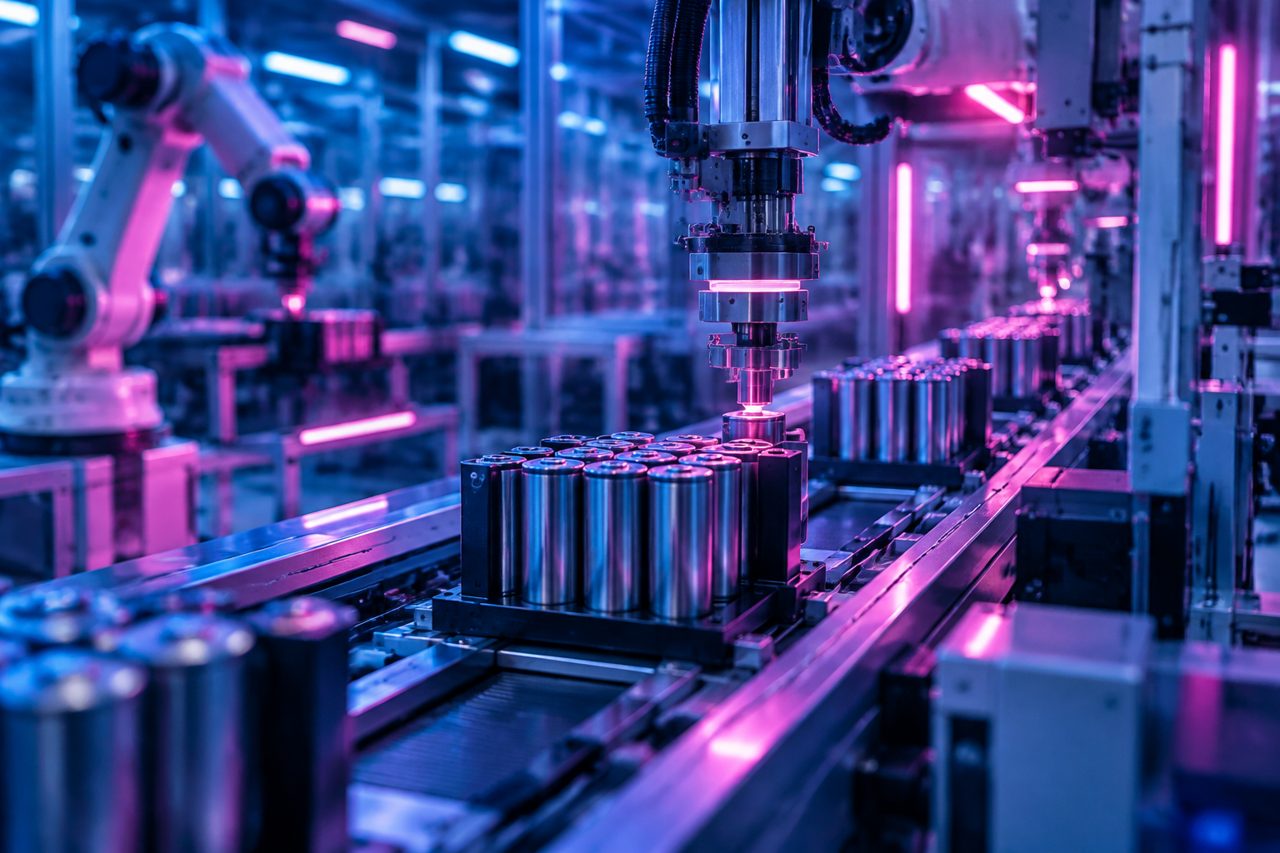
Vast buildings, state-of-the-art equipment, capacity announced in gigawatt-hours: on paper, Europe’s battery industry looks impressive. But a factory cannot pay off its machinery with press releases. Every week, it must deliver cells that meet specifications to customers willing to buy them. Looking ahead to September 2026, Europe’s real industrial test therefore comes down to a question less spectacular than an opening ceremony: how much of its production infrastructure is actually operating, and how efficiently?
This forward-looking analysis for September 2026 draws on events documented through December 2024. Developments envisaged beyond that date are scenarios, not an account of events that have already occurred.
Headline capacity does not generate revenue
In the gigafactory race, the gigawatt-hour has become the unit of prestige. It measures the amount of energy that can be stored in the batteries produced, but says nothing about how many cells will actually be sold. Nameplate capacity, actual output and saleable output represent three different economic realities behind the same building.
A line can operate without reaching its planned production rate. It can also produce quickly but reject too many cells. Finally, it can manufacture successfully yet remain partly idle for lack of orders. Capacity utilisation and quality yield must therefore be assessed together. A factory busy making unusable products is no healthier than an underused one.
This distinction is critical in a capital-intensive industry. Buildings, dry rooms, electrode coating equipment and workforce training are expensive long before the first delivery. When saleable volumes fall, those costs are spread across fewer kilowatt-hours. Unit costs rise, even if the machinery is technologically competitive.
The warning signs of 2024 changed how risk is assessed
Europe’s difficulties are not an abstract hypothesis. In June 2024, BMW confirmed the cancellation of a cell order from Northvolt amid delivery delays. In November, the Swedish manufacturer filed for US Chapter 11 bankruptcy protection. These events showed how industrial ambition could be undermined by execution problems and cash requirements.
Another signal came from ACC, the joint venture bringing together Stellantis, Mercedes-Benz and TotalEnergies through Saft, which put its factory projects in Germany and Italy on hold in 2024, notably to reassess technologies and costs. This did not mean a wholesale abandonment of Europe’s battery industry. Rather, it exposed the potential gap between initial plans and market developments.
Electric car sales had not disappeared, but their growth was less consistent than hoped, depending on the country. In Germany, the withdrawal of federal purchase subsidies at the end of 2023 had notably disrupted demand. For a cell manufacturer, these fluctuations feed directly back through the supply chain: carmakers adjust their production plans, then their purchases.
Order books must withstand uncertainty
A commercial partnership does not necessarily amount to a firm order. Behind a long-term supply announcement may lie indicative volumes, qualification requirements or scope for revisions. Yet a bank financing equipment is less interested in a promise of cooperation than in credible revenue visibility.
The most protective contracts may provide for minimum volumes, compensation in the event of cancellation or shared funding of dedicated investments. But carmakers are reluctant to lock in purchases when their own sales remain uncertain. They also want to retain multiple suppliers to negotiate prices and reduce dependence.
The central risk is one-sided flexibility: the customer adjusts its purchases, while the manufacturer retains its employees, debts and factory. Looking ahead to 2026, a project’s resilience should therefore be judged as much by the contractual strength of its sales commitments as by the prestige of its partners.
Production yield: the detail that eats into margins
Producing a cell requires a series of sensitive operations: material mixing, coating, drying, assembly, filling, electrochemical formation and inspection. A defect discovered at the end of the line can condemn a cell that has already consumed materials, energy and machine time. Scrap therefore carries a much greater cost than its apparent volume alone suggests.
Ramping up production means stabilising both quality and speed. Accelerating too early can multiply defects; slowing down sometimes preserves quality but weakens fixed-cost absorption. Teams must learn to identify causes, adjust equipment and reproduce the right conditions across multiple workstations and shifts.
This is a major source of established Asian producers’ advantage: beyond their scale and supply chains, they have accumulated experience in mass production. Buying similar machinery does not automatically transfer that expertise. For Europe, training, maintenance and workforce stability are therefore investments in competitiveness.
Financing the learning curve, not just the buildings
Financing a factory does not end with construction. During the start-up phase, the company pays for raw materials, staff and energy while deliveries remain limited. Inventory ties up cash; customer qualification processes take time. A technically promising line can therefore run short of cash before reaching stable industrial operation.
Public support focused on initial investment is therefore not always enough. Loans, guarantees, shareholder contributions and customer advances can help bridge this period. But support for the production ramp-up must not become an unconditional cheque: financing is more effective when tied to verifiable qualification, yield and delivery milestones.
When comparing projects, investors should ask in particular for:
- Actual operational capacity, separate from announced expansions.
- Saleable volumes and quality yield, using consistent definitions.
- The share of orders backed by binding commitments.
- The cash required to reach a commercially viable production rate.
The right chemistry must meet the right market
A factory can also be underused because its product no longer matches demand closely enough. The rise of lithium iron phosphate batteries, or LFP, already well established in 2024, illustrates this risk. Their cost advantages and absence of nickel and cobalt make them particularly attractive for vehicles designed around affordability, despite generally lower energy density than nickel-rich chemistries.
Yet switching chemistry is not simply a commercial adjustment. Materials, processes and qualification may require costly adaptations. Europe’s response could be a more modular expansion, aligned with identified markets, rather than a proliferation of simultaneous extensions. Proximity to carmakers, low-carbon electricity and traceability can differentiate the offering, but cannot indefinitely compensate for a factory operating well below capacity.
What next? For September 2026 and beyond, the decisive scenario is not necessarily the one in which Europe announces the most gigawatt-hours. It is the one in which its manufacturers secure customers, reduce scrap and have enough financing to learn without stopping production. Sovereignty will then be measured less by ribbon-cutting ceremonies than by cells that meet specifications, delivered consistently and sold at a sustainable price.