


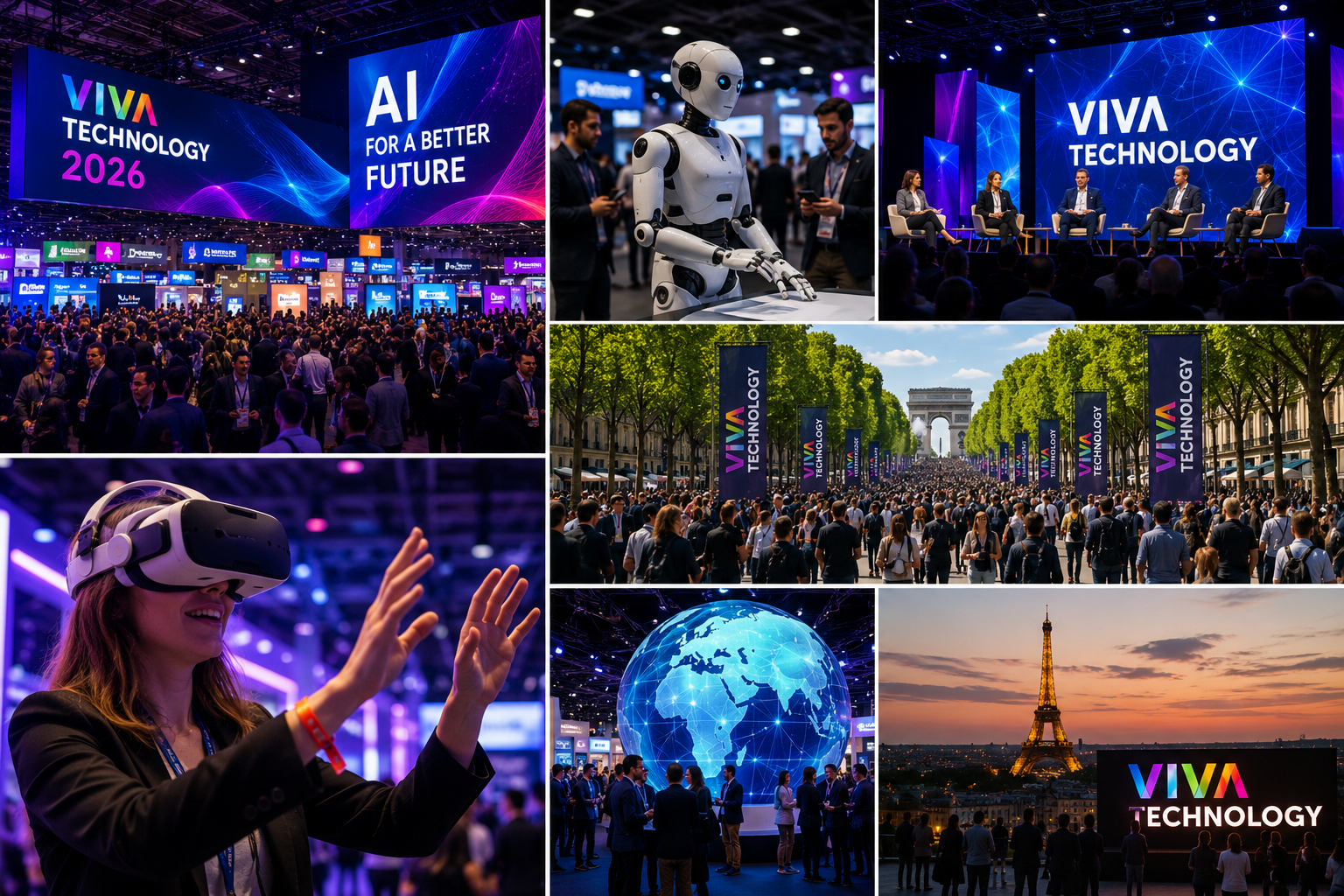
VivaTech 2026 will not simply be another technology event in Paris. It will be a test. A test of Europe’s ambition, its ability to scale, and its capacity to transform innovation into technological power.
From June 17 to 20, 2026, VivaTech returns to Paris Expo Porte de Versailles for its 10th edition. The anniversary matters. In ten years, the event has moved from a promising French innovation gathering to one of Europe’s most visible tech platforms. It now brings together startups, global companies, investors, public institutions, researchers, executives and policy makers around one question: who will shape the next decade of technology?
That question is more urgent than ever. Artificial intelligence is no longer a side topic in the tech industry. It is becoming the infrastructure of productivity, security, creativity and industrial transformation. Every company now wants to talk about AI. But the real issue at VivaTech 2026 will not be who has the most impressive demo. It will be who can turn AI into measurable business value, trusted systems and strategic independence.
The official themes of the 2026 edition already show this shift. VivaTech is not only focusing on artificial intelligence, but also on productivity, sovereignty, ethics, Greentech, energy, mobility, cybersecurity, defense, health, longevity, creative industries and deeptech. This is important because technology is no longer treated as a separate sector. It now touches every major economic and political question: how we work, how we produce, how we defend ourselves, how we manage energy, how we treat patients and how we compete globally.
The most symbolic signal of this edition is Germany’s role as Country of the Year 2026. This is not just a diplomatic label. It changes the narrative. For years, France has built one of Europe’s most visible startup ecosystems, with Paris becoming a strong stage for founders, investors and global tech leaders. Germany brings something different: industrial depth, engineering culture, Mittelstand discipline, energy transition expertise and a powerful manufacturing base. Together, the Franco-German innovation partnership can become more than a political slogan. It can become a framework for European technological sovereignty.
This matters because Europe’s central weakness has rarely been a lack of ideas. Europe has world-class researchers, engineers, universities, founders and industrial players. Its problem is often execution at scale. Too many promising technologies remain trapped between laboratory, prototype and market. Too many startups struggle to become global champions. Too many European companies depend on foreign cloud platforms, chips, software layers and AI infrastructure. VivaTech 2026 will be judged on whether it can show real answers to that problem.
One of the strongest angles for this edition is infrastructure. The AI race is not only about models. It is about compute, data centers, energy, chips, cybersecurity and access to capital. Europe can regulate AI, debate AI and celebrate AI. But without infrastructure, it risks becoming a customer of other people’s technology. This is why the conversation around sovereign AI, European cloud capacity and industrial partnerships will be central. The question is simple: can Europe build the foundations of its own AI economy?
VivaTech 2026 also expands beyond the traditional exhibition hall. On June 14, before the official opening, the Champs-Élysées are expected to become a public showcase for innovation, with technologies linked to AI, robotics, mobility, health and climate. This is more than a marketing move. It shows that technology has become part of public culture. The future is no longer hidden inside conference rooms. It is being staged in the city, in front of citizens, families, students and young professionals.
That public dimension will continue with the VivaTech Festival on June 20, designed to open the event to a broader audience. This is one of the most interesting changes. VivaTech is no longer only speaking to investors, executives and startup founders. It is also trying to speak to the next generation. That matters because Europe’s tech future depends not only on capital and regulation, but also on talent, imagination and public trust.
For startups, however, VivaTech 2026 will be less about visibility and more about proof. A booth is not a business model. A pitch is not traction. In the current funding environment, founders need to show customers, revenue, partnerships, technical differentiation and a credible path to scale. The event’s startup challenges and awards can provide exposure, but exposure alone is no longer enough. The best startups will use VivaTech not as a stage, but as a business accelerator.
There is also a sharper political layer. The French State’s presence around digital sovereignty, public digital services, AI in government and digital identity shows that governments no longer want to simply regulate technology from the outside. They want to build, recruit and demonstrate their own digital capacity. GovTech is becoming strategic because public infrastructure is now digital infrastructure.
This is why VivaTech 2026 could become a turning point. Not because every announcement will be revolutionary. Not because every startup will become a unicorn. But because the event concentrates the real questions facing Europe today. Can Europe build its own AI infrastructure? Can it turn deeptech into industrial leadership? Can it connect startups with large companies faster? Can public institutions become credible tech actors? Can European cooperation move beyond speeches and become concrete projects?
The uncomfortable truth is that Europe cannot afford another decade of beautiful innovation without enough scale. The United States continues to dominate platforms, cloud, venture capital and AI infrastructure. China is building technological power with speed, coordination and industrial depth. Europe has values, talent and regulation. But values alone are not a strategy. Talent alone is not a market. Regulation alone is not power.
That is why VivaTech 2026 matters. It arrives at a moment when Europe must decide whether it wants to be a serious technological actor or simply a sophisticated consumer market for foreign platforms. The difference will not be made by slogans. It will be made by infrastructure, capital, industrial partnerships, talent and execution.
The real question at VivaTech 2026 will not be whether Europe can innovate. Europe already knows how to innovate. The real question is whether Europe can transform innovation into power.


