



Artificial intelligence is entering a new phase. The story is no longer only about better chatbots, smarter assistants or spectacular demos. The latest AI news shows something deeper: the industry is becoming a race for infrastructure, capital, regulation and control.
Over the past year, the most important announcements have followed the same pattern. OpenAI, Google, Anthropic and other major players are not simply releasing new models. They are trying to build systems that can work longer, reason better, use tools, write code, analyze documents, control software environments and support professional workflows. In other words, AI is moving from conversation to execution.
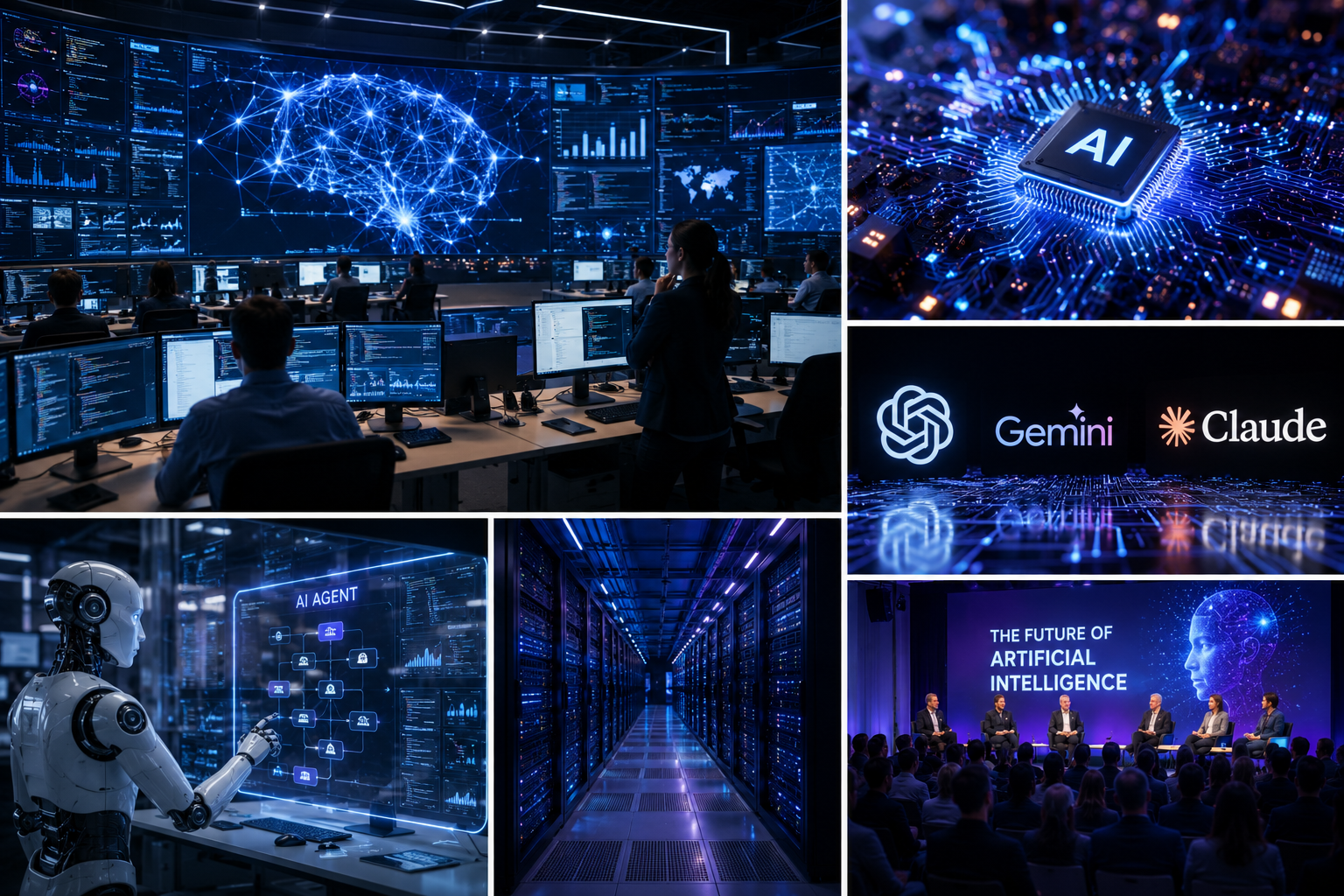
This shift is visible in the latest frontier models. OpenAI has presented GPT-5.2 as a model designed for professional work, long-context understanding, coding, vision and agentic workflows. Google has pushed Gemini 3 and Gemini 3 Deep Think toward deeper reasoning, science, logic and complex problem solving. Anthropic has continued to position Claude around coding, computer use, long-running tasks and enterprise reliability, with its recent Opus and Sonnet updates focusing heavily on agents and professional work.
This matters because the AI market is changing shape. The first wave of generative AI was about access. People discovered that they could write, summarize, translate, brainstorm and code with a chatbot. The second wave is about productivity. Companies are asking whether AI can reduce costs, accelerate operations and create measurable business value. The third wave, now emerging, is about autonomy: systems that do not just answer, but plan, act, verify and complete multi-step tasks.
That is where the real tension begins. An AI assistant that writes an email is useful. An AI agent that can browse systems, modify code, analyze financial documents, trigger workflows and interact with external tools is much more powerful. It is also much riskier. The more AI systems act in the real world, the more questions arise around accountability, security, transparency and human oversight.
This is why regulation is becoming a central part of the AI story. In Europe, the AI Act and the General-Purpose AI Code of Practice are turning abstract debates into concrete obligations. Model providers will increasingly need to document risks, explain safety measures and demonstrate responsible deployment practices. For startups and enterprises, this means that AI compliance is no longer a legal footnote. It is becoming part of product strategy.
But regulation alone will not define the winners. Infrastructure may matter even more. The AI boom requires enormous computing power, advanced chips, energy, data centers and cloud capacity. The companies that control the infrastructure will have a structural advantage over those that only build applications on top of it. This is why partnerships between AI labs, chipmakers and cloud providers have become some of the most important business stories in the sector.
The OpenAI-NVIDIA strategic partnership illustrates this new reality. The plan to deploy massive AI data center capacity shows that the next phase of AI will be built not only with algorithms, but with electricity, GPUs, cooling systems, supply chains and billions of dollars in capital expenditure. Artificial intelligence is becoming an industrial sector, not just a software category.
Anthropic’s rise also reflects this transformation. The company has become one of the central actors in the AI race, not only because of Claude’s capabilities, but because enterprise AI now requires trust, safety and reliability. In professional environments, companies do not only want clever outputs. They want systems that can be monitored, integrated and controlled. That is why coding agents, document analysis tools and enterprise workflows have become a battlefield.
For Google, the challenge is different but equally strategic. Gemini is not just a standalone model. It sits inside a much larger ecosystem: search, cloud, Android, Workspace, YouTube and developer tools. If Google succeeds, AI becomes a native layer across its entire product universe. That could make Gemini one of the most important distribution channels for AI in everyday work.
For businesses, the message is clear: AI adoption is no longer optional, but blind adoption is dangerous. Companies need to move beyond experimentation and ask harder questions. Where does AI actually create value? Which workflows should be automated? Which decisions require human supervision? What data can be used? How will errors be detected? What happens when an AI agent takes the wrong action?
The latest AI news also points to a financial bubble risk. Huge valuations, infrastructure deals and model launches create excitement, but they also raise expectations. Investors will eventually ask whether AI companies can generate enough revenue to justify the capital being deployed. Enterprises will ask whether AI tools deliver measurable returns. Governments will ask whether the benefits are shared broadly or concentrated in a few powerful platforms.
This is the real story behind the headlines. AI is no longer just a technology trend. It is becoming a new layer of economic power. The companies that dominate models, chips, data centers, cloud platforms and agent ecosystems may shape the next generation of the internet.
For Europe, this is both a warning and an opportunity. The continent has strong researchers, engineers, startups, industrial companies and regulators. But if it fails to build infrastructure and scale champions, it risks becoming dependent on foreign AI platforms. Responsible AI is important, but sovereignty requires more than principles. It requires compute, capital, talent and execution.
The latest AI news therefore tells a simple story: the chatbot era was only the beginning. The next AI race will be about who controls the systems that work, decide and act on behalf of humans.
And that race has already started.


