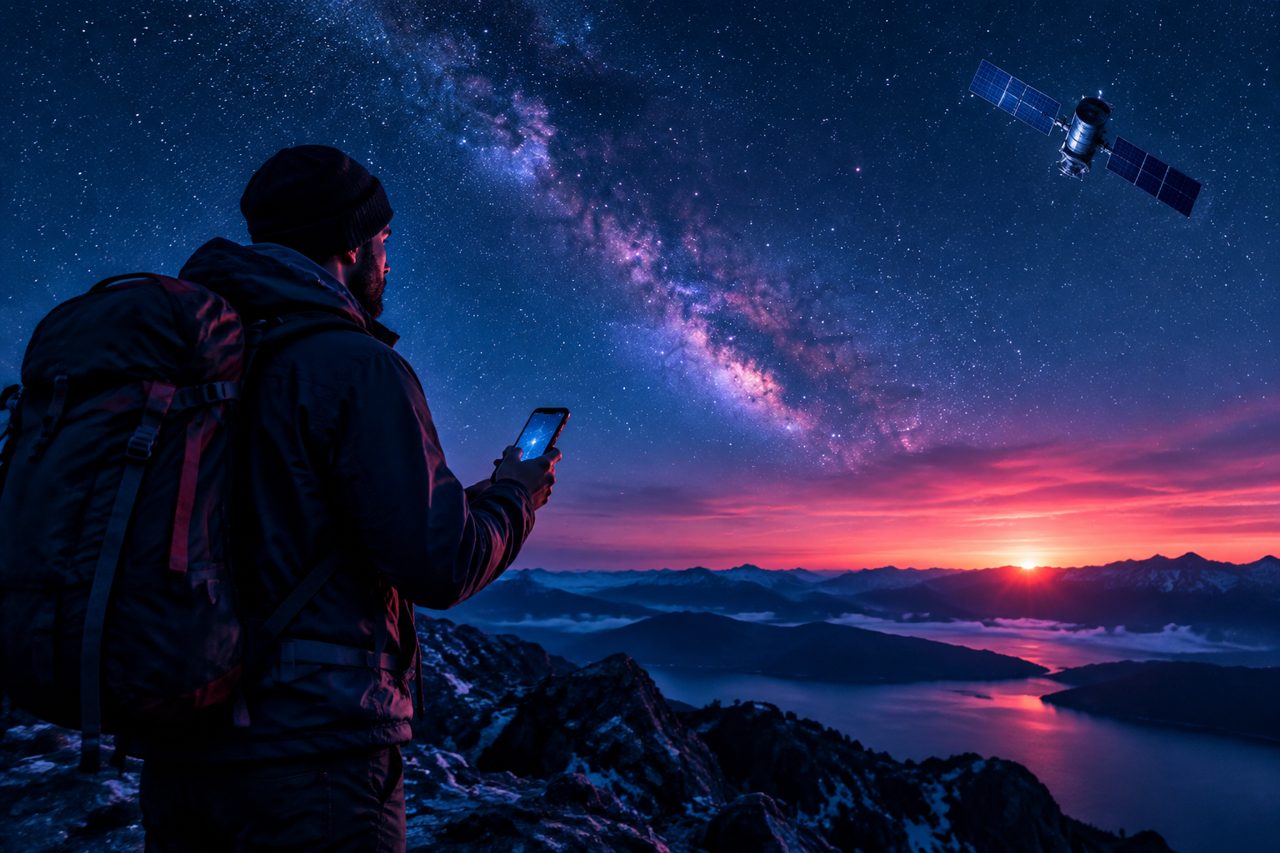
A car stranded on a remote road, an injured hiker, a village without mobile coverage after a storm: these are the first scenarios for satellite mobile connectivity. Not necessarily streaming everywhere. Apple, Starlink and AST SpaceMobile share the same ambition—connecting an ordinary phone to space—but use different architectures and make different promises. To assess the outlook for September 2026, this analysis distinguishes facts established through early 2025 from developments that remain prospective. The real issue goes beyond the feat of radio engineering: who will pay, for what service, and how often?
Apple: selling peace of mind rather than gigabytes
With Emergency SOS via satellite, launched in 2022 on the iPhone 14 lineup, Apple chose a narrow but crucial need. Beyond mobile and Wi-Fi coverage, users can communicate with emergency services in countries where the service is available. The interface helps them point their phone toward a satellite and collects information needed for the response. This is not a conventional call: short messages travel over a constrained connection.
Apple relies on Globalstar and its infrastructure, using frequencies dedicated to satellite communications. Compatible iPhones incorporate the necessary capabilities; a simple software update therefore cannot turn an older model into a satellite terminal. A clear view of the sky matters greatly: terrain, buildings and foliage can delay or prevent transmission. This connection is more of a safety net than an always-on network.
The scope has nevertheless expanded. Apple added roadside assistance in certain markets, then introduced Messages via satellite with iOS 18 in the United States and Canada on compatible models. These features must be distinguished: SOS availability does not guarantee access to personal messaging. The country, software and commercial terms remain decisive.
Its business model remains unusual. The service was offered at no additional cost for an initial period with the purchase of an eligible device, with extensions announced for certain groups of users. Apple can fund this safety net through the value of the iPhone and loyalty to its ecosystem. Its increased financial commitment to Globalstar, announced in 2024, confirms a commitment to the underlying infrastructure. It does not, however, establish that the service will remain free forever or that a universal subscription is coming.
Starlink: turning satellites into cell towers
Starlink Direct to Cell follows a different approach: satellites equipped to communicate with existing LTE phones using partner operators’ frequencies. This system should not be confused with Starlink internet access using a dedicated dish. Here, the smartphone must recognize an extension of its mobile network delivered from space.
The first Direct to Cell satellites were launched in January 2024. In the United States, the partnership with T-Mobile reached an important regulatory milestone in late 2024, ahead of a public beta announced in early 2025. Other agreements have been signed, including with operators in Australia, New Zealand, Canada and Japan. But a map of partners is not a map of commercially available coverage: each territory requires approvals and technical integration.
The advertised advantage is substantial: avoiding the purchase of a phone specifically designed for satellite connectivity. Yet “LTE-compatible” does not mean “every device, immediately.” Supported radio bands, software, certifications and operator decisions can narrow the actual list. For readers in France, a US launch is therefore no promise of local availability.
Messaging is a realistic starting point. Voice and data require a more demanding progression, rather than automatically matching terrestrial 4G. Commercially, Starlink can sell wholesale capacity to operators, which then decide whether to include it in their plans or charge for an add-on. Space-based connectivity thus becomes a selling point for attracting or retaining subscribers.
AST SpaceMobile: betting on broadband for ordinary phones
AST SpaceMobile also targets ordinary smartphones and partner operators’ frequencies, but puts broadband more directly at the heart of its proposition. In 2023, the company demonstrated voice and 4G, then 5G, connectivity using its experimental BlueWalker 3 satellite. Its first five commercial BlueBird satellites were launched in September 2024.
One of its distinguishing features is the very large antennas deployed in orbit. Their surface area helps capture a phone’s weak signal and establish a usable connection. AST has built relationships with several major operators, including AT&T and Vodafone; Verizon also announced an agreement in 2024. This strategy seeks to make satellites an additional layer of existing networks.
A fundamental difference remains between a demonstration and an everyday service. A handful of satellites cannot provide continuous coverage across all target markets. A constellation must be funded, manufactured and launched, ground infrastructure installed, and approvals obtained. In assessing the outlook for 2026, AST must therefore be judged as much on actual service continuity as on its demonstrated speeds.
Coverage and capacity: the limits marketing glosses over
Three questions make it possible to compare offerings without conflating their promises:
- Where does the service work? A satellite passing overhead is not enough: spectrum rights, authorized countries and commercial agreements determine access.
- With which phone? Apple requires an iPhone with the appropriate hardware. Starlink and AST target standard devices, subject to compatibility and approval.
- For what purpose? An SOS, a message, a voice conversation and a video require different levels of bandwidth and continuity.
The main bottleneck is shared capacity. A satellite cell covers a vast area, but its radio resources remain limited. A few messages sent by motorists in remote locations represent a modest load; thousands of people simultaneously losing network access after a disaster pose a different problem. Prioritizing emergencies and managing congestion then become essential.
Indoor coverage also remains a challenge. A connection that works outdoors may fail inside a house, beneath a metal roof or at the bottom of a valley. Low Earth orbits reduce propagation delay compared with geostationary satellites, without eliminating interruptions, obstructions or transmission difficulties. Satellites complement terrestrial towers; they do not make them redundant.
Charging for a network people rarely use
The commercial paradox is simple: connectivity is extremely valuable when it saves the day, but may go unused for months. A standalone subscription risks running up against this infrequent use. Inclusion in a premium plan, a business offering or the price of the phone therefore seems plausible. The challenge is to fund costly infrastructure without promising unlimited capacity.
What next? For September 2026 and beyond, the most plausible scenario is the coexistence of services rather than a single winner: built-in assistance from Apple, a network extension negotiated with operators for Starlink, and broadband ambitions for AST. Their success will have to be measured against concrete criteria: local availability, devices actually supported, reliability and pricing after promotional periods. Direct connectivity will have found its business model when users know precisely what it guarantees—and what it does not.