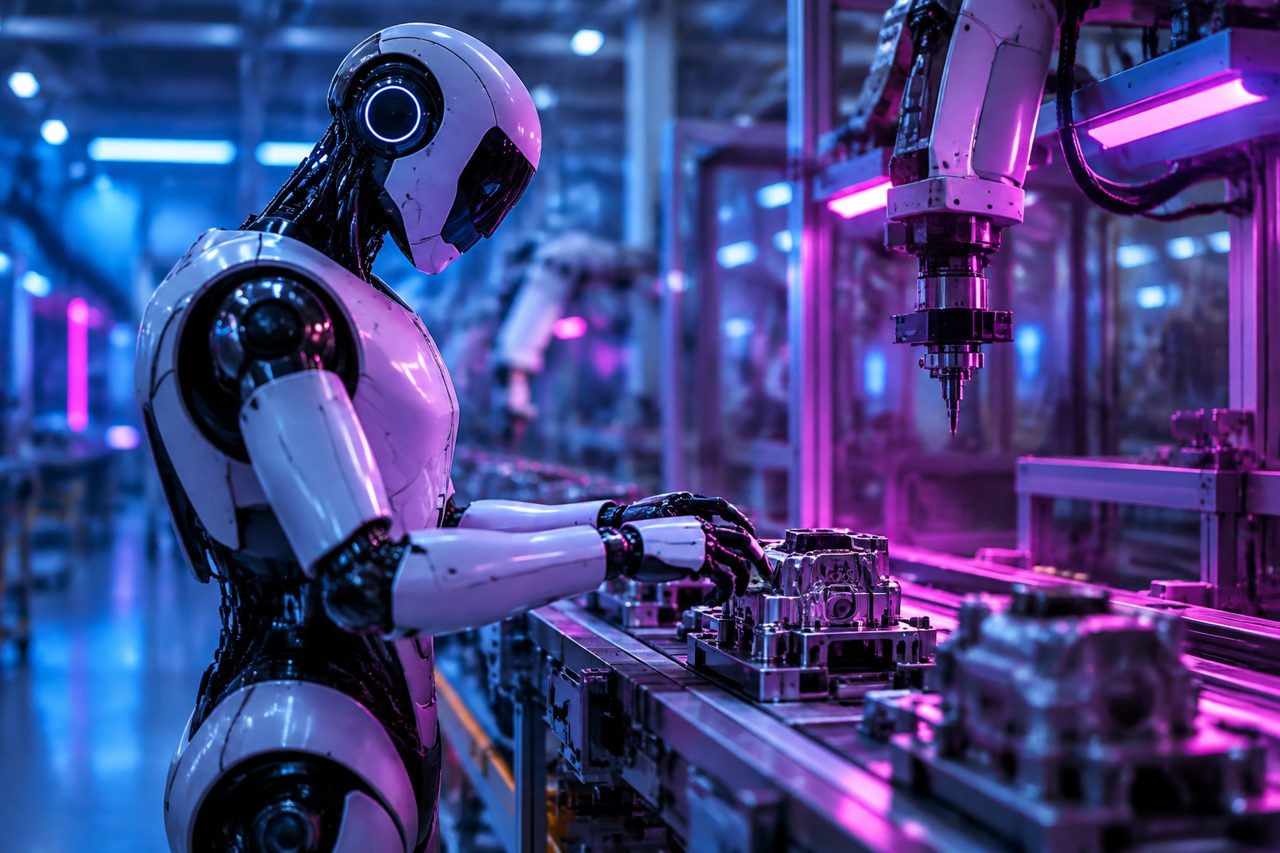
The robot moves forward, picks up a crate, turns and puts it down in the right place. The video lasts thirty seconds; the comments are already heralding the end of physically demanding work. In a factory, however, the test begins after that successful shot: repeating the movement all day, handling the unexpected, injuring no one and avoiding the need for constant intervention by a technician. Looking ahead to September 2026, the real challenge for humanoids is therefore not how closely they resemble us. It is their ability to become equipment that a production team can rely on.
This analysis draws on events and trends documented through December 2025. The outlook discussed for September 2026 consists of projections, not an account of verified subsequent deployments.
From the film set to the workstation
Industrial interest is far from imaginary. BMW has tested Figure robots at its US plant in Spartanburg. Mercedes-Benz has announced trials with Apptronik humanoids. In logistics, GXO and Agility Robotics announced a commercial agreement in 2024 to deploy Digit following a pilot phase. These initiatives show that companies want to test the technology on practical tasks. They do not, on their own, prove that widespread adoption would already be profitable.
Words matter here. A supervised trial, a paid pilot and a workstation integrated into production represent different levels of maturity. The first explores a possibility; the second evaluates a service; the third puts operational continuity on the line. A partnership announcement does not reveal how many hours the robot actually works, or how many people help it succeed.
The human form nevertheless has a strong argument in its favor: buildings, passageways and containers have often been designed for humans. A robot with arms and legs could adapt to them without a complete rebuild. But looking like an operator does not mean being able to take over their job. Balance, grasping and perception all add problems to solve.
Availability: the first reality check
The first meaningful indicator is productive operating time. A humanoid can remain switched on for eight hours and produce for only a fraction of that time. Charging, battery swaps, recalibration, waiting for instructions, failed grasps or software restarts: every interruption reduces its contribution. Advertised battery runtime must therefore not be confused with workstation availability.
The next step is to examine how often failures occur and how long they last. A rare but lengthy incident can disrupt a factory floor; a succession of minor stoppages can monopolize a supervisor. Manufacturers will want to know, in particular, the mean time between failures and the mean time to restore service, with a clear explanation of what each calculation includes.
Averages, however, are not enough. Does the robot still perform at the end of the day, when its components heat up? After several weeks of wear? With misshapen packaging or different lighting? Industrial reliability is measured over time and across a variety of situations, not through a compilation of the best takes.
Throughput: success is not enough; the robot must keep pace
In a video, a slow movement can sometimes seem reassuring. On a production line, it can create a bottleneck. The robot must maintain the required pace while preserving quality: picking the right part, positioning it correctly, avoiding damage and confirming the operation to the production system. Speeding up a movement serves no purpose if it increases errors.
The right indicator is therefore not simply the number of cycles completed, but the number of cycles completed to specification per hour. Their variability must also be examined. An operation that usually takes twenty seconds but sometimes takes two minutes can be harder to integrate than a slightly slower, entirely predictable process. Trial figures are meaningful only when accompanied by the test protocol.
Finally, the comparison must be fair. For repetitive transfers between two fixed points, a conveyor or an industrial arm may remain simpler and less expensive. A humanoid becomes attractive if its mobility and versatility eliminate the need for several specialized pieces of equipment, or make it possible to automate a task that has previously been too variable. That value must be demonstrated, workstation by workstation.
Safety is about more than walking slowly
A humanoid introduces a particular risk: it can fall. Other hazards include collisions, pinch points between its joints and the surrounding environment, and dropped loads. Its familiar silhouette may even encourage excessive trust. An operator should never have to guess whether the robot has seen them or is about to change direction.
The assessment must cover the entire application: the robot, its tool, the object being carried, traffic flows and human interactions. Industrial robot safety standards provide a starting point, but applying them requires a tailored analysis. An emergency stop is not enough: among other things, it is essential to check what happens to the robot’s balance when a movement is interrupted.
Caution also has an operational cost. If human presence constantly triggers a slowdown, actual throughput falls. If the robot must remain behind a barrier, part of the promise of collaboration disappears. Safety is not an external obstacle to performance: it defines the conditions under which that performance is acceptable.
Counting the humans behind autonomy
The least visible criterion is often the most revealing: how many interventions are needed to keep the robot working? These may take the form of teleoperation, remote approval, repositioning an object or a reset. Such assistance is legitimate during the learning phase. It becomes problematic when it disappears from the financial assessment or the sales pitch.
A buyer should ask for a simple breakdown:
- The share of operations completed without assistance.
- The number of interventions per hour and their duration.
- The nature of the assistance: guidance, remote control or an in-person intervention.
- The number of robots one person actually supervises under normal conditions.
This transparency makes it possible to distinguish autonomy from work shifted elsewhere. A robot that requires almost continuous monitoring does not necessarily eliminate a workload: it transforms it. Conversely, occasional assistance shared across several machines can be a viable compromise. The goal is not absolute autonomy, but a predictable service in which all resources are accounted for.
The robot’s price is only the beginning
Integration, maintenance, parts, energy, connectivity, training and downtime all come on top of the purchase or rental cost. Updates must also be managed: improving one capability must not degrade behavior that has already been validated. The relevant cost is that of an operation completed to specification, on time and safely, over a representative period.
What next? For September 2026 and beyond, the most plausible scenario is progress through narrowly defined tasks in prepared environments, rather than the mass arrival of all-purpose mechanical colleagues. The decisive evidence will come from comparable operational reports that include failures and human assistance. The day a factory-floor manager can predict a humanoid’s output as confidently as that of any other piece of equipment, the technology will have crossed a far more important threshold than a million views.