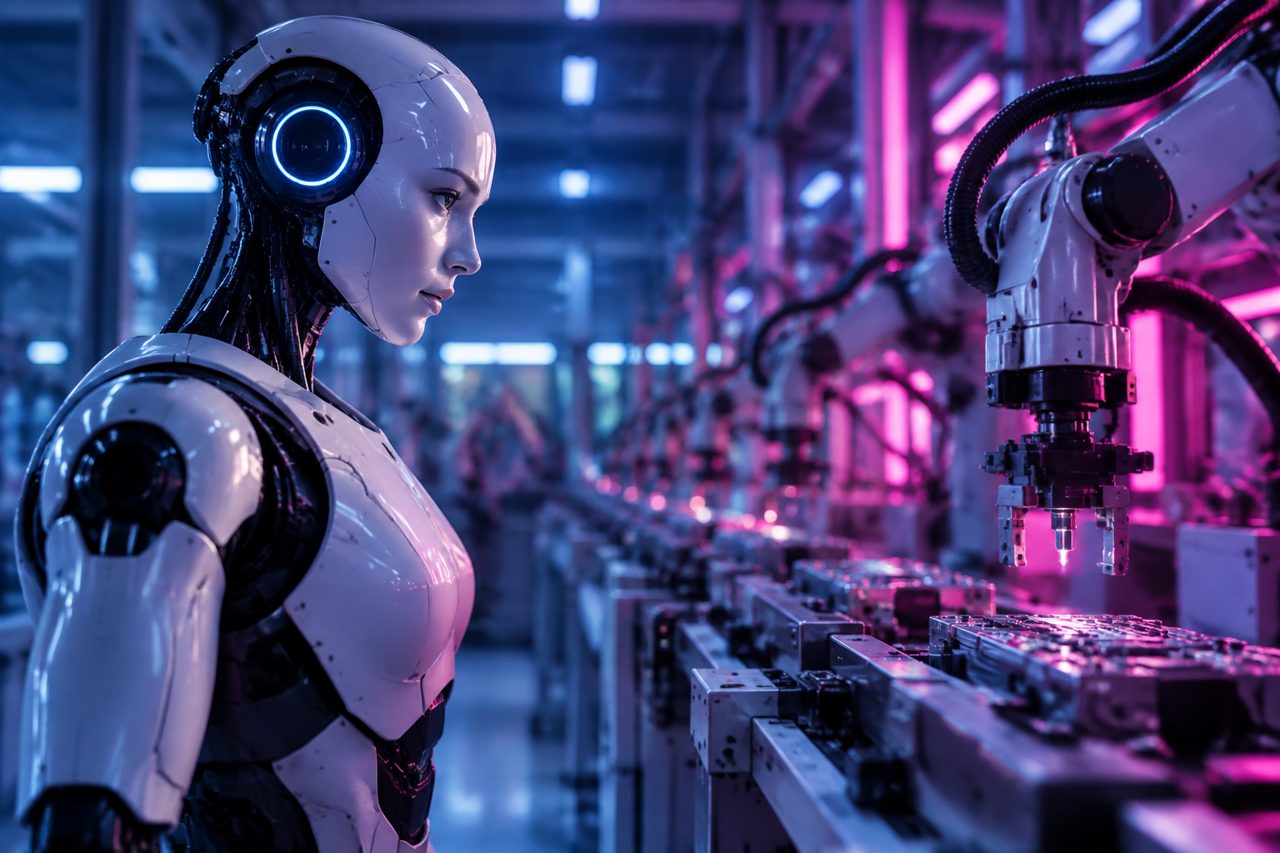
A robot picks up a part, turns and places it in a bin. The video lasts thirty seconds; the factory runs for hours. The future of industrial humanoids hinges on that gap. To earn their place alongside operators, they will have to do far more than imitate human movements: maintain throughput, avoid accidents, handle the unexpected and justify every euro invested. Looking ahead to September 2026, the decisive question is therefore not “can they work?” but under what conditions do they become genuinely useful?
This analysis draws on public announcements and trials documented through 2024. The developments envisaged for September 2026 are projections, not an assessment of deployments confirmed as of that date.
From initial contracts to realities on the factory floor
In 2024, several manufacturers opened their doors to these machines. BMW announced an agreement with Figure to explore their use at its Spartanburg plant in the United States. Mercedes-Benz began a collaboration with Apptronik focused on Apollo. In logistics, GXO announced a commercial agreement to deploy Agility Robotics’ Digit following a pilot phase. These initiatives signal tangible interest, but do not yet demonstrate widespread profitability.
Their common ground is revealing: the first assignments under consideration often involve material handling, replenishment or moving containers. Not assembling an entire car. Companies are initially looking for clearly defined, repetitive and sometimes strenuous tasks where a machine can be evaluated without overhauling the entire production process.
The case for humanoids is appealing: entering an environment designed for humans, taking the same routes, reaching the same shelves and using some existing equipment. But a human shape is no guarantee of economic viability. On a flat, repetitive route, a wheeled mobile robot may be simpler. For a fixed movement, an industrial arm retains considerable advantages.
Throughput: getting the movement right is not enough
In a factory, the time that matters is not that of the best movement captured on camera. It is the full cycle: locating the part, grasping it, checking the grip, moving, placing it and starting again. Hesitation, poorly positioned objects and stoppages must also be factored in. A robot that is fast once in ten attempts may be less valuable than a system with modest but consistent performance.
The test becomes particularly demanding when a robot has to keep pace with a production line. A delay of a few seconds can exhaust a buffer stock and then bring neighboring workstations to a halt. By contrast, a replenishment task with some scheduling flexibility can tolerate greater variability. The first viable market could be for useful tasks that are not tightly constrained by immediate throughput requirements.
Measure the bad day, not just the best one
A rigorous trial must cover multiple shifts, variations in lighting, misshapen packaging and changes in part types. It must also distinguish cycles completed successfully without help from those rescued by an operator. Averages do not tell the whole story: the frequency of slowdowns and the time needed to restart after an incident determine the system’s real value.
Safety: sharing space changes the rules
A humanoid combines several risks: moving arms, transported loads and, for a biped, the possibility of losing balance. Its familiar shape can create a misleading sense of reassurance at close quarters. Yet a heavy machine that falls or drops a container does not become harmless simply because it has a head and two hands.
Safety depends on the complete system: robot, gripper, load, floor, traffic and work organization. Reducing speed near an operator limits certain hazards, but also affects productivity. Installing a physical barrier can sometimes make risks easier to control, while diminishing the appeal of a machine intended to share human spaces.
Industrial and collaborative robotics safety standards provide a foundation, but do not remove the need for an application-specific analysis. Safe stopping, presence detection and recovery after an incident must all be planned for. The question is not simply whether the robot avoids a person, but how it behaves when its perception is wrong.
Autonomy: counting the invisible interventions
The word encompasses two realities. First, energy autonomy: how long can the machine work before recharging or changing its battery? The answer depends on the load carried, distances traveled and movements performed. A runtime quoted without context tells us little about actual availability during a production day.
Then there is operational autonomy: how long can it work without assistance? A demonstration may involve teleoperation or a prepared environment. That is not necessarily misleading if it is made explicit; it simply changes the nature of the performance being measured. A remote operator who regularly gets the robot unstuck remains a resource that must be paid for and coordinated.
Advances in artificial intelligence offer opportunities to recognize objects, interpret instructions and adapt movements. But producing a plausible action is not enough on a factory floor. Faced with an unfamiliar part or an overturned bin, knowing when to stop and call a human may be preferable to improvising. Credible industrial autonomy therefore includes the ability to manage its own limitations reliably.
Cost per task: the final arbiter
The purchase price attracts attention; it does not tell us how much it costs to actually move a part. The calculation must include installation, workstation modifications, supervision, energy, maintenance, wear parts and downtime. Leasing or service-based billing changes how risks are allocated, not the need to measure these expenses.
The right denominator is the number of tasks completed to specification, not the number of hours the robot is switched on. An inexpensive machine that is frequently unavailable may cost more than a pricier piece of specialized equipment. Errors count too: a damaged part or one placed in the wrong location can trigger costs far exceeding that of the original movement.
The comparison must cover several options: retaining the current workstation, improving its ergonomics, installing a conveyor, or using an arm or a mobile robot. A humanoid becomes more attractive if its versatility can genuinely be put to use. If it always performs the same movement in the same place, paying for two legs and dynamic balance may be difficult to justify.
What would tip the balance toward adoption
Looking ahead to September 2026, the most convincing signal would be less a new video than a repeat order following a rigorously measured pilot. Results on availability, human interventions and cost per task would help distinguish technical progress from industrial value. Workforce acceptance also matters: accessible maintenance, clear responsibilities and training are prerequisites for sustainable deployment.
What next? The most plausible scenario is gradual adoption, workstation by workstation, rather than a mass arrival of all-purpose mechanical workers. Humanoids could find a role where human-designed environments make conventional automation difficult, without imposing unattainable throughput requirements. Their real victory would not be to look more like people, but to become reliable, repairable and economically justifiable equipment.