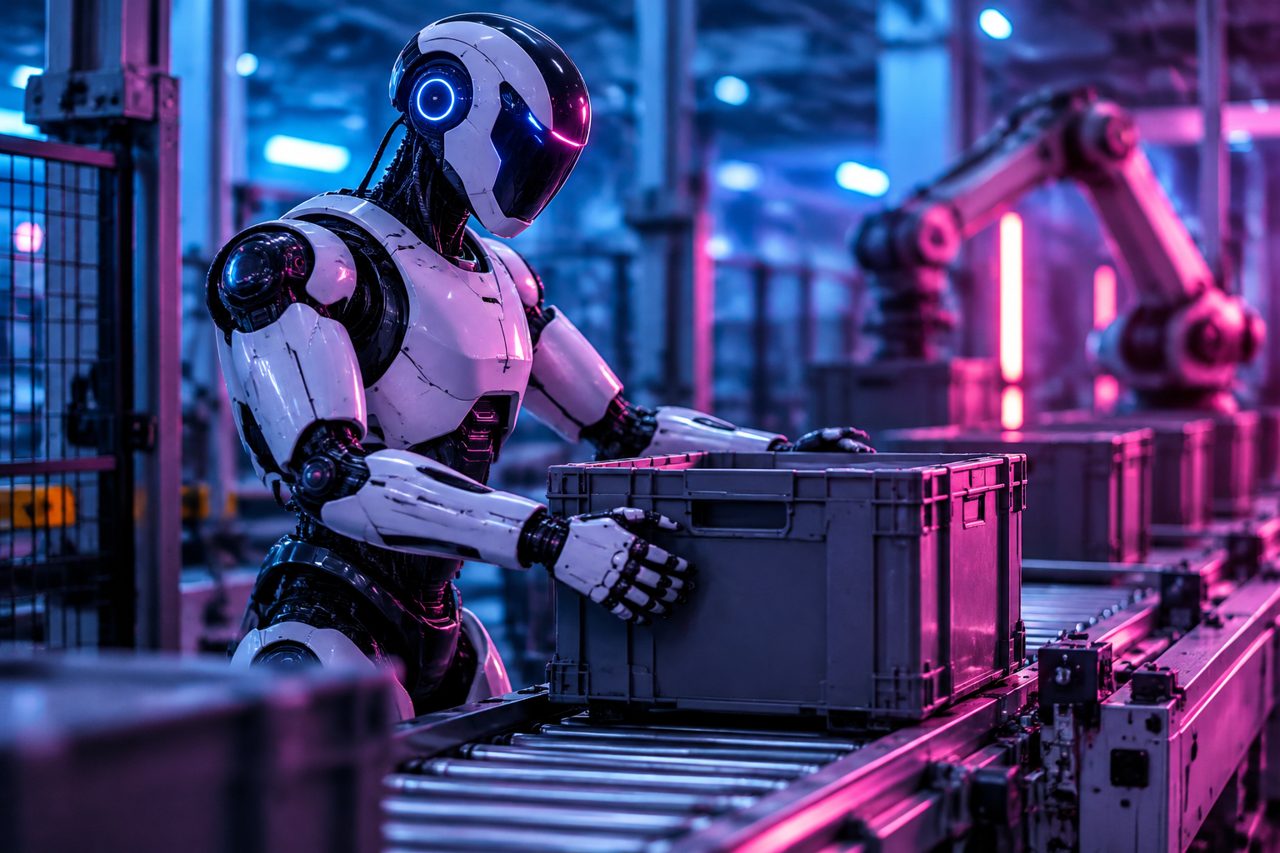
A robot picks up a part, turns and places it in the right spot. The video lasts thirty seconds; the factory has to run all day. The future of industrial humanoids hinges on that gap. Figure, Agility Robotics and Boston Dynamics embody three approaches to the same promise: putting versatile machines to work in spaces designed for us. But a human silhouette is not a business model. Looking ahead to September 2026, the decisive question is no longer simply “what can it do?” but “for how long, at what risk and at what cost?”
Three paths, the same reality check
To understand this transition, we need to start with documented milestones, without treating announcements as proof of widespread adoption. The events of 2024 presented here provide reference points; their implications for September 2026 are forward-looking analysis, not a verified account of deployments at that date.
In January 2024, Figure announced a commercial agreement with BMW Manufacturing to identify applications in automotive production. Its Figure 02 robot, unveiled in August of the same year, was subsequently involved in a trial at BMW’s Spartanburg plant in the United States, placing sheet-metal parts into fixtures. Repetitive work that demands precision is far more representative of industry than a conversation in front of a camera.
Agility Robotics is advancing in a related but distinct field: logistics. Its bipedal robot Digit is designed, among other things, to move totes. In June 2024, GXO announced a multiyear agreement with Agility following a trial at a warehouse handling logistics for the Spanx brand. This move to a commercial arrangement is significant. It does not, however, establish universal profitability across all buildings and workflows.
Boston Dynamics, meanwhile, unveiled a new, fully electric Atlas in April 2024 after retiring its hydraulic version. Through its owner, Hyundai, the manufacturer has a potential industrial environment in which to test the platform. Its demonstrations show remarkable expertise in movement; they should not be confused with public data on uptime or production costs.
Reliability is measured between demonstrations
On a factory floor, successfully performing a movement is not enough. It has to be repeated when the lighting changes, a part arrives slightly askew or a tote shows unusual wear. These small variations are routine for an operator. For a robot, they can turn a well-controlled sequence into an unexpected stoppage.
The first useful indicator is therefore the rate of tasks completed correctly without assistance. This must be accompanied by cycle time, as well as its variability: an acceptable average can conceal frequent slowdowns. On a paced production line, a few hesitations are enough to disrupt downstream operations.
Human interventions must also be counted. A technician who regularly repositions a part, a remote operator who resolves a problem or an engineer who adjusts the software are not minor details. Their work belongs in the system’s overall assessment. Teleoperation can be a useful troubleshooting or learning tool, provided it is not concealed behind the word “autonomous.”
Finally, maintenance needs to come out of the shadows. Hands, joints, gear reducers, sensors and batteries work together in environments that may be dusty or subject to vibration. An impressive architecture becomes operationally viable when vulnerable parts can be replaced quickly, faults can be diagnosed and after-sales support delivers.
Safety takes more than a red button
A humanoid may share employees’ walkways, workstations and tools. This compatibility with human environments makes it attractive, but also creates risks: falls, collisions, pinch injuries and dropped objects. A walking robot must maintain its own balance; its hazard envelope extends beyond the reach of its arms.
The analysis must therefore cover the entire application, not just the machine. What load does it handle? At what speed? Near whom? What happens when a sensor becomes unavailable or the network connection drops? Safe behavior in a clearly marked area does not guarantee the same level of safety on a cluttered factory floor.
Industrial and collaborative robotics safety standards provide a foundation, but applying them requires an analysis tailored to mobility and use cases. Presence detection, force limits, safe stopping and exclusion zones: these safeguards can reduce throughput or require changes to the workspace. That is normal. Safety is a prerequisite for production, not an optional extra to be added after the business case has been calculated.
The real benchmark: cost per successfully completed task
The purchase price attracts attention. A factory manager, however, must add up integration, maintenance, energy, licensing, supervision, training and downtime. That expenditure must then be divided by the number of tasks actually completed and accepted by quality control. An incorrectly placed part does not count as productive output.
A robotics-as-a-service contract can shift some expenditure to a subscription and transfer certain risks to the supplier. It does not make them disappear. Uptime commitments, repair lead times, contractual exclusions and charges for interventions then become just as important as the technical specifications.
Above all, humanoids should not be compared only with employees. Their competitors also include industrial arms, conveyors, mobile robots and simple workstation modifications. Why pay for two legs if a wheeled base will do? Why use a sophisticated hand if a specialized gripper gets the job done faster?
The strongest justification may be flexibility: reusing a machine for several tasks in an existing building without rebuilding the entire installation. But that value must be demonstrated by accounting for task-switching time, the accessories required and the validation of each new application.
What an industrial pilot should really prove
A useful trial looks less like a video shoot than a measurement campaign. The protocol must incorporate normal production variations and report failures as well as successes, at least internally. Three questions help keep it on track:
- Reliability: how many tasks meeting specifications are completed between interventions across several representative days?
- Safety: are incidents and degraded operating conditions managed without relying on constant human vigilance?
- Economics: does the total cost remain competitive with alternative solutions, with a margin for unexpected problems?
What next? The most plausible trajectory is not the sudden arrival of all-purpose workers, but progress through narrowly defined tasks, controlled environments and gradual expansion. Figure, Agility Robotics and Boston Dynamics will each have to turn their strengths into verifiable productive hours. For manufacturers, the right approach is to buy measured performance rather than an anthropomorphic promise. The real milestone may be a very quiet one: a humanoid that has become reliable enough for people to stop stopping to watch it.