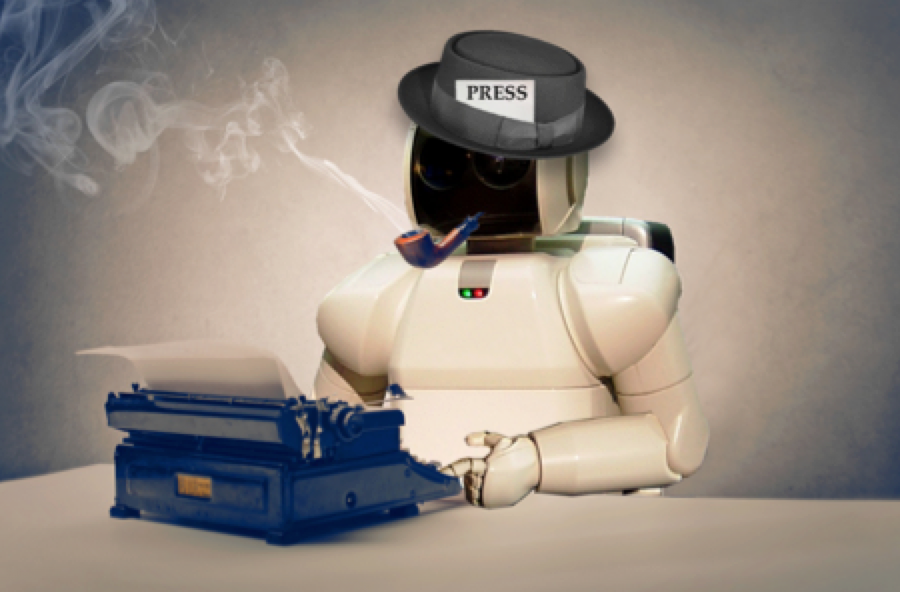
It is one of the themes dear to science fiction and anticipation literature. Fritz Lang prophesied it, Asimov theorized it, James Cameron brought it to the screen. The myth of humanity’s replacement by robotic entities has been present for a long time in the collective subconscious of a society increasingly dependent on new technologies.
But beyond the advancements in cybernetics and artificial intelligence, which will not be the subject of this article, let us ask a simple and legitimate question since you are reading my words on a news site: Are robots going to end up replacing journalists?
At first glance, the question may seem strange, except that an American company, “Automated Insights,” stated in a recent study that more than a million articles worldwide are already written by robots on a daily basis.
Moreover, those who resort to this “stratagem” no longer hide it. Forbes, Associated Press, Yahoo, and even “Le Monde” (which engaged in the exercise last year on an experimental basis) publish news flashes or articles every day on their sites that are entirely generated by algorithms… and without any human intervention.
To put things into perspective, this formula is mainly used to announce election results, analyze stock market fluctuations, or comment on sports results.
There are also other applications in the event of natural disasters. In 2014, for example, barely three minutes after a light earthquake, the news was already on the front page of the Los Angeles Times information site, representing a significant gain in time and personnel.
But how does it work concretely? Well, the “robot,” via its optimized program, will “draw” information from various available sources, compare figures, isolate highlights, add specific comments, and finally, format it according to a pre-determined layout.
Even the angle of attack and the tone used can be configured! The style can be educational, sarcastic, neutral, or laudatory as desired.
What do confirmed journalists think? Do they run the risk of finding themselves unemployed? Mourad Hamed Abdelouaheb is an Algerian political reporter who has looked into the phenomenon: “I do not think that robots can replace us to the extent that they can never have that curious and critical spirit, nor that flair that some investigative journalists have. I don’t see how a robot, even if equipped with massive artificial intelligence, can analyze and develop facts in a critical manner.”
The legitimate question that arises is: can the reader perceive the difference? Not at all, according to the conclusions of a study conducted by Chister Clerwall, a Swedish media professor, who compared—blindly—sports commentaries written by robots and journalists.
The group surveyed estimated that there were no fundamental differences between the articles. Those written by humans were simply more “readable” and friendly, while those generated by robots were more generous with technical details.
Hichem Belattar is preparing a master’s degree in mathematics at the University of Sherbrooke; he observes this evolution with an amused eye: “Technology has made lightning progress in the field of artificial intelligence and machine learning; we can create programs allowing the analysis and processing of gigantic data in all fields, including journalism!
However, I don’t think that one day we can give a critical spirit or allow the development of an argument proper to a computer; the journalist will be able to focus on articles with real added value…”

The Guardian estimates that robots could write up to 90% of news articles by 2030… from there to thinking that what you have just read was generated by an algorithm, there is only one step…


