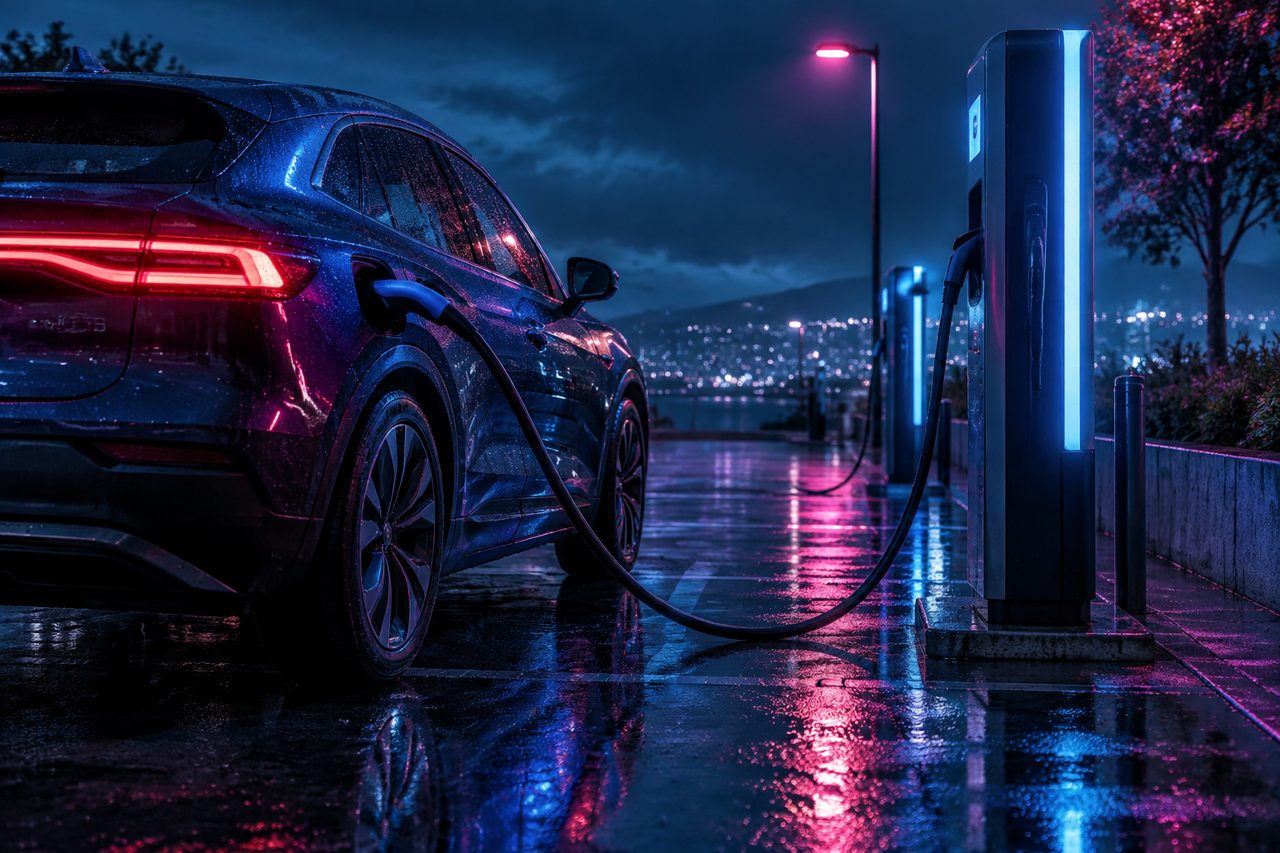
A station appears on the screen, four chargers are listed, and the detour seems reasonable. On arrival, one connector fails to respond, payment stalls, and power falls well short of the promise. This scene sums up the next challenge for electric vehicles: turning a charging network into a reliable service. By September 2026, the real test could be less about the number of sockets than the certainty of getting back on the road. The trends described here draw on facts established through 2024; their projected development towards 2026 represents an outlook, not an account of observed results.
Counting sockets is no longer enough
The first battle was essential: installing charging points where none existed. In France, as elsewhere in Europe, rollouts accelerated in the early 2020s, on motorways, in retail car parks and along streets. This growth made more journeys feasible. Yet it does not tell the whole story of how easy those journeys are.
A charging point provides a way to charge a vehicle, but is not necessarily a self-contained, resilient station. Several points may share a power supply, payment equipment or a network connection. A single failure can then disable several of them. Conversely, a station with many bays offers a fallback when a connector breaks down.
The right unit of measurement therefore becomes the successful journey. Did the driver find an accessible space? Did they start the session without assistance? Did they receive enough energy in the expected time? These questions say more about the service delivered than a national total, however impressive.
Available in the system, unusable on site
The word “availability” conceals several realities. A charger may communicate normally with the monitoring system while having a damaged cable or an unreadable screen. It may also work perfectly but sit behind a car park’s closed barrier. That is without counting spaces occupied by vehicles that are not charging, roadworks and poorly documented access restrictions.
Metrics are comparable only if their methodology is made clear. Is each connector measured, or the entire station? Are maintenance operations excluded? Is a charger operating at reduced power considered available? An excellent overall rate can conceal equipment that regularly fails on a route with no nearby alternative.
For users, information must above all be up to date and actionable. A technical status has value only if it reflects the situation they encounter. Driver reports can complement monitoring, but not replace it: asking customers to discover faults is not a maintenance policy.
Payment: the small obstacle that brings everything to a halt
Plugging in is sometimes followed by a second ordeal: choosing the right charging card, downloading an app, creating an account or waiting for bank authorisation. Roaming already allows drivers to use different networks through a single service, but it eliminates neither price differences nor all authentication failures.
The EU’s AFIR regulation, applicable since April 2024, has set simplification in motion. In particular, it requires publicly accessible charging points deployed from 13 April 2024 onwards to offer ad hoc charging, with requirements varying according to power output. For points rated at least 50 kW, this means a card reader or a contactless device that accepts payment cards. This framework does not mean that all existing infrastructure was instantly upgraded.
Direct card payment reduces dependence on subscriptions. It does not solve everything, however: an out-of-service terminal, a misunderstood pre-authorisation or an insufficiently visible price can still spoil the experience. Plug & Charge, which automates identification and charging authorisation for compatible vehicles and networks, offers another route. Its widespread adoption remains a prospect, not a universal reality.
Advertised power is not a charging-time guarantee
The sign advertises a 300 kW charger. Inside the car, the screen shows 65. That alone does not prove there is a fault. Power depends on the vehicle, its state of charge, battery temperature and battery preparation before the stop. It changes during the session, generally dropping sharply as the battery fills.
The infrastructure also plays a part. Power may be shared between several vehicles, limited by the electricity connection or reduced by thermal protection. A busy station can therefore deliver a different experience from an empty one. The label describes maximum capacity under certain conditions, not a guaranteed rate for every driver.
To compare services, it is better to look at the energy actually delivered over a meaningful period, taking the vehicle and its initial condition into account. Above all, operators would benefit from explaining limitations: a cold battery, shared power or degraded equipment. This transparency would help avoid confusing normal behaviour with a technical fault, while making genuine problems more visible.
Maintenance becomes a competitive advantage
Installing a charger is visible. Replacing a cable before it breaks, updating software without interrupting service or keeping a spare part in stock attracts less attention. Yet reliability is built through these routine operations. Fast charging combines power electronics, cooling, telecommunications and payment systems: all components that need monitoring and maintenance.
Remote maintenance can resolve some issues, but it cannot repair a broken connector. That requires a technician, an available part and access to the site. At an isolated service area, these constraints weigh more heavily. The time taken to restore service therefore deserves as much attention as the availability rate.
Looking ahead to 2026, greater differentiation through service quality seems plausible. Networks able to detect faults quickly, respond effectively and provide accessible support could build stronger customer loyalty. This shift is not automatic, however: cost pressures can also lead to maintenance being postponed.
The right criteria for assessing a network
For local authorities, fleet managers and drivers, a useful dashboard should bring together several indicators rather than elevate a single figure:
- Successful starts: does a session begin on the first attempt?
- Continuity: does charging finish without an unexpected interruption?
- Service in practice: do access, payment and information work on site?
- Repairs: how long do faults persist?
- Fallback options: are there enough connectors or a nearby station?
What happens next? By September 2026, the desirable scenario would be a shift in competition: less publicity focused solely on installations, and more verifiable commitments on how they operate. Comparable data, understandable pricing and maintenance built into tender specifications from the outset could accelerate this shift. The winning network will not necessarily be the one promising the highest power, but the one drivers can trust with a journey without routinely preparing a plan B.