For more than ten years, we have witnessed a boom in mobility 2.0, “decarbonized, intermodal and collaborative”, which has seen the appearance and development of “smart” vehicles, carpooling web applications and technological devices to facilitate car-sharing.
These innovations affect both our chosen journeys, such as going shopping, going to the gym or visiting friends; as well as the more constrained ones, linked to home-to-work commuting. These latter journeys, which represent only a third of the trips made by the French, are nevertheless those that structure their days; carried out 70% by car and solo, they are sources of pollution, congestion and stress. It is not surprising to see a set of mobility solutions oriented towards companies, employees, their expectations and their needs. These solutions propose changing the mode of transport (bike sharing, multimodal application), changing the use of transport modes (corporate fleet car-sharing, home-to-work carpooling, eco-driving tools) or changing organizations (teleworking and coworking spaces and tools).
While mobility solutions abound (and a quick trip on the web is enough to realize it), few companies and employees use them because, for a quite obvious reason, the choice of transport modes is not decreed but stems from various constraints, habits and mobility programs. Proposing a set of potential solutions cannot constitute a viable alternative without genuine change management being carried out.
What is the PDM? Who is it for?
The Mobility Plan (formerly the Company Travel Plan PDE) is established by the Law on Energy Transition for Green Growth, which establishes, through its article 51 (Law n° 2015-992 of August 17, 2015 relating to energy transition for green growth – Article 51)[1], the obligation for any company with more than 100 employees on the same site to adopt a PDM. The Mobility Plan consists of a set of measures aimed at optimizing employee travel in order to reduce their environmental impact, based on their needs, preferences and accepted and acceptable levers to change their mobility habits.
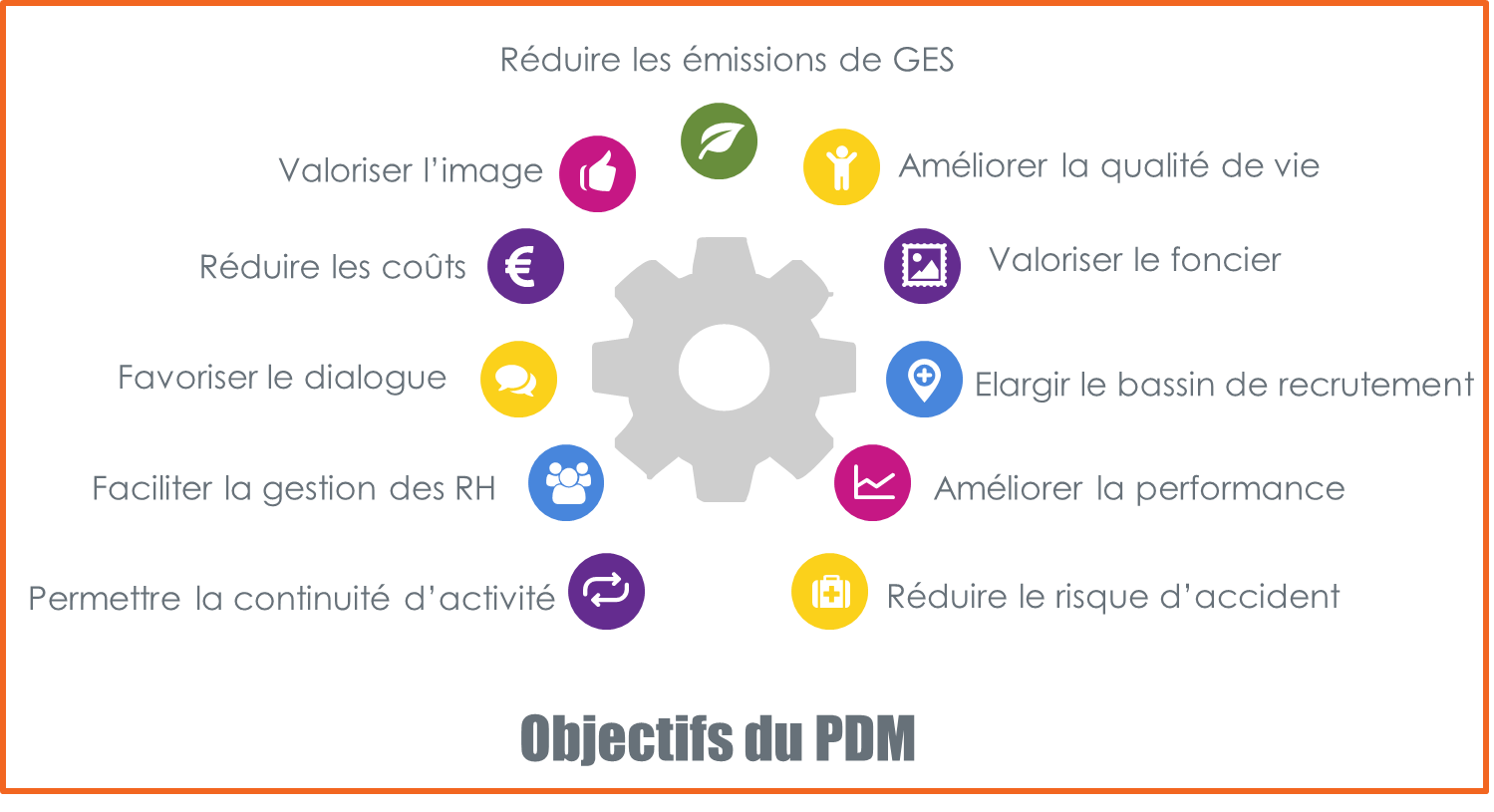
The PDM should not be considered as yet another regulatory obligation to which companies must submit, but as an opportunity to respond to everyday problems they face. While the stated objective of the PDM fits into a global approach to reducing environmental impact, it is also an opportunity to rethink issues of:
– parking: that famous “last mile” which sometimes wastes as much time as the rest of the kilometers traveled, not to mention investments in creating new parking spaces or maintaining existing ones;
– attractiveness: for companies facing recruitment difficulties due to distance, isolation, etc.;
– absenteeism: by reducing psychosocial risks due to stress exclusively linked to home-work commutes, which affects 15% of employees[1];
– accidents: by reducing the risk of commuting accidents, which constitute more than 6 million non-worked days, representing a loss of more than €750 million for companies[2]
– business continuity: thanks to increased independence regarding disruptive episodes such as strikes, extreme weather conditions, etc.
[1] Dares Analyses, Travel times between home and work, n° 081, November 2015
[2] Assurance Maladie – Risques Professionnels, Annual Report 2017
A co-constructed approach
It appears that the PDM is above all an organizational and management tool allowing the convergence of the company’s interests with those of its employees, and fitting perfectly into a Quality approach, an Environmental Management System or a CSR approach (Corporate Social Responsibility). It relies on management involvement, which constitutes a steering committee to communicate to its employees and get them to adhere to its approach. This committee’s role will be to define the PDM objectives, monitor the different stages, validate the results and plan the actions to be implemented.
The PDM is structured in four stages:
– diagnosis: costs related to company travel (transport account), employees’ mobility practices, site accessibility, etc.;
– action plan: problems to be solved, (realistic) objectives to be reached, monitoring measures and indicators, the budget allocated to the PDM, etc.;
– implementation: everyone’s roles, the schedule and tools of actions to be carried out, actors and partners in the case of subsidies, etc.;
– monitoring and evaluation: tools for monitoring and dissemination of results, quantification of the effects of measures, etc.
If tomorrow, the primary way to get to work will be in our pocket, it will be by building a coherent approach that combines technical solutions with human concerns. Are these not the conditions that lead to change?