A molecule can change medicine without immediately changing patients’ lives. It still needs to be manufactured, packaged in a reliable device, delivered to pharmacies and made available for continued treatment. With incretin-based obesity drugs, the factory is becoming as strategically important as the laboratory. Behind the clinical results lies a pressing question: how can a therapeutic breakthrough be turned into accessible care without confusing commercial success with collective benefit?
To shed light on the challenges ahead in September 2026, this analysis draws on established events and findings, particularly from 2023 and 2024. Developments considered beyond that period are presented as prospects, not as an account of verified events.
A medical revolution meets industrial reality
Incretins are hormones involved in the body’s response to food. Drugs that act on their pathways, particularly GLP-1 receptor agonists, influence insulin secretion, satiety and food intake. Semaglutide, marketed under brands including Wegovy for weight management, and tirzepatide, which targets GIP and GLP-1 receptors, have changed expectations for obesity treatment.
Their value goes beyond the scales. The SELECT trial, published in 2023, demonstrated a cardiovascular benefit from semaglutide in a specific population: adults with overweight or obesity who had cardiovascular disease but not diabetes. In March 2024, the US health regulator expanded Wegovy’s indication to include reducing the risk of certain cardiovascular events in eligible patients. This finding does not automatically extend to all products or all patients.
Nevertheless, this medical credibility broadens potential demand. Supply difficulties observed in the early years after launch revealed a gap between the pace of adoption and industrial capacity. Marketing authorization creates neither filling lines nor available stock.
Manufacturing the molecule is not enough
The chain begins with the active ingredient. These treatments are peptides: manufacturing them requires complex synthesis, purification and testing stages. Increasing volumes means securing raw materials, equipment and expertise while maintaining consistent quality standards. A new facility does not become fully productive on the day it opens.
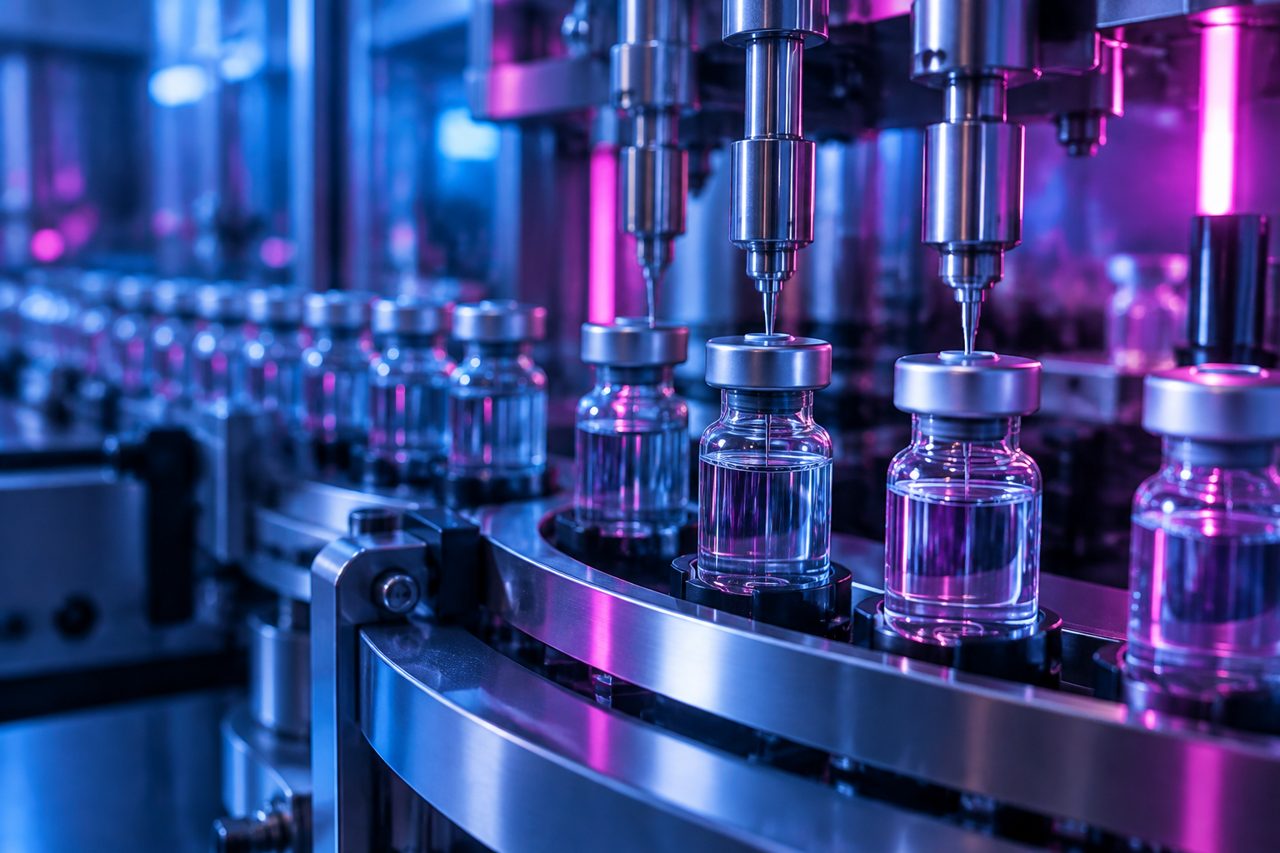
Next comes a less visible stage: aseptic filling. The solution must be placed in its container without contamination, volumes checked, units inspected and every batch documented. A shortage of capacity at this stage can limit deliveries even when the active ingredient is available. Device assembly, labeling, packaging and distribution then follow, with temperature requirements specific to each product.
Investments that reveal what is really at stake
In February 2024, Novo Holdings, Novo Nordisk’s controlling shareholder, announced the acquisition of contract manufacturer Catalent. The deal provided for the transfer of three filling sites to Novo Nordisk. The distinction between the two entities matters, but the industrial signal was clear: control over packaging operations was becoming crucial to sustaining growth.
Eli Lilly also announced a substantial increase in its investment at its Lebanon, Indiana, site in 2024, notably to expand production of the active ingredients used in tirzepatide. These projects show that competition also hinges on construction timelines, process qualification and staff recruitment. Looking ahead to 2026, their contribution to genuinely available volumes must be assessed, not simply inferred from announcements.
The injection pen: a critical technology
For patients, the medicine is often an object held in the hand for a few seconds. For manufacturers, that pen represents an assembly of components, mechanical tolerances and safety features. It must deliver the correct dose, remain easy to use and minimize errors. Depending on the market and product presentation, devices may be single-use or multidose: the industrial and practical constraints differ.
The choice is therefore not merely aesthetic. A sophisticated device can make self-administration easier, but requires more parts and assembly capacity. A vial can bypass some constraints without being a universal solution: it requires appropriate equipment and handling. Simplifying factory operations must not make administration dangerously complicated for patients. Ergonomics deserves as much attention as production speed.
These devices also raise the issue of waste. Widespread regular injections mean more packaging, plastic components and sharps waste. Ecodesign and waste collection become practical concerns, without allowing any compromise on sterility. As for oral formulations under development, they could change the equation, but removing the needle guarantees neither simpler manufacturing nor lower costs.
Access cannot be measured by the number of boxes
Greater availability does not resolve the financial question. Obesity is a chronic disease and, for many patients, treatment may be long-term. Treatment-withdrawal studies have shown that weight regain can occur after discontinuation. The relevant cost is therefore not just that of the first month: it is the cost of a sustainable course of care, with its benefits, adverse effects and reassessments.
Health systems must balance a potentially very large patient population against limited resources. Targeting those most likely to benefit from treatment can be medically justified. But opaque criteria, burdensome procedures or high out-of-pocket costs can turn this prioritization into socioeconomic selection. Recognition of obesity as a disease should not depend on income.
Follow-up remains essential infrastructure
Prescribing requires an assessment of indications, contraindications and concomitant treatments, followed by support through gradual dose increases and monitoring of tolerability, particularly gastrointestinal effects. Follow-up must also address diet, appropriate physical activity and preservation of muscle mass. This is not a matter of pitting medication against supportive care: integrating the two is part of treatment.
Telemedicine can facilitate some consultations, but it does not systematically replace a clinical examination. Shortages and demand also encourage dubious supply channels: in 2024, the WHO issued an alert about falsified batches of Ozempic. A reliable legal supply therefore also protects patients against counterfeits and purchases outside authorized channels.
Changing the criteria for success
To assess innovation, three indicators deserve as much attention as a new factory: continuity of dispensing, quality of follow-up and reduced inequalities in access. Additional capacity can ease supply constraints without automatically bringing prices down. Patents, competition, reimbursement policies and public-sector negotiations remain decisive.
What comes next? Looking ahead to September 2026, the desirable scenario is a scale-up in capacity accompanied by suitable devices and better-organized care pathways. There is no guarantee that these will progress at the same pace. The next advance could therefore be less spectacular than a new molecule: a treatment that is continuously available, appropriately prescribed and financially manageable. It is at this level that medical promise will become collective progress.