Asking what an inscription means, photographing a scene without taking out your phone, taking a call while walking: smart glasses bring computing closer to our line of sight. They also move the camera onto an object that is easily forgotten. For their owner, this discretion is part of the convenience. For the person sitting opposite, it creates uncertainty: am I being recorded? Looking ahead to September 2026, this asymmetry will help determine their acceptability. This analysis draws on products and events established before that date; the developments discussed are forward-looking.
The real shift: less screen, more context
Back in the 2010s, Google Glass had already exposed the unease caused by a camera worn on the face. Subsequent generations changed strategy. Launched in 2023, Ray-Ban Meta glasses opted for a familiar frame, a camera, microphones and speakers, with no screen in front of the eyes. Their initial promise was more modest than that of an always-present computer: capture, listen, communicate. The gradual arrival of AI features capable of using images has broadened that ambition, with availability varying by market and language.
This approach has a tangible advantage: it eliminates some manual steps. Cycling, cooking or carrying groceries leaves little room for holding a phone in front of you. Glasses can make calls or voice commands easier. For some people with visual impairments, scene descriptions also offer potential assistance, without guaranteeing the accuracy needed in dangerous situations. Their usefulness lies less in a novel feature than in immediate access to it.
However, three uses must be distinguished: listening to audio, capturing a memory and submitting your surroundings to an AI system. The first does not require filming passersby. The second creates a file that could be shared. The third may transmit an image to a remote service for analysis. A single frame therefore conceals very different operations, which neither the wearer nor those around them necessarily understand at a glance.
A camera without the gesture of filming
The smartphone has an imperfect but familiar social cue: someone raises it, frames a shot and looks at the screen. Glasses erase part of that choreography. In a café, on a train or outside a school, looking at someone can now coincide with capturing an image. This does not mean that all glasses record continuously. But the inability to distinguish their operating states quickly is enough to sow doubt.
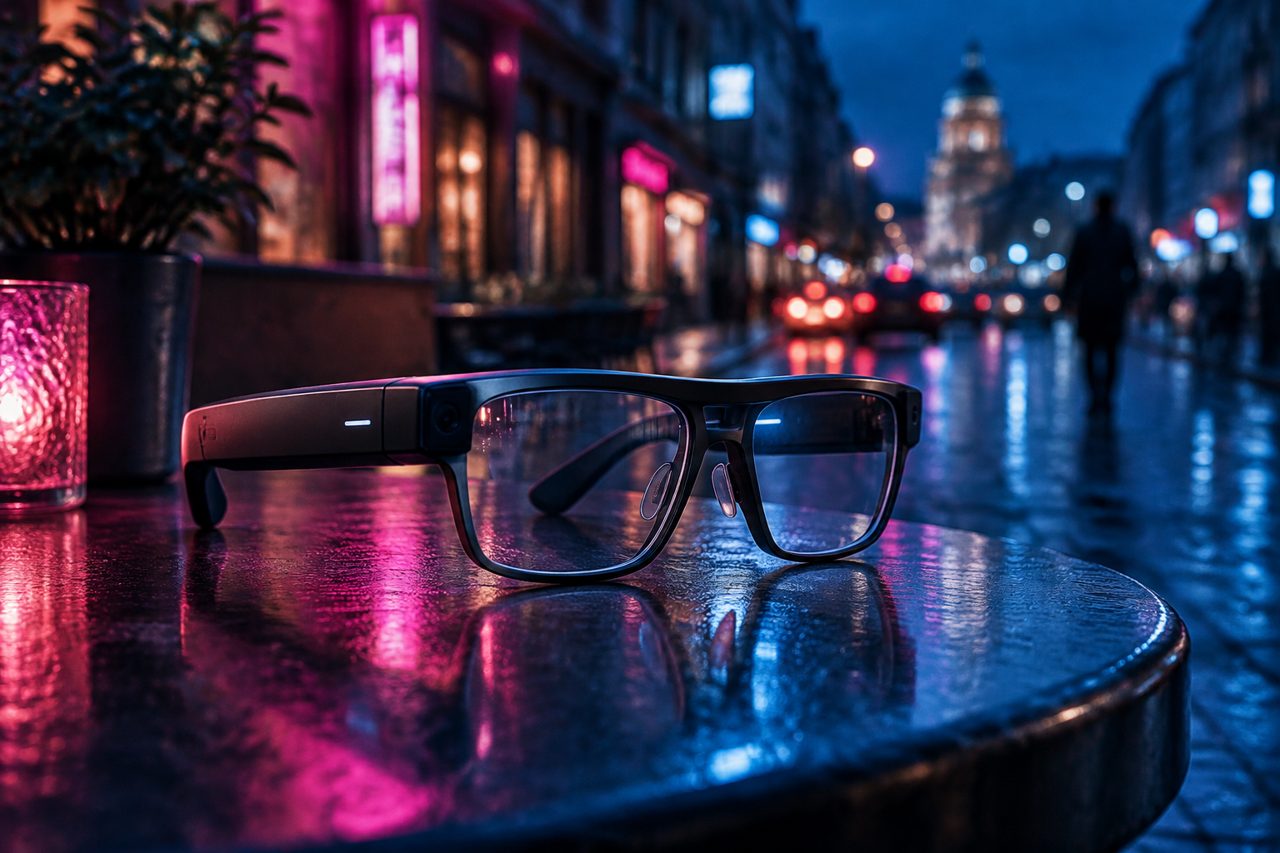
Ray-Ban Meta glasses, for example, have an outward-facing indicator light intended to signal image capture. This is a necessary response, not a complete solution. People still have to notice the light, know what it means and see it despite sunlight, distance or the angle of the wearer’s face. An indicator light does little to inform someone behind the wearer, even though their voice may be picked up by the microphones.
The challenge therefore goes beyond the presence of an LED. A technically active signal does not necessarily convey information that people understand. And informing someone does not automatically amount to obtaining permission. A person may discover they have been filmed without having had time to step aside, object or understand where the images will end up.
What being in public does not automatically permit
In France, filming in the street is not subject to a blanket ban. That does not give anyone carte blanche to distribute an identifiable image of a passerby, record private remarks or build a database of faces. Image rights, privacy protections and personal data rules may apply depending on the context, purpose and use of the recordings.
The GDPR provides an exemption for strictly personal or household activities, but its scope is not unlimited. Public distribution or professional use may change the legal assessment. Where the regulation applies, a small light alone does not fulfil obligations concerning transparency, justification for processing and respect for rights. Consent is not the only possible legal basis; nor should entering a camera’s field of view be assumed to constitute consent.
The most sensitive situations are not always dramatic: a conversation at the reception desk of a medical practice, a document on a desk, a recognisable child leaving an activity. An image can reveal more than its intended subject. AI increases the value of this contextual material, making it all the more important to limit what is collected.
Meaningful notification: a design challenge
One credible approach would be a common language across manufacturers. People should not have to recognise every model to know whether it is taking a photo, recording video or analysing a scene. Looking ahead to 2026, harmonised indicators would be a plausible step forward, but should not be presented as a certainty.
- An explicit indicator: visible from several angles, linked to capture at the hardware level and difficult to disable discreetly.
- Distinct states: differentiate audio use, recording and sending images to an AI service, without creating a proliferation of incomprehensible codes.
- A simple way to stop: allow the wearer to stop capture immediately and clearly confirm that it has stopped.
- Reduced collection: prioritise local processing, occasional captures and short retention periods wherever possible.
None of these measures is sufficient on its own. Local processing reduces some transfers but does not prevent subsequent distribution. Blurring can protect faces without concealing a voice, a uniform or an identifiable location. An audible signal, meanwhile, risks being drowned out in the street or becoming intrusive in a quiet space. Devices will need to be tested with the people exposed to them, not just with buyers.
Social practices to negotiate
In places where people spend time together, rules can be clearer than on the street. A company, a performance venue or a healthcare facility can set appropriate conditions of use, without conflating prescription glasses with recording functionality. The aim should be to regulate capture rather than treat every wearer with suspicion. Accessibility needs also call for accommodations, not blanket bans.
For users, saying “I’m taking a photo” often remains more effective than an indicator light. This habit does not resolve every situation, but it restores an interaction where technology has removed the visible gesture. Manufacturers would do well to encourage it rather than selling frictionless capture alone: that friction sometimes protects social relationships.
What next? The desirable scenario for September 2026 and beyond is neither an always-on camera nor the wholesale rejection of smart glasses. It is assistance that knows how to remain restrained: capturing only what is necessary, making its activity understandable and leaving genuine room for refusal. Their lasting success will depend as much on the comfort of those who wear them as on the trust of those they encounter.