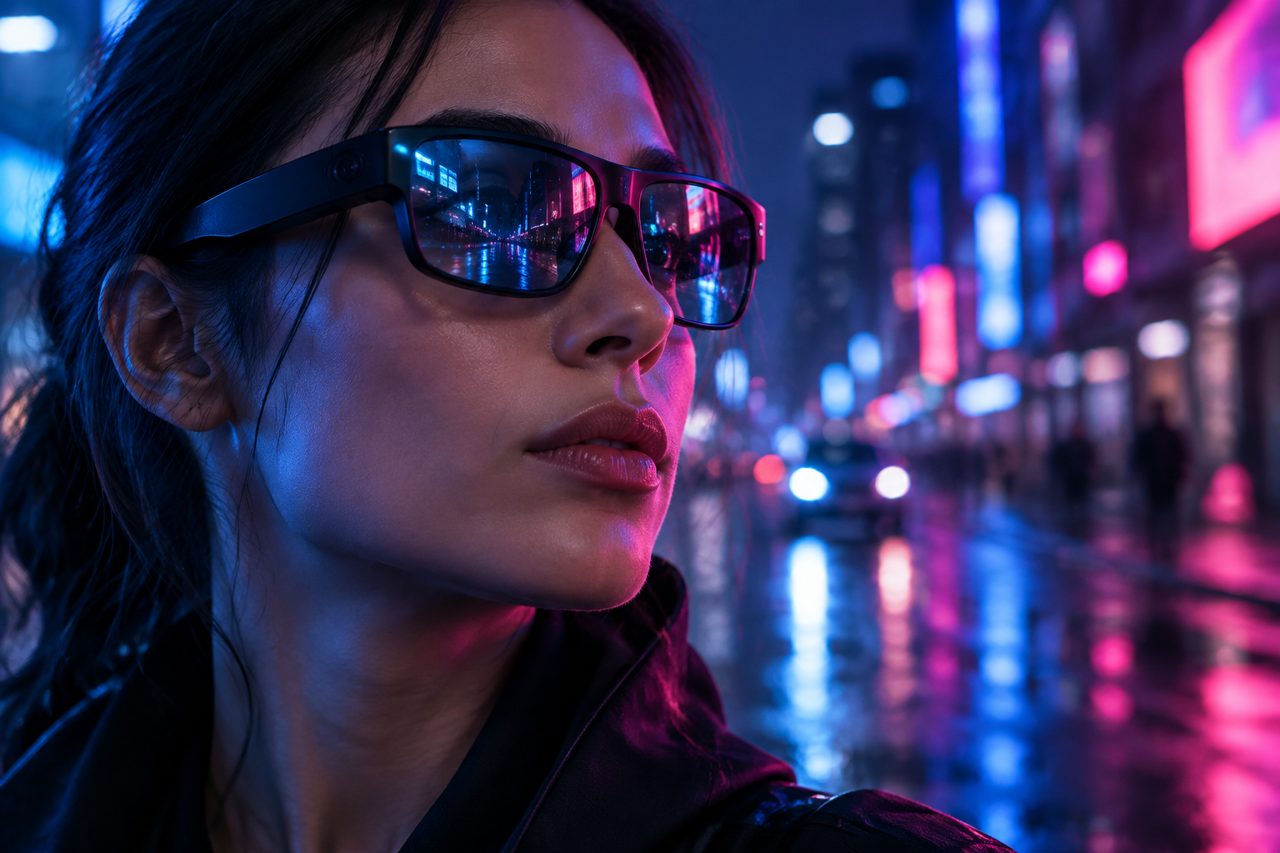
A conversation at a counter, a subway ride, an impromptu meeting: with smart glasses, these everyday scenes can become images, sounds or queries sent to an artificial intelligence system. The wearer gains an assistant at eye level. Everyone else inherits a question: am I being recorded? Looking ahead to September 2026, the challenge is not just to make these devices useful, but to make their presence socially acceptable. This analysis draws on facts documented through July 2024; any subsequent developments discussed are forward-looking scenarios.
From holding up a phone to wearing a camera
Google Glass had already exposed the problem in the early 2010s. Its unusual appearance signaled a technological device, without always making clear what it was doing. Hostile reactions and restrictions in some establishments left a lasting lesson: a personal device becomes a collective concern as soon as it can record the people nearby.
Ray-Ban Meta glasses, launched in 2023, shifted the debate. Their strength lies precisely in their ordinary appearance: they look like glasses someone might wear without any technological ambitions. Their features include taking photos, recording video, making calls and listening to audio. In spring 2024, Meta began rolling out AI features in the United States and Canada that could answer questions about what the glasses’ camera sees.
These products should be distinguished from augmented reality glasses with sophisticated displays. This generation of Ray-Ban Meta glasses does not overlay a screen onto the world. Their proposition is simpler: a camera, microphones, speakers and a voice interface, connected to a phone and remote services. This simplicity can make everyday use easier while making recording less obvious to those nearby.
Real benefits, but everyday value remains to be proven
There is no shortage of compelling use cases. Photographing a repair when both hands are occupied. Asking for information about a landmark. Keeping a record of a walk without looking at a screen. For some blind or partially sighted people, an audio description of a scene can also provide valuable help, as long as assistance is not confused with absolute reliability.
An AI can misread a label, invent a detail or misinterpret a situation. Wearing it on your face does not free it from the limitations of models available on a phone. The ease of voice interaction may even obscure uncertainty: an answer immediately whispered into the ear can seem more reliable than it actually is.
Looking ahead to 2026, the prospect of a more context-aware assistant seems plausible, without being a certainty. Translation, information recall or navigation could make the device more appealing. But every advance raises a question: to help more, must it observe more? A tool activated occasionally and a permanent memory of the day are not the same product.
Consent cannot be reduced to an indicator light
Ray-Ban Meta glasses have an outward-facing indicator light intended to signal when the camera is recording. It is a useful measure, not a complete answer. People still need to see the signal, understand what it means and be able to respond. In a crowded train carriage or bright light, that chain can break. An indicator signals activity; it does not prove that those affected have agreed to it.
The phone has never guaranteed perfect consent. Nevertheless, it involves recognizable gestures: someone takes it out, frames a shot and points it. With glasses, looking and filming can appear very similar from the outside. The person being observed does not necessarily know whether the device is switched off, taking a photo, transmitting a scene to an AI or recording video.
Audio further complicates the equation. A camera has a frame; a microphone can pick up a nearby conversation or information spoken off-camera. A parent may agree to a group photo without wanting conversations around their child to be stored. Consent must therefore relate to an understandable use, not merely to the presence of an object.
What AI changes: interpreting rather than simply storing
A recorded image and an analyzed image do not pose exactly the same risks. The latter can be used to extract text, recognize objects or produce a usable description. Depending on the available features and the systems to which it is connected, this analysis can turn a fleeting scene into information that can be searched, transmitted and combined with other data.
This does not mean that all glasses automatically identify passersby. It would be misleading to suggest that they offer across-the-board facial recognition. The risk also lies in the connections that can be made: a legible badge, an address on a letter or a photographed workplace screen can reveal a great deal, without any biometric identification algorithm.
The entire chain must therefore be examined. What data leaves the glasses or the phone? For what processing? How long is it retained? Is it used to improve models? The answers depend on the service and its settings. Local processing can reduce exposure to remote servers, but it does not remove the need to secure the device or respect the people being recorded.
The law exists; the situation remains hard to interpret
In France and the European Union, these devices do not create a rule-free zone. Personal data protection, image rights, privacy and workplace-specific rules may all come into play. The GDPR provides an exemption for certain strictly personal or household activities, but this is not a blanket authorization for all recording or sharing.
Filming in public spaces does not always require the prior agreement of everyone present. Conversely, being on the street does not eliminate all rights over one’s image and data. Context, purpose and distribution matter. In a medical practice, school or business, sensitive information and specific obligations make caution even more necessary.
Making control as simple as capture
Trust will not come from a longer instruction manual. It requires visible design choices: a signal that is difficult to conceal, accessible controls to switch off cameras and microphones, limited retention and clear explanations of data transfers. Wearers must be able to check what is active without digging through multiple menus.
Shared spaces will also need workable rules. Asking people to disable recording during a medical consultation or confidential meeting seems more targeted than indiscriminately banning all glasses. Accommodations will be needed for accessibility uses. Above all, the person facing the wearer must be able to refuse and have that refusal respected, without technical debate or suspicion.
What next? For September 2026 and beyond, the desirable scenario is not necessarily an assistant that sees everything. It is a device that knows when not to look, explains when it transmits data and leaves room for refusal. The next battle over smart glasses may hinge less on camera quality than on their ability to make control as natural as capture.