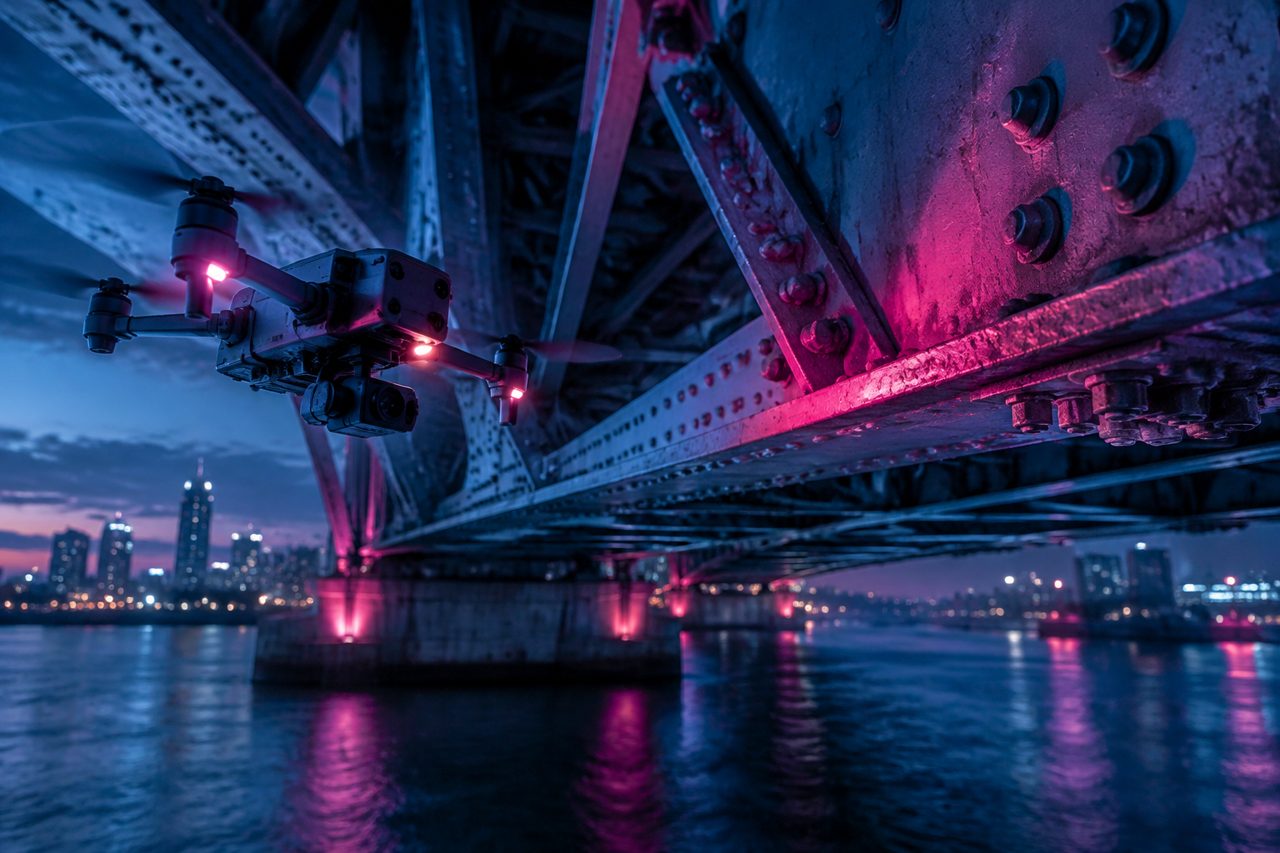
A drone flies along the deck, photographs a crack, then disappears beneath an arch. A suspicious area appears on the inspector’s screen. A few metres further along, a sensor detects unusual deformation. Should the bridge be closed? Should a repair be scheduled? Or should checks establish whether heat explains the discrepancy? Technology can raise the alarm; it cannot, on its own, deliver the verdict. Looking ahead to September 2026, the challenge is therefore not simply to deploy more instruments, but to turn their observations into reliable decisions.
Ageing structures, urgent choices
The collapse of the Morandi Bridge in Genoa in August 2018 was a stark reminder of the potential consequences of structural failure. In France, the 2019 Senate report on bridge safety highlighted gaps in knowledge and maintenance of bridge assets, particularly among smaller local authorities. The National Bridges Programme, launched in 2021 and led by Cerema, subsequently helped to inventory and assess municipal structures.
These initiatives address a very practical challenge: bridge managers must allocate limited resources across bridges of different ages, materials and uses. A modest structure may be essential for emergency services or farms. A striking bridge, meanwhile, may be well documented and regularly maintained. Size alone does not determine risk or urgency.
The problem therefore goes beyond detecting a crack. It requires knowledge of previous repairs, the loads carried, the condition of the foundations and the consequences of a closure. Technological developments already under way offer the prospect of more detailed monitoring by September 2026. But widespread deployment and tangible benefits remain prospects, not established outcomes.
The drone: a closer look, not an X-ray
For visual inspection, drones offer an obvious advantage: rapid access to some hard-to-reach parts of a structure. They can document a pier, a cornice or the underside of a deck, while reducing some work at height. Geolocated photographs and three-dimensional models then make comparisons between inspection campaigns easier, provided consistent image-capture protocols are maintained.
The limitations become apparent in the field. Beneath a bridge, satellite signals may be unavailable; turbulence, obstacles and proximity to water complicate flight control. Lighting changes the appearance of cracks. Usable resolution depends on distance, optics and sharpness, not just the advertised pixel count. Operations also remain subject to aviation rules and requirements to protect bridge users.
Above all, a surface image does not automatically reveal corrosion of reinforcement, the condition of an internal cable or a foundation defect. Thermography can identify certain anomalies under suitable conditions, but it is not a universal diagnostic tool. Drones complement human access and specialist testing; they replace neither direct contact with the structure nor examination of its hidden parts.
Sensors listen to the bridge in operation
Instruments installed on the structure add another dimension: time. Gauges track local deformation; accelerometers record vibrations; other devices measure the opening of a crack or the tilt of a component. Optical fibres can track deformation at multiple points, or even along the length of a sensing cable. This makes it possible to observe how the bridge behaves under traffic and changing weather conditions.
This continuity is valuable, but misleading if interpreted incorrectly. A bridge expands as temperatures rise. Its vibrations change with traffic, wind and support conditions. A variation therefore does not necessarily indicate deterioration. Conversely, a local defect may develop without immediately producing a clear signal in the selected sensors.
A baseline must be established, seasonal cycles covered as fully as possible and measurement quality checked. A depleted battery, a detached sensor or an interrupted transmission can create an apparent anomaly. Monitoring foundations exposed to scour requires specific observations, sometimes underwater. Instrumenting the deck is not enough to understand what the river is washing away around the piers.
Cross-checking evidence rather than collecting alerts
Consider an illustrative scenario: a photographic inspection identifies a crack near a support. Comparison with earlier images suggests it has changed. At the same time, a sensor records a change in deformation. The engineer checks these findings against temperature data, recent works and drawings. Their agreement may justify a close-up inspection, testing or a recalculation of load-bearing capacity. On its own, however, it does not yet prove that safety has been compromised.
This is where analytical software can help. It sorts images, suggests areas to examine and identifies deviations in long time series. But a model trained on particular types of concrete or photographic conditions may perform less well elsewhere. False positives overwhelm teams; false negatives foster dangerous confidence. A successful demonstration therefore does not amount to operational validation.
A “digital twin” can bring together geometry, historical records, measurements and calculations. But a viewable model must be distinguished from a properly calibrated mechanical model. An attractive visual representation offers no guarantee of predictive capability. Reliability depends on the assumptions, the available data and the uncertainties that remain explicitly acknowledged.
Prioritising works without automating responsibility
For a bridge manager, the right question is not: “Which bridge generates the most alerts?” It is: “Where would an intervention reduce risk the most?” The answer combines the structure’s condition, its potential failure mechanisms, traffic, alternative routes and the human consequences of an incident. A single score can obscure situations that are not comparable.
A robust approach combines three levels:
- Observe: inspections, images and measurements with documented quality.
- Diagnose: structural expertise, targeted investigations and appropriate calculations.
- Decide: maintenance, repair, restrictions or closure according to the assessed risk.
The true cost also includes installation, calibration, connectivity, analysis and equipment replacement. For some structures, rigorous periodic inspections and regular maintenance will be more useful than a permanent sensor network. For others, targeted instrumentation will help track an identified phenomenon. Data must remain exportable, access secure and responsibilities clearly assigned.
What next? The most credible prospect for September 2026 is a tiered approach to monitoring: improving knowledge of every structure, instrumenting those that warrant it and investigating significant anomalies in greater depth. Drones and sensors can help prevent certain failures, provided an alert leads to expert assessment and then to funded action. The decisive advance will not be a more impressive dashboard, but a defect understood early enough to repair before it becomes an emergency.