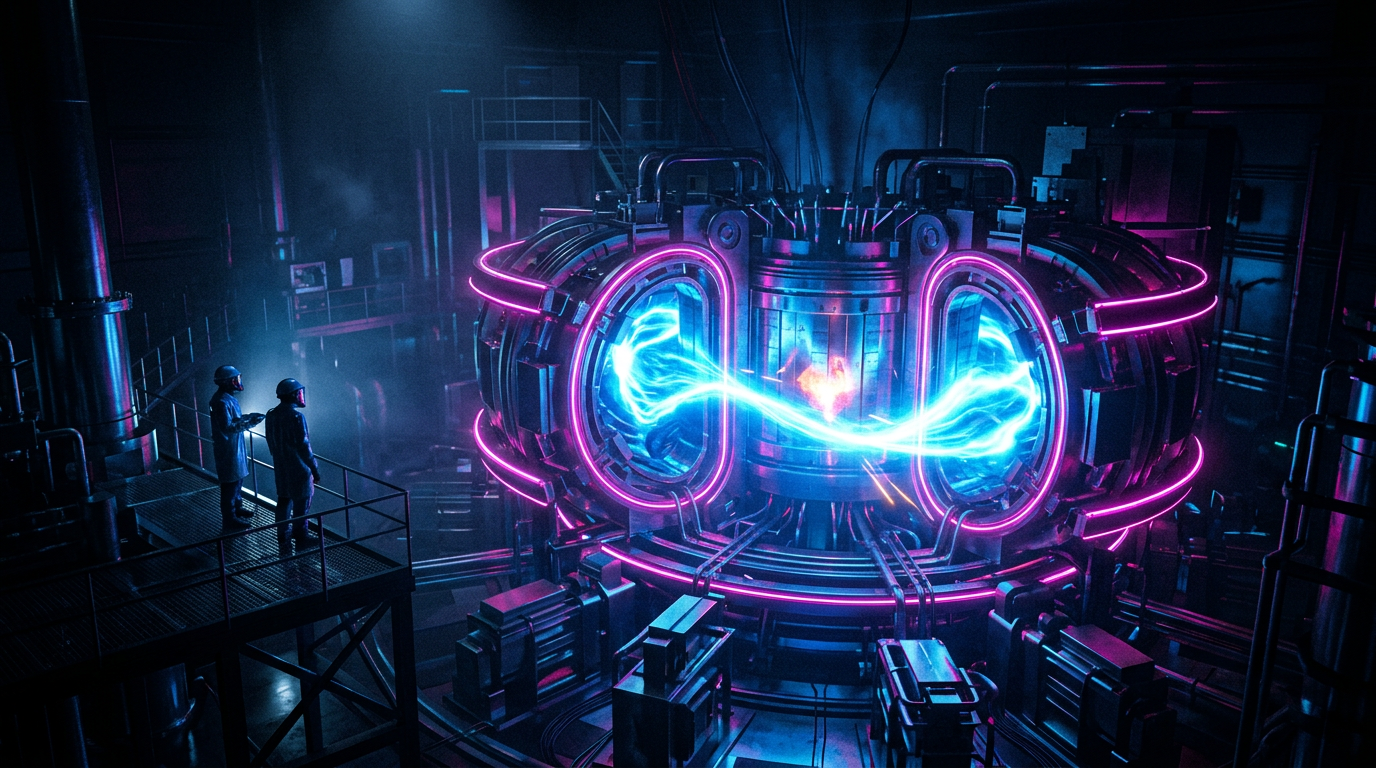
Long confined to the realm of science fiction or theoretical research, nuclear fusion is crossing a decisive threshold. Unlike fission, used in our current power plants and consisting of breaking heavy atoms, fusion reproduces the mechanism at the heart of stars: the union of light nuclei to release colossal energy. A technological shift that promises carbon-free, controllable electricity without long-lived radioactive waste.
Key figures of a revolution in progress
To understand the scale of the challenge and recent progress, one must look at the technical indicators sending the sector’s meters spinning:
- 150 million degrees: This is the temperature reached within the most efficient tokamaks, ten times the temperature of the Sun’s core.
- Q > 1: The symbolic threshold of scientific profitability. In 2022, the Lawrence Livermore National Laboratory generated more energy than it consumed to trigger the reaction.
- 2035: The horizon set by the international ITER project in France for the production of the first high-performance plasma.
- 40 billion: The approximate amount in euros of public and private investments injected into the sector globally.
These data testify to an unprecedented acceleration. While the path to commercial exploitation remains fraught with obstacles, particularly regarding material resistance and maintaining magnetic confinement, optimism is growing among private investors who are launching numerous startups (Commonwealth Fusion Systems, Helion Energy) alongside large state consortiums.
What you need to know about safety and the environment
The main advantage of fusion lies in its intrinsic safety. Unlike fission, there is no risk of a “meltdown” or an uncontrolled chain reaction. If an incident occurs, the plasma cools instantly and the reaction stops dead. Furthermore, the fuel used, mainly isotopes of hydrogen (deuterium and tritium), is found in abundance in seawater or can be produced from lithium.
Environmentally, fusion does not generate greenhouse gases. It produces helium, an inert gas, and the reactor components become radioactive but for a limited duration (about a hundred years compared to millennia for current waste).
Concrete tips for following this innovation
For decision-makers and tech enthusiasts, here is how to understand this rapidly changing sector:
- Distinguish fusion from fission: Do not confuse the two anymore. Fusion is the long-term solution that will solve the problem of waste and fuel resources.
- Monitor superconducting magnets: This is the key technology. Recent progress on high-temperature magnets allows for the design of smaller and less expensive reactors.
- Do not expect deployment before 2040: Despite the enthusiasm, implementation on the electrical grid will take time. Fusion is a marathon, not a sprint.
- Follow the French ecosystem: With ITER in Cadarache, France is the global epicenter of this research. Many technological SMEs gravitate around this titanic project.
In conclusion, nuclear fusion is no longer just a distant promise. It is becoming a major geopolitical and industrial issue. While engineering challenges remain immense, the convergence of private capital and public research gives hope for a first industrial exploitation by the middle of the century.