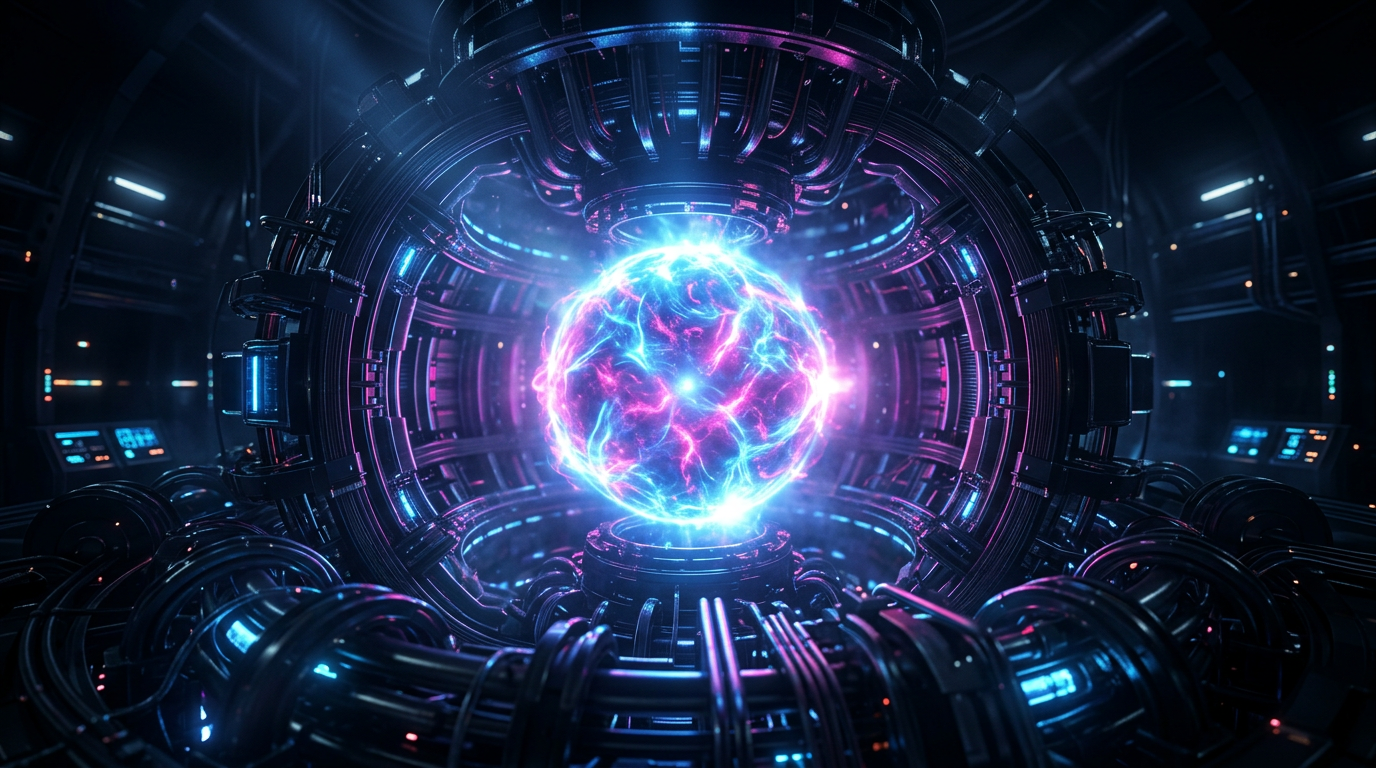
Long relegated to the status of a promise eternally located fifty years in the future, nuclear fusion is experiencing an unprecedented acceleration. Unlike fission, which breaks heavy atoms while generating radioactive waste, fusion consists of uniting light nuclei to release colossal energy. It is the very process that powers the stars. Today, laboratories are no longer alone: the private sector has taken hold of the subject, transforming a scientific quest into an imminent industrial challenge.
The Incursion of Venture Capital into Plasma
The research landscape has radically changed in less than a decade. While the international ITER project, under construction in the south of France, remains the flagship of scientific cooperation, start-ups such as Commonwealth Fusion Systems (USA), Tokamak Energy (UK) or Renaissance Fusion (France) are shaking up the schedule. These companies benefit from a unique technological conjunction:
- High-temperature superconductors: They allow for the creation of much more powerful and compact magnets, reducing the required size of reactors.
- Numerical simulation: Current computing power allows for modeling the behavior of plasma—this gas heated to 150 million degrees—with a precision previously impossible.
- The climate urgency: The need to find a controllable, carbon-free, and virtually unlimited energy source is attracting billions of dollars in private funds.
Strategic Stakes for Businesses
For the economic world, fusion represents the Holy Grail of the energy transition. Unlike solar or wind, it is not intermittent. For energy-intensive industries such as steelmaking, chemicals, or AI data centers, the promise is one of long-term energy cost stability. But the challenge is not only physical, it is industrial. It is now necessary to build supply chains for rare materials, such as lithium or tritium, and to invent maintenance methods for machines subjected to extreme neutron fluxes.
Major energy groups are not mistaken. TotalEnergies, Chevron, and Eni are investing massively in these technological gems. They are not just seeking to green their image, but to secure their place in the energy mix of 2040. Fusion will not replace renewables tomorrow, but it could become the backbone of global power grids in the second half of the century.
Perspectives: The 2030-2035 Horizon
The current critical step is that of ‘net gain’: producing more energy than that consumed to heat the plasma. The National Ignition Facility (USA) briefly achieved this via laser in 2022. The next decade will see the emergence of industrial prototypes capable of maintaining this reaction continuously. Experts predict the first injections into the power grid between 2035 and 2040.
Science has done its job; it is now up to engineers and financiers to see it through. Although technical obstacles remain immense, particularly regarding material resistance, the shift is irreversible: fusion has moved from the physicists’ blackboard to entrepreneurs’ business plans. For tech and business, it is perhaps the greatest industrial adventure of the 21st century beginning.