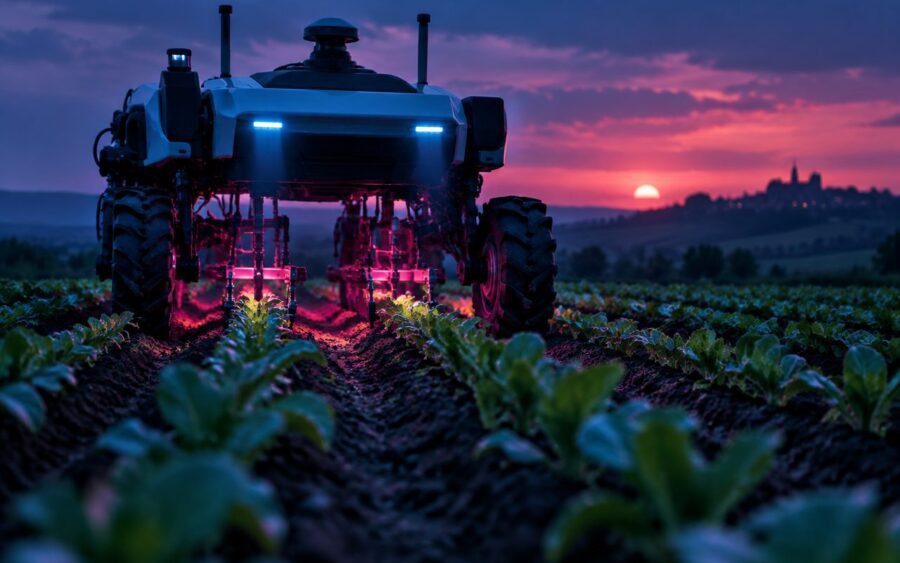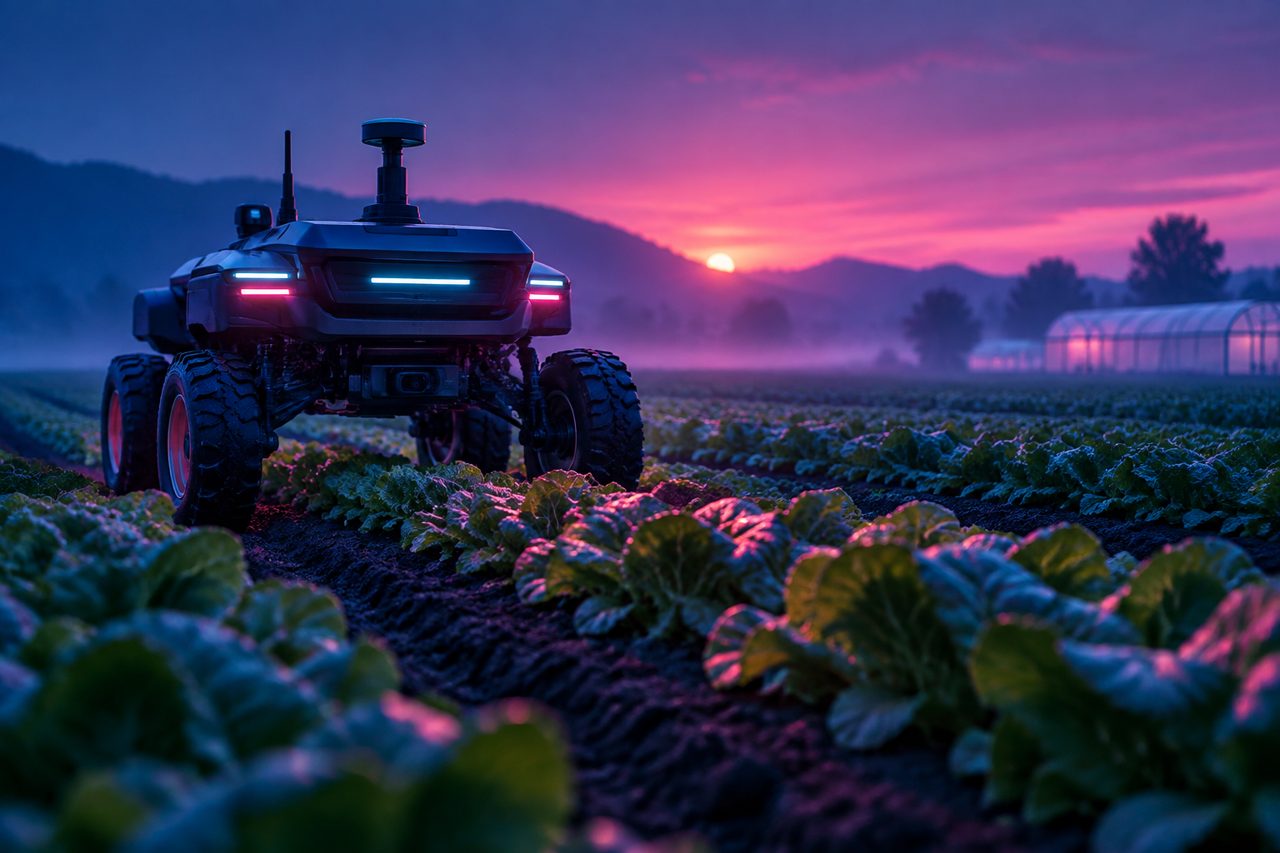
A tractor moves over vegetable beds. Beneath a hood, cameras scan the soil while beams heat the weeds. No spraying, no blade between the rows: weeding becomes a matter of image recognition and thermal precision. With its LaserWeeder, US company Carbon Robotics has turned that promise into a commercial reality. The question remains: can fields be cleared fast enough, at the right time and at an affordable cost? This analysis distinguishes documented achievements from prospects envisaged for September 2026.
Identify, target, heat: a demanding sequence
The principle seems simple. Cameras observe the plants, software distinguishes crops from weeds, and the system then directs a laser at a vulnerable part of the weed. Light energy turns into heat and damages the targeted tissue. The aim is not to burn the entire plant to a crisp, but to damage its growing point enough to stop its development.
Everything hinges on how these steps fit together. The system must identify a young carrot without confusing it with a weed, locate the target while moving, then deliver enough energy. An error can leave a weed alive or damage the crop. Overlapping leaves, residues and tiny seedlings make this assessment more difficult. Performance therefore depends as much on computer vision as on the laser itself.
Carbon Robotics is not alone in this field: Germany’s weederaser, among others, is also exploring laser weeding. But the word “robotic” can be misleading. The LaserWeeder sold by Carbon Robotics is a tractor-mounted implement, not necessarily an autonomous vehicle. Automating the task does not mean making the entire operation fully autonomous. The equipment still needs to be driven, adjusted, monitored and maintained.
A credible promise for certain crops
The first benefit is avoiding herbicide application during the pass in question. The laser does not spray an active substance onto the target or cultivate the soil like a mechanical hoe. This lack of mechanical contact can be useful close to crop plants, where a blade risks cutting roots or burying young shoots.
The proposition is particularly appealing for high-value crops, especially vegetables, where hand weeding is expensive and available chemical options may be limited. In organic farming, it can complement mechanical tools and reduce some manual interventions. The calculation changes in a large cereal field: the area to cover becomes vast, while the value produced per hectare leaves less scope to recoup the cost of an expensive machine.
A plant that has been hit must also be distinguished from a weed that has been controlled for the long term. A young annual is generally a more favourable target than a perennial capable of regrowing from its underground structures. New flushes of weeds may require several passes. The laser does not empty the soil’s seed bank: it plays a role within a strategy that includes rotations, cover crops, stale seedbeds and other control methods.
Work rate: the real test
At a demonstration, people watch plants disappear. On a farm, they watch tomorrow’s weather forecast and the hectares still awaiting treatment. The laser must spend a minimum amount of time on each target. When weeds are numerous or more developed, the workload increases. Adding more beams can improve capacity, but also adds components, power requirements and cost.
Forward speed alone therefore cannot describe productivity. Working width, weed density, headland turns, travel between fields, adjustments and stoppages must all be factored in. A work rate quoted for sparse vegetation cannot be applied to a heavily infested field. The best measure remains the area actually weeded to the required standard within the available window.
That window can close quickly: weeds keep growing while another field waits. A precise but overly slow machine may miss the stage at which treatment is most effective. Conversely, with suitable planning, it could substantially reduce follow-up hand weeding. Looking ahead to September 2026, the challenge is less a race for power than an improvement in effective work rates and consistency.
The weather does not disappear with herbicides
Lasers avoid certain spraying constraints, notably droplet drift. That does not make the operation independent of outdoor conditions. After rain, the soil may not be able to support a heavy tractor and implement. Dust, mud or condensation can interfere with observation and require protective optical covers to be cleaned. The condition of the plants and how exposed they are must also be considered.
Controlled lighting can facilitate night work and reduce variations in light levels. It does not eliminate leaves obscuring targets or uneven terrain. Above all, powerful lasers require beam containment, safety devices and rigorous maintenance procedures. The availability of a technician and spare parts matters as much as the algorithm when a breakdown occurs at the height of the season.
What does a weed-free hectare cost?
The purchase price does not represent the full investment. Financing, the tractor required, energy, maintenance, any software services, training and downtime must all be included. Set against these are the costs avoided: products, mechanical passes or hours of manual labour. Reduced crop damage may also have value, provided it is measured rather than assumed.
Before signing, three checks are essential:
- Test it on your crops: measure surviving weeds, any damage and the follow-up work required.
- Model a full season: calculate how many hectares can actually be treated within the agronomically effective windows.
- Assess service support: establish repair times, warranty exclusions and terms of access to data.
Contract services or collective purchasing could make this technology accessible to more farms. These are possibilities, however, not automatic solutions: several neighbouring farms may need the same equipment at the same time. The environmental footprint also deserves a comprehensive comparison. Reducing herbicide use has benefits, but manufacturing and moving a machine, then powering its lasers, consumes resources. The outcome depends on the system being replaced.
A role to establish, not a universal replacement
Laser weeding appears better equipped to serve specific niches than to replace every treatment. Its success will be judged through independent trials repeated over several seasons, producing comparable agronomic and economic results. Demonstrations prove that a task is possible; they do not yet prove that it will be profitable everywhere.
What next? Looking ahead to September 2026, the most plausible scenario is selective growth: equipment adopted where crop values, labour costs and field layouts justify the investment. Progress could come from better software, simpler maintenance and increased capacity. To find its place, the laser will above all have to deliver on a less spectacular promise: season after season, a sufficiently weed-free hectare at the right price.