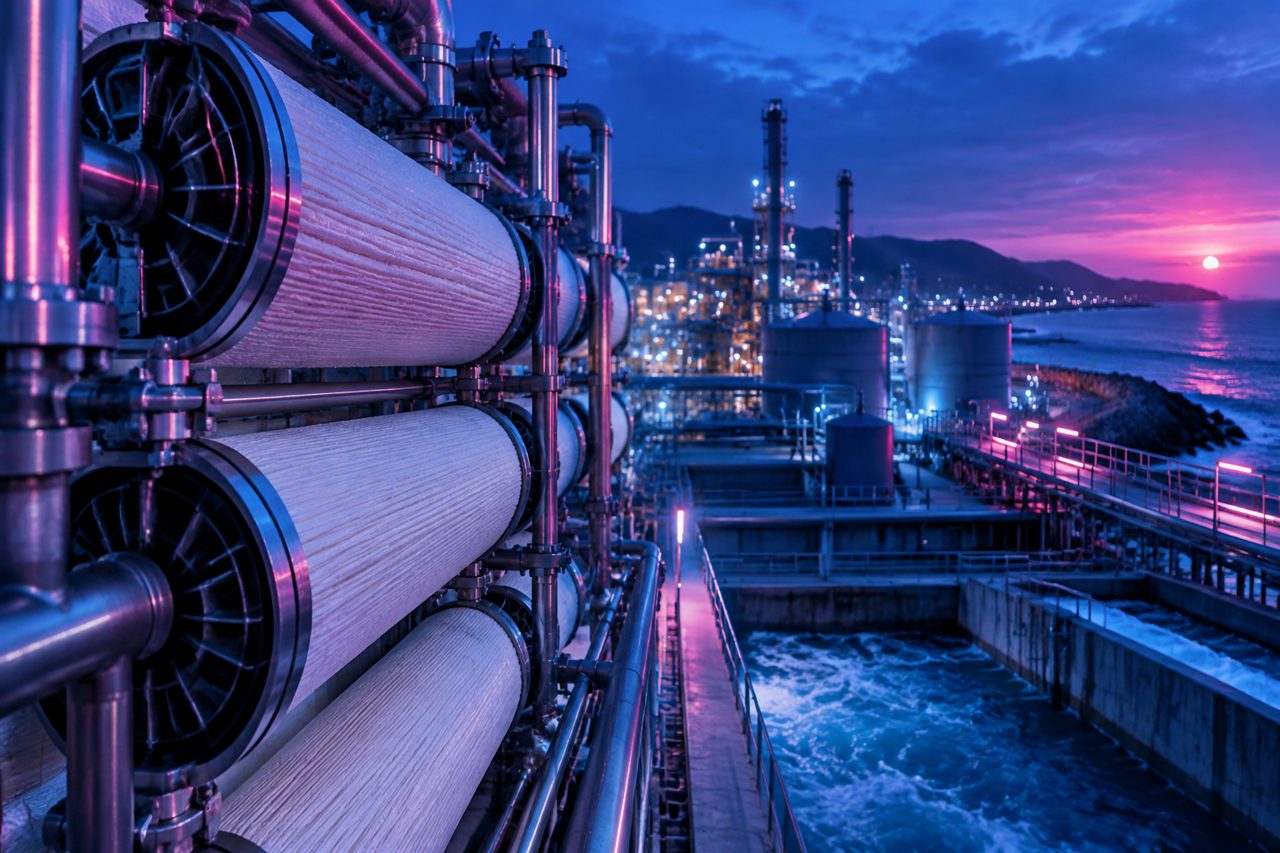
Turning seawater into drinking water: the promise seems irresistible when reserves are dwindling. But behind the tap, pumps are running, filters are fouling and highly saline water is being returned to the marine environment. New membranes can ease the burden of this costly process, but cannot eliminate its constraints. Looking ahead to September 2026, the question is therefore less about a miracle material than about verifiable industrial progress: sustainably producing water that meets quality standards, with less electricity, cleaning and downtime. Here is what technologies already documented offer grounds to expect, without confusing laboratory promise with proven performance.
The bill goes beyond the filter
In a reverse osmosis facility, the dominant technology in new seawater desalination plants, water is forced under high pressure against a membrane that allows most water molecules through while retaining salts. This requires energy: a few kilowatt-hours per cubic metre in modern facilities, with variations depending on salinity, temperature, the quality required and the scope of the calculation. Pumping, pretreatment and final treatment also count.
Energy recovery devices have already done much to change the equation. They recover much of the pressure in the outgoing concentrate to help pressurise incoming water. Membranes are therefore being introduced into a system that is already optimised. The final cost also includes construction, financing, chemicals, replacements and sometimes long-distance transport to consumers. Improving a membrane does not reduce all these costs at once.
More permeable, but without letting salt through
The industry benchmark remains the thin-film composite membrane, whose active layer is generally made of polyamide. Manufacturers are refining its structure, thickness and surface to make it easier for water to pass through. Greater permeability can reduce the pressure needed for the same output, or reduce the installed membrane area. But these two benefits do not automatically add up: they depend on the plant’s design.
The challenge is to maintain salt rejection, mechanical strength and service life simultaneously. An extremely thin layer that delivers spectacular results over a few square centimetres must remain uniform across industrial-scale surfaces. A single defect is enough to compromise the quality of the water produced. Certain compounds, such as the boron found in seawater, complicate matters further: depending on health requirements and operating conditions, removing them may require pH adjustments or a second pass.
Graphene and nanomaterials: assessing the promises
Nanoporous graphene, graphene oxide, two-dimensional materials, nanocomposites and aquaporin-inspired membranes: research is pursuing many avenues. They aim to organise the pathways taken by water more precisely, or to make the surface less hospitable to contaminants. These approaches, however, differ in both performance and maturity. Some have led to commercial products, without replacing conventional membranes in large-scale seawater desalination.
For September 2026 and the years that follow, gradual improvements remain a more credible scenario than a sudden replacement. Any innovation will have to demonstrate its stability in real-world water, withstand cleaning and be manufactured at an acceptable cost. If it contains nanomaterials, their potential release and subsequent fate will also need to be assessed. The decisive result is not a laboratory flow-rate record, but reliable production over several years.
Fouling: the invisible tax
In the field, salt is not the only enemy. Organic matter, particles, microorganisms and mineral deposits eventually obstruct the passage of water. To maintain production, operators sometimes increase the pressure, then have to clean the membranes. Each intervention consumes chemicals, takes equipment out of service and can accelerate membrane ageing. A slightly less permeable surface that stays cleaner for longer may therefore deliver better economics.
Hydrophilic coatings and certain surface modifications aim to limit the adhesion of unwanted substances. They do not make facilities self-cleaning. Biofilm, in particular, is a tenacious opponent: bacteria colonise surfaces and produce a protective matrix. Another difficulty is that conventional polyamide membranes have limited tolerance for certain oxidants, including free chlorine. Effective disinfection while preserving the active layer therefore requires careful process management.
Pretreatment returns to the forefront
Part of the battle can be won before the reverse osmosis modules. Depending on the site, screening, coagulation, flotation, media filtration or ultrafiltration remove contaminants that could disrupt downstream processes. During algal blooms, robust pretreatment can make the difference between maintaining production and slowing a plant down. Subsurface water intakes, where suited to local geology, also offer valuable natural filtration.
Innovation is as much about this treatment chain as it is about materials. Sensors, combined with operational models, can help anticipate deterioration in incoming water quality and adjust chemical doses or cleaning schedules. This offers operational potential, not an automatic guarantee. Excessive pretreatment increases costs and waste; too little leaves membranes exposed. The right settings must be demonstrated over the full cycle, accounting for seasonal variations at the site.
A physical limit and an accounting limit
Even a perfect membrane cannot eliminate the minimum energy needed to separate water from salt. This thermodynamic constraint depends in particular on salinity and the proportion of fresh water recovered. As facilities improve, further gains become harder to achieve. A dramatic increase in permeability therefore does not translate into a proportional reduction in total electricity consumption.
To assess an offer, the comparison must focus on the cost per cubic metre of compliant water delivered, not just the cost of the filtration module. What pressure is needed in cold water? How many cleaning cycles? What service-life guarantee? Using low-carbon electricity can reduce the climate footprint, but does not demonstrate lower energy requirements. And water produced more cheaply on the coast may still be expensive to transport to higher elevations.
Brine remains the sticking point
Extracting more fresh water reduces the volume of concentrate, but increases its salinity and the risk of mineral precipitation. It does not eliminate the mass of salts that must be managed. At sea, the impact depends on the discharge flow rate, currents, depth, habitats and chemical residues. Diffusers and a carefully chosen location promote dilution, but do not remove the need for ecological assessment and monitoring.
Recovering minerals or moving towards zero liquid discharge can make sense in certain industrial contexts. It is not a universal solution: concentration, crystallisation and separation consume energy and require viable markets for the recovered products.
What next? The most useful advances could come from combining a more robust membrane, targeted pretreatment and better operational control. For local authorities, the sound approach is to demand results under real-world conditions, including discharges. Desalination can secure a water supply; it still needs to be weighed against water conservation, leak repairs and wastewater reuse.