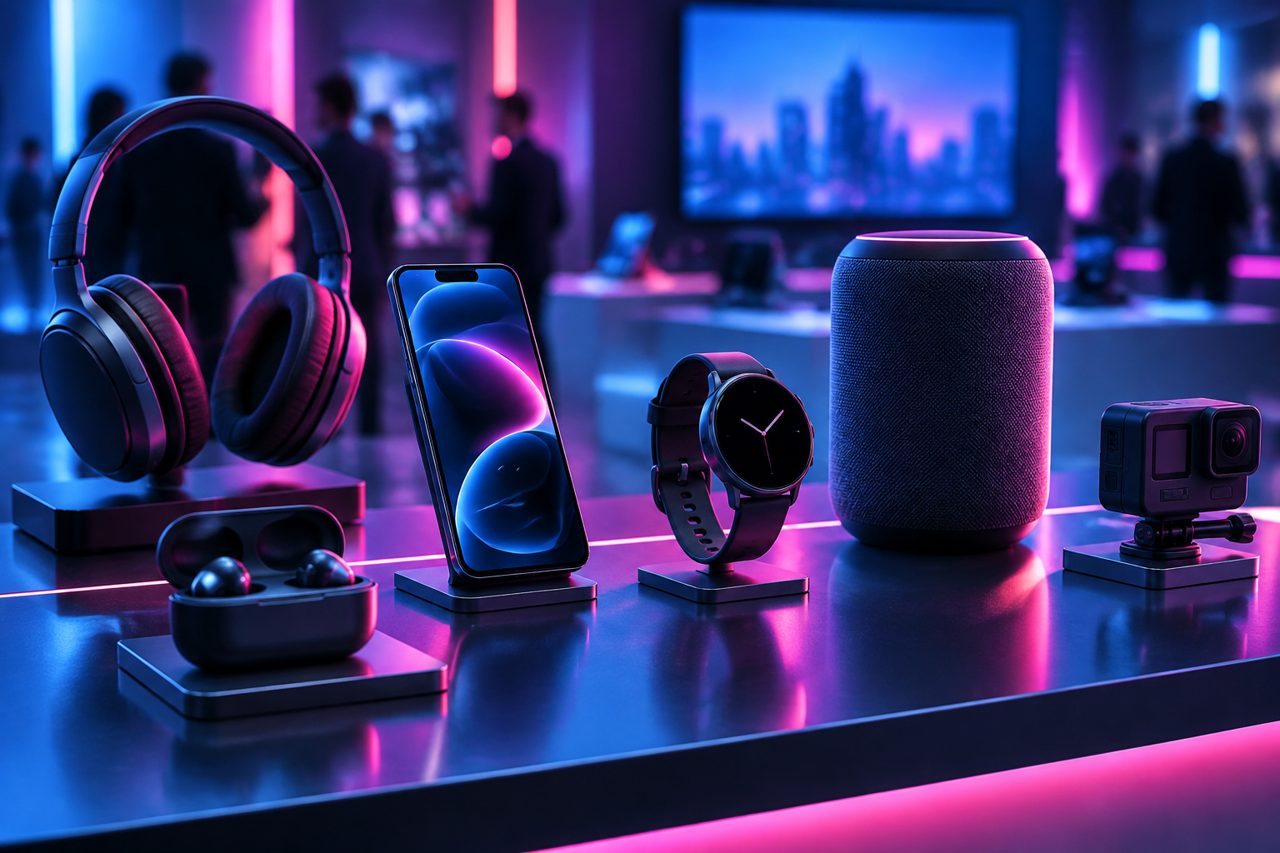
A pendant that listens, glasses that describe a scene, a refrigerator that suggests dinner: at CES in Las Vegas, almost every device can now claim an extra layer of intelligence. But between the demonstration and everyday life, one question persists: what does this AI really offer once the battery is drained, the subscription bill arrives and the data has been sent to the cloud? Looking ahead to September 2026, this is where these devices’ credibility will be tested.
This analysis draws on documented products and events, particularly around CES 2024, followed by the first commercial setbacks for this generation of devices. The outlook for September 2026 is presented as such: this is not a report on announcements from the 2026 edition.
A demonstration is not yet a use case
CES excels at one thing: making the future look appealing in just a few minutes. Someone asks a question, the device understands, and an answer appears. But a controlled demonstration does not show how it behaves on a noisy subway, with an unfamiliar accent, a poor connection or several people speaking. Nor does it reveal how many corrections are needed to complete a task.
Unveiled at CES 2024, the rabbit r1 embodied this promise of an assistant separate from the smartphone, capable of simplifying access to services. Its commercial launch subsequently drew widespread criticism over its limitations and reliability. The issue extends beyond this product: a dedicated device must justify its existence against the phone already in our pocket. An appealing voice interface is not enough if it adds another device to charge and carry.
By contrast, some features have an immediately understandable purpose: reading text to someone with a visual impairment, captioning a conversation or identifying an unusual noise from a machine. They still need to be tested in real-world conditions. The right metric is not the number of features announced, but the time saved and the errors avoided, without shifting the effort onto the user.
Battery life: measure a day, not a specification sheet
On-device AI consumes energy. Cameras, microphones, wireless connectivity and local processing put demands on an often tiny battery. Offloading computation to servers can ease some constraints, but requires network traffic and creates a dependence on coverage. There is no magic solution: each architecture shifts the trade-offs.
For smart glasses, standby battery life matters less than how long they last during a walk involving navigation, photos and voice queries. For a pendant, occasional listening must be distinguished from extended transcription. An honest measurement should specify the scenario, the active features and any use of the charging case. Without that, two advertised battery-life figures are not necessarily comparable.
The battery also raises a question of longevity. If its capacity declines after several years, can it be replaced at a reasonable cost? A sealed miniature device can become frustrating to use long before its software becomes outdated. Useful battery life therefore combines day-to-day endurance, repairability and consistent performance, rather than just a promise at launch.
Privacy: who listens, who stores, who decides?
A context-aware assistant becomes more relevant when it knows where we are, what we are looking at and whom we are speaking to. That is precisely what makes it sensitive. Ray-Ban Meta glasses, launched in 2023, illustrate this shift toward interfaces worn on the face. Their practical appeal does not remove the need to consider the people being filmed or recorded, who did not buy the device.
The first distinction concerns where processing takes place. Recognition performed on the device can limit data transfers, without guaranteeing privacy on its own. Conversely, a remote service is not automatically unacceptable, provided it specifies which data is sent, how long it is retained and for what purposes. The word “secure” answers none of these questions.
Before buying, four checks are essential:
- Can the microphone or camera be physically disabled?
- Are recordings retained, and can they be deleted easily?
- Is their use to improve models clearly explained and controllable?
- Do essential features remain accessible without optional data collection?
In a household, consent extends beyond the account holder. Children, guests and service providers may enter a sensor’s field of view. A visible indicator light and simple controls are then worth more than a lengthy privacy policy buried in an app.
Subscriptions: the real price comes after checkout
Running models on servers costs money. Manufacturers may therefore increasingly introduce subscriptions, usage quotas or premium plans. This model is not inherently illegitimate: a service that is genuinely maintained deserves payment. But it turns buying a device into a financial commitment whose scope may change.
Consumers must be able to distinguish between what works for free, what requires payment and what disappears after cancellation. A camera that retains its basic features without a subscription does not offer the same implicit deal as an assistant that becomes almost unusable. Claims such as “AI included” should specify a duration, limits and the terms of any potential changes.
The relevant calculation spans several years: purchase price, monthly fees, essential accessories, battery and repairs. Exit options also need scrutiny. Can users retrieve their notes, histories or settings in a usable format? A device that saves a few steps but locks data into a proprietary service can create a disproportionate dependence.
Support: when the server shuts down, what remains?
Humane’s experience provides a concrete warning. Released in 2024, its AI Pin relied heavily on remote services. Following the announcement in February 2025 that HP was acquiring Humane assets, those services were shut down at the end of the same month. The device’s core features stopped working: owning the hardware was not enough to keep it usable.
This vulnerability also affects established brands. A strategy changes, a model provider raises its prices, a product line is discontinued. Buyers should therefore ask for a minimum support end date, a security update policy and a clearly described fallback mode. For a refrigerator expected to last a long time, the stakes are far higher than for an accessory.
Looking ahead to September 2026, credible differentiation could come from these commitments rather than another spectacular feature. Local processing where appropriate, conventional controls retained, exportable data, a replaceable battery: these choices make innovation less fragile. They also allow an AI failure to be kept separate from a failure of the device itself.
What next? AI-powered devices could find their place by making fewer promises and offering more guarantees. For consumers and reviewers alike, the best checklist remains simple: what problem do they solve, for how long, with what data and at what total cost? The next decisive advance at CES may not be a device that speaks better, but one whose usefulness survives the demonstration, the cancellation and its manufacturer’s departure.