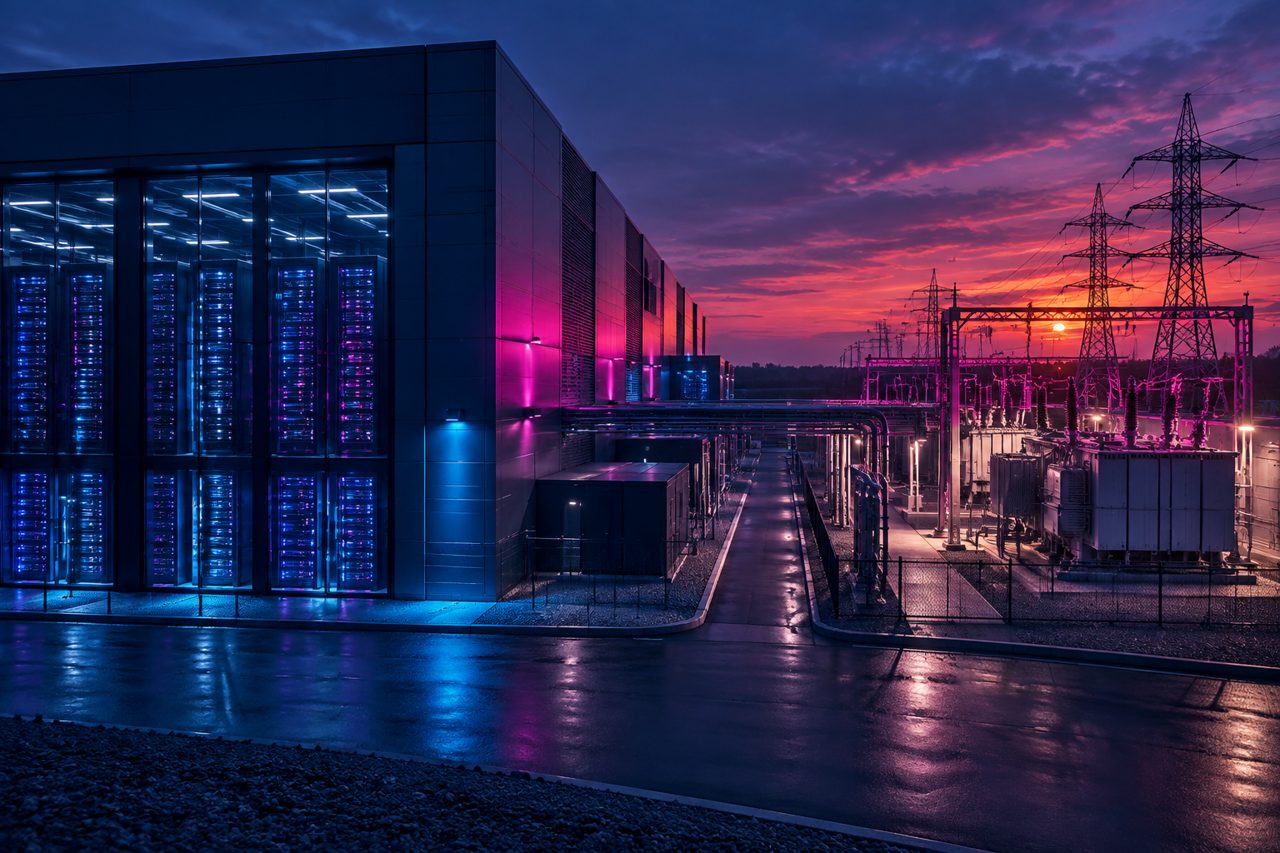
Available land, fiber-optic cables nearby, servers on order: on paper, the future data center is ready. Yet it is missing the essential ingredient: a power supply that matches its ambitions. In the race for artificial intelligence, a grid connection is becoming as strategic as the GPU. Looking ahead to September 2026, the question is no longer simply who has the best chips, but who can run them, where and under what conditions. This analysis draws on facts documented through 2024; developments considered beyond that point are forward-looking assessments.
Computing power meets its physical limits
Generative AI is bringing an industrial reality back into focus: digital technology consumes space, materials and energy. Training a large model requires clusters of specialized accelerators. Subsequently responding to users requires permanent infrastructure, whose consumption depends on request volumes, model sizes and software optimizations. Efficiency is improving, but its impact can be offset by expanding usage.
In its Electricity 2024 report, the International Energy Agency estimated that global electricity consumption from data centers, AI and cryptocurrencies could double between 2022 and 2026. This broad scope should not be confused with AI alone. It nevertheless pointed to growing pressure on power systems, without making it possible to attribute every new megawatt to a chatbot.
The problem is primarily local. Consumption that is modest at the national level can become considerable in an area with a concentration of data center campuses. The grid must accommodate these demands while also supplying homes, transport and factories. Having enough electricity over the course of a year does not mean being able to deliver the necessary power at a specific location.
Grid connections become the new critical path
For a developer, proximity to a high-voltage line guarantees nothing. Substation capacity must be checked, the grid may need upgrading, permits must be obtained and equipment must be reserved. Transformers, switchgear and backup systems rely on industrial supply chains that do not keep pace with chip orders.
These difficulties were already apparent before the generative AI boom. In Ireland, the concentration of data centers around Dublin prompted authorities to tighten controls on new grid connections. In Northern Virginia, a long-established hub of the US cloud industry, growing demand has also raised questions about electricity transmission and planning. AI is therefore intensifying a longstanding strain.
One plausible scenario for September 2026 is that projects will face stricter selection based on their readiness to secure power. A less prestigious site with genuinely available capacity may move ahead of a location close to customers that is still waiting for grid upgrades. The value of land is then measured as much in deliverable megawatts as in buildable square meters.
Cooling becomes a siting decision
Once delivered, electricity is largely converted into heat. AI systems concentrate substantial power in server racks. The densest architectures are driving a shift toward liquid cooling, particularly through cold plates in direct contact with components. This does not make the heat disappear: it still has to be removed from the building.
This shift requires a rethink of piping, maintenance, leak detection and outdoor equipment. A facility designed for conventional servers does not automatically become an AI factory simply by replacing its machines. Depending on its design, adapting it may require extensive work or make constructing a new building the preferable option.
Water also enters the equation. Some systems use evaporation to limit electricity consumption; others favor less water-intensive cooling, with energy and economic trade-offs. Water and electricity consumption must therefore be assessed together, taking the climate and local water stress into account. A good energy performance indicator is not enough to establish an environmental assessment.
“Green” electricity does not solve everything
Major cloud providers have long signed renewable power purchase agreements. These deals can support new wind and solar farms and stabilize costs. But buying as much renewable electricity over a year as one consumes does not guarantee a carbon-free supply every hour. Solar and wind generation varies, while computing demand can remain high at night or when there is no wind.
This gap explains the interest in continuous or complementary power supplies. In September 2024, Microsoft and Constellation announced an agreement linked to a plan to restart the Three Mile Island reactor that shut down in 2019, separate from the one involved in the 1979 accident. The announcement illustrated the growing ties between technology giants and nuclear power, but it did not represent immediately available capacity: approvals and recommissioning remained critical.
France has an advantage here, with its nuclear fleet and generally low-carbon electricity. That does not eliminate local grid connection constraints or the trade-offs involved in reindustrialization. Attracting a data center also requires consideration of fiber connectivity, skills, climate risks and public acceptance of the project.
Moving computing, or shifting its electricity consumption?
Not all computing workloads have the same requirements. Training can sometimes be located far from users, provided the necessary data and connections are available. By contrast, some interactive services require low latency. Sovereignty, confidentiality and contractual obligations also limit the options for relocation.
Another approach is to adjust consumption over time. Deferrable workloads can be scheduled when the power system is under less strain. But interrupting an expensive cluster is not cost-free: it reduces utilization and can complicate operations. Backup batteries can provide certain services to the grid, but they are not a universal solution to prolonged shortages.
Who pays for shared infrastructure?
Competition for electricity ultimately leads to a political question: who pays for the upgrades? If a grid is expanded to accommodate a campus, allocating the costs between the operator and other users becomes a sensitive issue. Authorities must also distinguish firm applications from speculative reservations, which can tie up sought-after capacity without leading to construction.
When assessing a project, it is better to examine its verifiable commitments rather than its promises alone: the grid connection timeline, the source and availability of electricity, water requirements, demand-response capabilities and local benefits. Heat recovery also warrants examination, but it depends on nearby users and suitable demand. Without a concrete use for the heat, it remains an intention.
What next? Looking ahead to September 2026, the advantage could go to players capable of designing computing, energy and cooling systems together, rather than treating electricity as an afterthought. Chips will remain decisive, but their usefulness will depend on infrastructure that takes much longer to build. For local communities, the challenge will be to welcome projects that deliver demonstrable value without weakening the grid or shifting their costs onto the public.